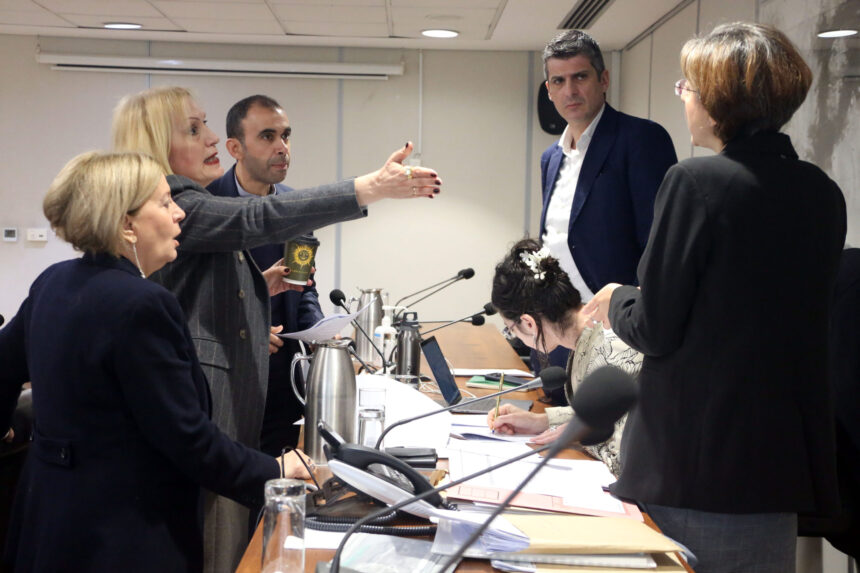
political donors — Withholding political donors’ names has been denounced as scandalous by the House institutions committee, which concluded its review of the framework governing post-service activities of former officials on Wednesday. The session highlighted growing concerns over the government’s refusal to disclose donor information, a stance that has drawn considerable criticism.
Political donors: Concerns Over Oversight and Conflicts of Interest
Committee chair Alexandra Attalides expressed the importance of strengthening oversight and safeguards against conflicts of interest. This discussion was prompted by a legal service opinion that blocks the publication of donor names linked to the social support agency previously chaired by first lady Philippa Karsera.
Critique of Data Protection Justifications
Attalides articulated her discontent with the decision to withhold donor identities, labelling it as “scandalous” and incompatible with European law. She argued that data protection provisions should not shield individuals or companies implicated in potential criminal conduct or matters of serious public interest.
“We are effectively being gagged,” she said, underscoring that the current interpretation of the law prevents parliament from identifying companies, linking them to organised crime, or exercising meaningful oversight. “This is absurd and dangerous for democracy,” she added.
Legislature’s Demand for Transparency
The committee’s inquiry was sparked by the accountant-general’s refusal, based on legal advice, to submit a list of donors and their contributions to the support agency. Authorities warned that disclosing such details could lead to administrative sanctions and potential breaches of EU data protection rules.
Members of parliament (MPs) have been urging for this information as part of an investigation into allegations of political patronage and conflicts of interest. Reports suggest that individuals or companies with state contracts, regulatory exposure, or pending government decisions have made substantial donations to the agency, raising serious ethical questions.
Highlighting Potential Corruption
An audit service report pointed out a “special relationship” due to the agency’s president being married to the President of the Republic. Attalides dismissed the legal arguments presented to the committee, asserting that EU data protection law permits disclosure where there is an overriding public interest, particularly regarding corruption, money laundering, or abuse of power.
She fiercely condemned the practice of anonymising corporate donors or reducing disclosures to initials, stating that it undermines accountability and makes parliamentary scrutiny ineffective. “This state is a kleptocracy,” she declared. “They do not serve the public good but the interests of those who reward favours. We will not accept this.”
Intention to Escalate the Matter
Attalides announced plans to escalate the issue to European institutions, including the European commissioner and, if necessary, the European court, to challenge what she labelled as “a systematic misuse of data protection law to obstruct transparency.”
The committee’s stance was reinforced by a formal response issued after receiving the accountant-general’s letter. Demetris Demetriou, chairman of the committee and a member of the Democratic Rally (Disy), remarked that the refusal to submit donor details strikes “at the very core of democracy.” He emphasized that this refusal represents a rejection by the executive branch of parliamentary control, as enshrined in the constitution.
Legal Framework and Parliamentary Authority
Demetriou pointed out that the committee had requested that the information be submitted in a classified format to fulfil its oversight role. He stressed that under the 1985 law governing the submission of information to the House and its committees, refusal to provide evidence is not permitted except in exceptional circumstances involving defence, security, or foreign affairs.
The committee further denounced the invocation of data protection law, highlighting that the general regulation allows the processing of personal data when necessary to comply with a legal obligation or to perform a task in the public interest. They referenced the 2018 national law on personal data protection, which permits parliament to process data within its constitutional powers.
The committee’s findings come amidst broader investigations into post-ministerial conduct, lobbying, and undeclared interests, with MPs advocating for legislative reform to close gaps that allow conflicts of interest to remain unchecked once officials exit public office.