The key and heart of Cyprus is a rich tapestry of history spanning 37 centuries, as explored in the three-volume work titled Walking in the Kingdom of Salamina by historian Anna Marangou. This extensive trilogy delves into the history of Ammochostos, known as Famagusta in English, starting from its roots in 1600 BC.

Photo: cyprus-mail.com
- The event gathered diplomats, EU representatives, and members of the academic community, uniting them in appreciation of Ammochostos’ enduring legacy.
Key and: A Comprehensive Historical Account
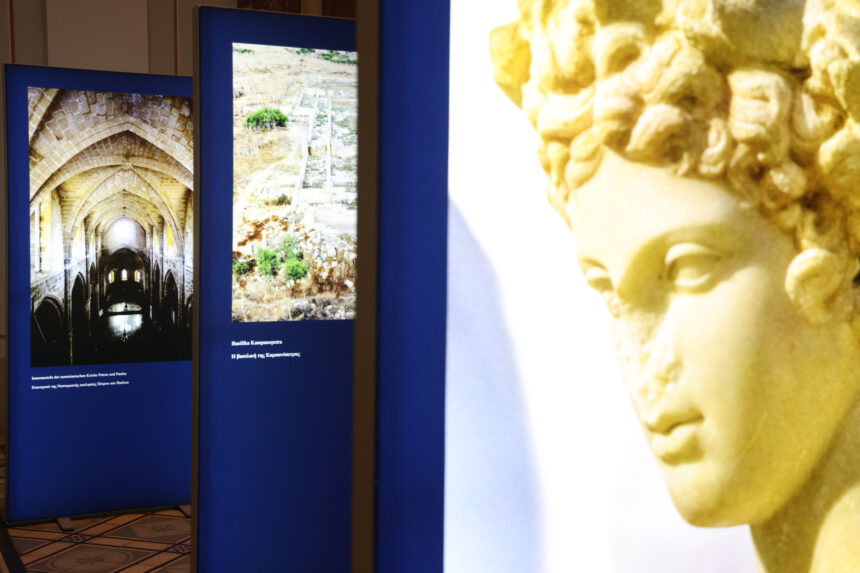
Marangou presented her trilogy at the University of Vienna ten days ago, under the auspices of Interior Minister Constantinos Ioannou, with the event organised by the Cyprus Cultural Centre of Vienna and the Press and Information Office (PIO). The presentation included a photographic exhibition featuring images from the book, captured by Petros Fiakkas and Giorgos Kladis.

Photo: cyprus-mail.com
The Significance of Salamina
Many may question why a book about Ammochostos references Salamina in its title. Marangou clarifies, stating, “Ammochostos is Salamina. Salamina is the continuation, the evolution of three other cities in the same area – prehistoric Engomi, Arsinoe of the Ptolemies and the subsequent Byzantine Constantia, our then capital.”
The Early Days of Engomi
The narrative of Ammochostos begins with prehistoric Engomi, a city-state established primarily for the trade of copper found in the Troodos mountains. Achaeans and Aegeopelagites inhabited the area from the 16th century BC, with significant settlements forming by the 12th century. Engomi showcased an urban centre that competed with larger civilisations, capable of managing extensive copper mining and export.
Marangou notes that Engomi was the oldest ‘state’ on the island, exerting influence over the rest of Cyprus. Sadly, little remains of it today, as the city was likely destroyed by earthquakes, prompting its inhabitants to migrate eastward towards the sea and establish Salamina of Cyprus.
Salamina’s Prosperity and Influence
According to legend, Salamina was founded by Tefkros, the brother of Aiantas, upon returning from the Trojan War, to remind him of Greece’s Salamina. The wealth generated from copper allowed King Evagoras to attempt uniting the ten kingdoms of Cyprus, drawing the interest of regional powers such as the Assyrians, Egyptians, and Persians.
Although Alexander the Great did not stop in Cyprus, his successors, the Ptolemies, did. They renamed the city Arsinoe and constructed a new port along with palaces and temples dedicated to Zeus. During the Roman era, Salamina flourished, with its residents enjoying luxurious amenities such as gymnasia, theatres, and villas adorned with marble columns and mosaics.
The Rise and Fall of Constantia
After a series of devastating earthquakes in the fourth century AD, the Byzantine Emperor Constantios rebuilt Salamina, renaming it Constantia and establishing it as the capital of Cyprus. However, the city faced significant challenges from Arab raids between the 7th and 10th centuries, which destroyed many landmarks.
The capture of Jerusalem by Arabs in 1187 had a profound effect on trade along Cyprus’ eastern coast. This shift in commerce led to the Crusades and saw merchants flocking to Constantia, where a well-protected port allowed for flourishing trade.
The Lusignan Era and the Importance of Ammochostos
In the wake of the Third Crusade, Richard the Lionheart defeated the Byzantine emperor and sold Cyprus to the French nobleman Guy of Lusignan in 1192. While Lefkosia became the capital, Ammochostos remained a crucial trading hub, described by Marangou as “the key and heart of Cyprus.”
From the 13th to 15th centuries, Ammochostos was a centre of transit trade connecting East and West. Despite the Pope’s prohibition on trading with Arab ports, Cypriots capitalised on the embargo to acquire and transfer goods from the East to the West. The city’s wealth attracted numerous travellers, with one German visitor in 1338 claiming, “I dare not speak about their riches.”
Transition Through Ottoman Control
Following a 91-year rule by Genoa, Ammochostos faced destruction at the hands of the Mamelukes from Egypt. The city’s strategic significance caught the attention of Venice, which took control of the island in 1489. However, in September 1571, after an 11-month siege, the city fell to Lala Mustafa.
Under Ottoman rule, many Greek Orthodox inhabitants were forced out, leading to the establishment of the suburb known as Varosha. Marangou explains the transition: “The Greek Orthodox inhabitants of Ammochostos – the majority – were kicked out and sent to live outside the city, to ‘varos’, which in Turkish means suburb.”
Revival and Cultural Heritage Under British Rule
The arrival of the British in 1878 marked a revival for Ammochostos, as they valued its rich cultural heritage, restoring many monuments. While most medieval residents were Turkish, a new city called Varosha emerged, populated by families from the Ionian islands, fostering a new beginning on the shores of Cyprus’ beautiful beaches.
A Tribute to History and Identity
During the book presentation, Interior Minister Constantinos Ioannou praised Marangou for her work in reviving memories and highlighting cultural landmarks. He remarked, “Her work is a contribution to the study and preservation of our history, but at the same time an act of respect for the cultural identity of much-suffering Cyprus.”
Kyros Patsalides, President of the Cyprus Cultural Centre of Vienna, echoed this sentiment, stating, “The town of Ammochostos is the soul of everyone and without a free Ammochostos, there can be no free Cyprus.”
The event gathered diplomats, EU representatives, and members of the academic community, uniting them in appreciation of Ammochostos’ enduring legacy.