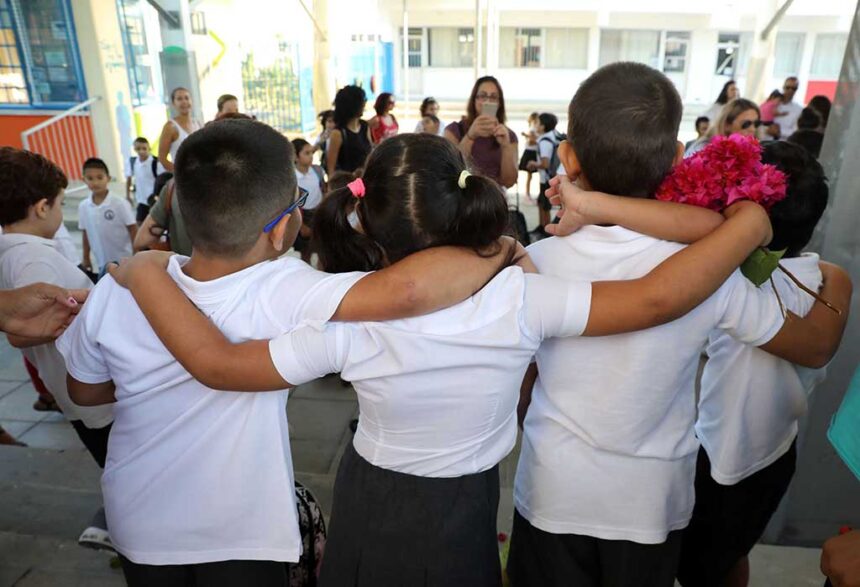
Fears of a future without children are palpable in the Limassol hills, where the heart of community life—the village school—is now in jeopardy. In Ayios Amvrosios, the local primary school, which had only eight pupils last year, will not reopen when the new school year begins, leading to a transfer of students to the nearby Kyvides school.
Stelios Gregoriou, the community leader, expressed his concerns, stating, “We only had one primary school. It had eight students last year. It has now closed, and the pupils will be transferred to Kyvides.” While the recent wildfires that swept through parts of the area did not damage the school building, the psychological impact has unsettled families. Gregoriou added, “But the fire still shook the families.”
In hopes of retaining young residents, Gregoriou is advocating for a new kindergarten to serve children aged three to five. “I had a meeting with an education officer. We are waiting to open a kindergarten that will accept children aged three to five,” he said.
Paphos first education officer Giorgos Yiallourides acknowledged the broader issues affecting village schools in Cyprus, noting that demographic and social changes play a significant role. He remarked, “The maintenance of schools in villages in Cyprus is an important issue, especially when considering issues related to low birth rates, internal migration, and demographic changes.” Decisions about school closures or consolidations are made by the cabinet, not solely the education ministry.
In a cabinet meeting held on April 24, it was decided to suspend the Ayios Amvrosios primary school, with plans for its consolidation with the Pano Kivides primary school set to begin in the 2025-2026 school year. However, some smaller schools with fewer than 15 pupils may continue operating under special arrangements, primarily based on geographical isolation and socio-economic needs.
Andreas, a father with a six-year-old daughter in Ayios Amvrosios, voiced his concerns about relocation. “We don’t want our daughter travelling long hours for school,” he said. “We already had doubts about staying. After the fire, and with the school’s future uncertain, we’ve started looking at options in town.”
Mattheos Protopapas, the leader of the Vouni community, shared that their primary school had closed years ago due to a lack of students, forcing children to be bused to Limassol daily. “We’ve reached the point where there are so few school-aged children left in the village,” he stated. “A few families remain, but if services like schools aren’t there, it’s hard to keep them.”
The recent wildfires have exacerbated fears, especially regarding fire prevention measures on private land. Protopapas explained, “We clean every year, but we can’t touch private plots unless the owner gives permission.” This legal gap has left families feeling vulnerable, with some already planning to move away. Maria, a Romanian mother of two living in Vouni, reflected, “Our house wasn’t burned, but the fire came so close. The children were shaken. It has made us think seriously about leaving, maybe back to Romania if the school shuts, or at least to Limassol, where we wouldn’t feel so isolated.”
Yiallourides reassured families affected by the fires, stating that the intention to leave schools among fire victims has not been prevalent. He cited a family whose home was destroyed but chose to remain in the community for their children’s education. “In no case of the cases of the fire victims that have been investigated has there been any intention to leave the school they were attending,” he noted.
In Souni-Zanakia, local leader Nikos Vikis confirmed that while their schools were not harmed, the emotional toll on the community is significant. “We used the school as a distribution centre during the fire,” he said. “The building was fine, but the people, especially the children, are shaken.” Vikis advocated for more support, highlighting the long-standing issues with early education services in the area.
With families in Souni-Zanakia expressing a pressing need for kindergartens, Eleni, a mother of a four-year-old, lamented the lack of educational options. “There’s no place for him to go. If we don’t get a kindergarten soon, we’ll probably move to another town.”
Yiallourides emphasised the importance of establishing community kindergartens to support rural areas, noting that these are private institutions subsidised by the state. He explained, “The establishment of community kindergartens is an important measure to support small communities that either do not have public kindergartens or cannot enrol in them due to age group.”
In Lofou, community council president Ioannis Neophytou confirmed that all local children now attend schools outside the village. “There are no pupils here anymore. The last families with young children have either left or sent them outside the village every day.”
As community leaders reflect on the future, the message is clear: without schools, villages risk disappearing. Gregoriou poignantly stated, “These schools are the glue that holds small villages together. If we lose them, we lose the families, and with them, the future.”