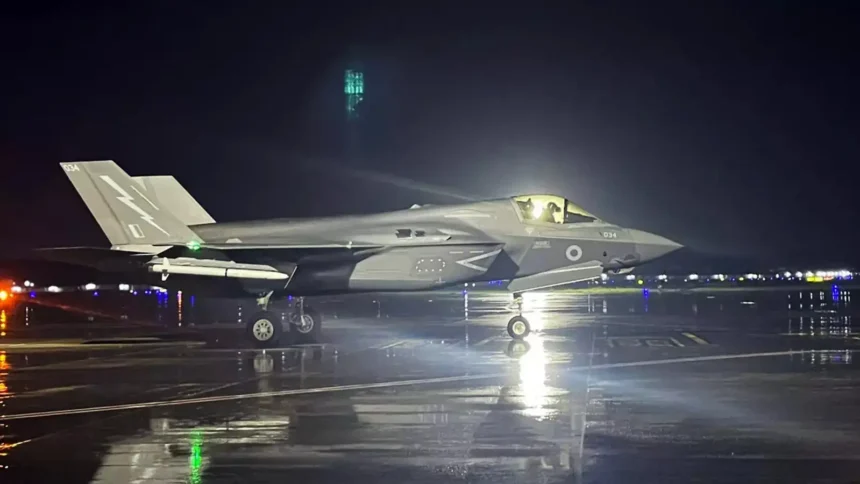
Cyprus was the likely launchpad as British fighter jets engaged and shot down drones flying in Jordanian airspace on Tuesday evening. The British defence ministry confirmed that F-35 fighter jets, operating in Jordan, successfully intercepted uncrewed aerial systems “in defence of Jordan.” This incident marks a significant milestone as the first operational engagement for the Royal Air Force’s F-35s.
- When queried about the unsuitability of the bases for US operations, Starmer noted that discussions with Cypriot President Nikos Christodoulides were ongoing, aiming for clarity on the matter.
According to the ministry, the operation involved support from Typhoon jets and a Voyager air-to-air refuelling aircraft, highlighting the collaborative efforts to protect British interests and allies in the region. These F-35 jets have been stationed in Cyprus since last month, with six aircraft deployed from the RAF’s base in Marham, Norfolk, amid rising tensions in the Middle East.
Concerns about a potential escalation involving Iran prompted this military positioning. British newspaper The Times previously reported that the UK government feared the US could initiate conflict with Iran, which would have wider implications for the region.
On the same day as the drone engagement, British Prime Minister Sir Keir Starmer announced the deployment of HMS Dragon, a Type 45 destroyer, along with two AW159 Wildcat helicopters to Cyprus. This move aims to bolster protection for British bases on the island, particularly following an Iranian-made drone strike that targeted the Akrotiri base on Monday.
During a press conference earlier, British Armed Forces Minister Alistair Cairns stated, “Any threat that emanates from Iran, that threatens our British interests, or, more importantly, the hundreds of thousands of [British] citizens in the Middle East, we will neutralise that threat, and we won’t make any apologies for it.” He reassured the public that all necessary steps would be taken to safeguard British citizens and national interests.
Starmer emphasised the UK’s commitment to supporting allies in lawful self-defence, stating, “Our focus is clear: protect life, reduce tensions, and maintain regional stability.” This commitment comes in light of the ongoing drone strikes that have raised alarms about security in the area.
In a related development, Starmer announced on Sunday that the UK would permit the United States to utilise its military bases, particularly the Diego Garcia airbase in the Indian Ocean and the Fairford airbase in Gloucestershire, for operations against Iran. However, US President Donald Trump expressed frustration over what he perceived as delays in this decision-making process, calling it “shocking.”
Trump remarked, “That island that you write about, the lease … for whatever reason, he made a lease of the island. Somebody came and took it away from him and it’s taken three or four days to work out where we can land.” He contrasted Starmer’s leadership unfavourably with Winston Churchill, implying a lack of urgency and decisiveness.
In response to the drone strike on Monday, Starmer clarified that British bases in Cyprus were not currently being used by US bombers, although he acknowledged the timing of the drone attack was coincidental to his announcements. He stated that the drone in question was believed to have been launched before his speeches.
When queried about the unsuitability of the bases for US operations, Starmer noted that discussions with Cypriot President Nikos Christodoulides were ongoing, aiming for clarity on the matter.