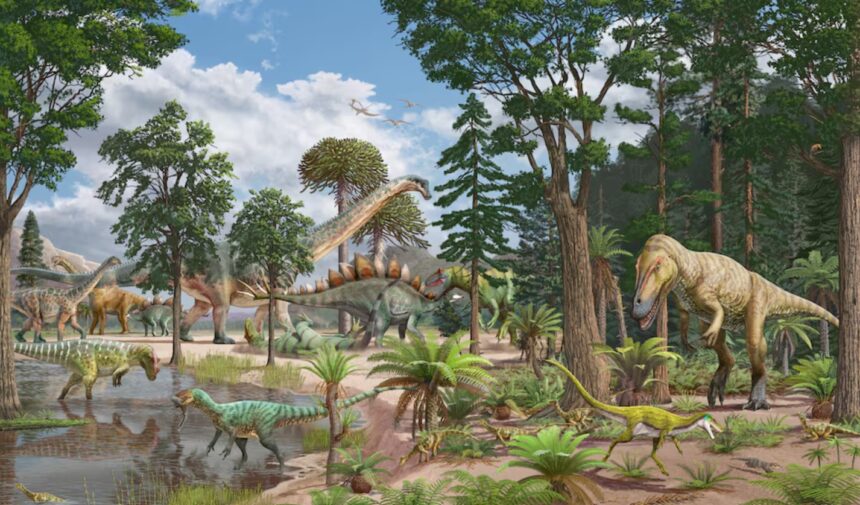
Baby long-necked dinosaurs, such as the Brachiosaurus, were a significant part of the diet for meat-eating dinosaurs during the Jurassic Period, according to new research.
- Baby long-necked dinosaurs, such as the Brachiosaurus, were a significant part of the diet for meat-eating dinosaurs during the Jurassic Period, according to new research.
Baby long-necked: Fossil Evidence Reveals Prehistoric Food Web
Scientists studying fossils from the Dry Mesa Dinosaur Quarry in southwestern Colorado have uncovered a detailed food web that highlights the interactions between various species in this ancient ecosystem. The research indicates that juvenile sauropods, despite their size, were a common target for larger predators.
A Diverse Ecosystem
The Jurassic ecosystem was rich in biodiversity, housing at least six types of sauropods, known for their long necks and massive bodies, alongside five types of carnivorous dinosaurs. This diverse group included the well-known Brachiosaurus, which could reach weights of up to 60 tons, and other notable sauropods like Diplodocus, Supersaurus, Apatosaurus, Camarasaurus, and Haplocanthosaurus.
In addition to the dinosaurs, the environment also supported various plant-eating species, flying reptiles known as pterosaurs, smaller reptiles, early mammals, crocodiles, fish, and insects. The interconnected nature of these species paints a vivid picture of life during this period.
Young Sauropods as Easy Prey
Paleontologist Cassius Morrison, the lead author of the study, stated that baby and young juvenile sauropods were particularly vulnerable to predation. “These sauropods would have been high in abundance compared to larger adult sauropods and were relatively defenseless and slow-moving, hence easy to catch and a perfect snack,” he explained.
The hatchlings of these massive dinosaurs emerged from eggs just a foot wide and required years to reach maturity. During this time, they were likely left to fend for themselves, making them easy targets for predators.
Predation Dynamics
While adult sauropods enjoyed a level of protection due to their enormous size, young individuals lacked such advantages. “Adult sauropods relied on their size, long tails, and herd behaviour for protection,” noted ecologist Steven Allain, a co-author of the study. “Unfortunately, this took time, meaning that the smaller individuals hadn’t reached that ‘too big to mess with’ stage yet.”
In contrast, the predators in the Dry Mesa ecosystem were formidable. The largest included Torvosaurus, measuring around 30 feet long, and Allosaurus, which reached lengths of approximately 26 feet. Other carnivorous dinosaurs such as Ceratosaurus, Marshosaurus, and Stokesosaurus added to the predatory threat.
The Risks of Targeting Adults
Hunting healthy adult Brachiosaurus or other large sauropods would have posed significant risks to predators. “Even if Allosaurus hunted in groups – which is still debated – bringing down a fully grown, healthy sauropod would have required coordination, stamina, and a lot of luck,” Allain said. The sheer size of these creatures served as a primary defence mechanism against attacks.
Predators likely preferred to hunt smaller or weaker individuals, such as juveniles, or those that were sick or injured. This tactic would have minimised the risks associated with confronting fully grown sauropods.
Reconstructing the Food Web
The research team employed various methods to reconstruct the Dry Mesa food web, including analysing chemical evidence in tooth enamel and examining fossilised stomach contents. Morrison highlighted the unique nature of the fossil deposit, which was created during a drought, allowing for a rare glimpse into the ecosystem’s complexity. “This deposit was made by a drought, so it’s one of the only places where you get everything, from small lizard-like animals to the largest dinosaurs,” he stated.
A Richly Interconnected System
The findings suggest that the Dry Mesa ecosystem was not merely a straightforward hierarchy of predators and prey but rather a richly interconnected network. The researchers identified over 12,000 unique food chains, with sauropods emerging as central components.
Allain remarked on the significance of this interconnectedness, stating, “The reconstructed food web this data has generated contains over 12,000 unique food chains, indicating a richly interconnected system rather than a simple hierarchy of predators and prey.”
Insights into Dinosaur Behaviour
This research not only sheds light on the dietary habits of dinosaurs but also enhances our understanding of their behaviour and survival strategies. The relationships between species, as well as their adaptations to the environment, reveal the complexities of life millions of years ago.