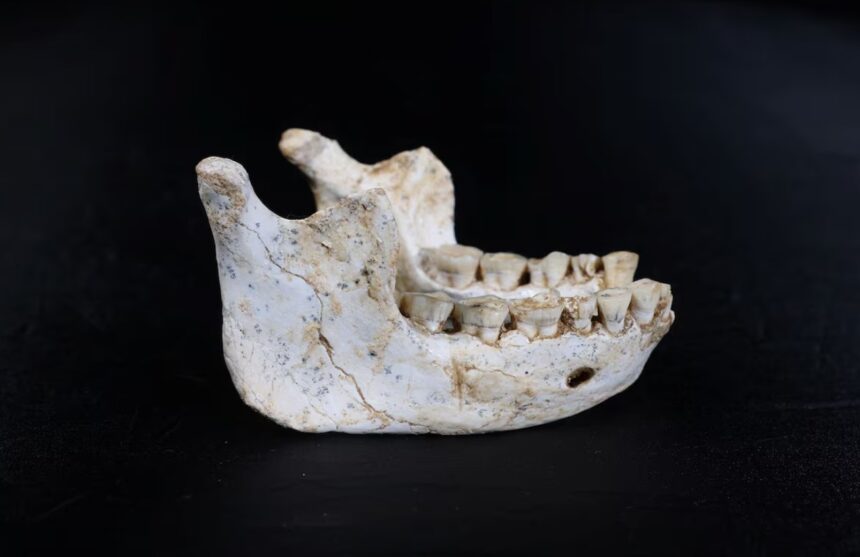
Fossils found in a Moroccan cave may provide crucial insights into the ancestry of Homo sapiens. Unearthed remains, dated to approximately 773,000 years ago, include lower jawbones of two adults and a toddler, along with teeth, a thigh bone, and some vertebrae.
- These findings not only enhance our understanding of the human evolutionary lineage but also highlight the complexities of survival in a landscape shared with formidable predators.
The discovery was made at the Grotte à Hominidés, located in Casablanca, where the cave appears to have served as a den for predators. Notably, the thigh bone bore bite marks from what may have been a hyena, suggesting that these early humans could also have been prey.
Researchers interpret these fossils as an evolved form of the species Homo erectus, which first emerged around 1.9 million years ago in Africa before spreading to Eurasia. The remains exhibit a blend of primitive and more modern human traits, which fills a significant gap in the fossil record of African hominins from one million to 600,000 years ago.
According to the team, led by paleoanthropologist Jean-Jacques Hublin from Collège de France and the Max Planck Institute for Evolutionary Anthropology, these fossils may represent a population that existed just before the evolutionary divergence that resulted in Homo sapiens, Neanderthals, and Denisovans. Hublin cautioned against definitively labelling them as the last common ancestor but acknowledged their potential closeness to these lineages.
The fossils display a mosaic of traits, reflecting evolutionary changes that were already taking place during this time. Hublin remarked, “The fossils show a mosaic of primitive and derived traits, consistent with evolutionary differentiation already underway during this period, while reinforcing a deep African ancestry for the Homo sapiens lineage.”
Interestingly, the oldest known Homo sapiens fossils, which date back to around 315,000 years ago, were also discovered in Morocco, specifically at the Jebel Irhoud archaeological site. The age determination of the Grotte à Hominidés fossils was made possible by analysing the magnetic signature of the surrounding cave sediments, which was essential for understanding their place in the human evolutionary tree.
Exceptional preservation of the fossils occurred due to the burial by fine sediments over time and the sealing of the cave entrance by a dune. In addition to the human remains, researchers found hundreds of stone artifacts and thousands of animal bones within the cave.
These fossils are contemporaneous with remains found at Gran Dolina in Spain, attributed to the archaic human species Homo antecessor. Hublin noted the intriguing similarities between the two sites, suggesting they may point to intermittent connections across the Strait of Gibraltar, a hypothesis warranting further exploration.
The Grotte à Hominidés remains reveal that these hominins had body proportions similar to modern humans, albeit with smaller brain sizes. The child’s mandible, estimated to belong to a one-and-a-half-year-old, was nearly complete, while one adult jawbone was nearly complete and the other was partial. The two adult jawbones appear to belong to individuals of different sexes, indicating a robust male and a more gracile female.
Despite their ability to hunt, these early humans faced significant dangers from large carnivores, including big cats and hyenas. Hublin pointed out that the femur displayed clear signs of carnivore modification, indicating it had been gnawed on, suggesting these hominins occasionally became prey themselves. However, the cave seems to have primarily functioned as a carnivore den, with humans visiting it infrequently.
These findings not only enhance our understanding of the human evolutionary lineage but also highlight the complexities of survival in a landscape shared with formidable predators.