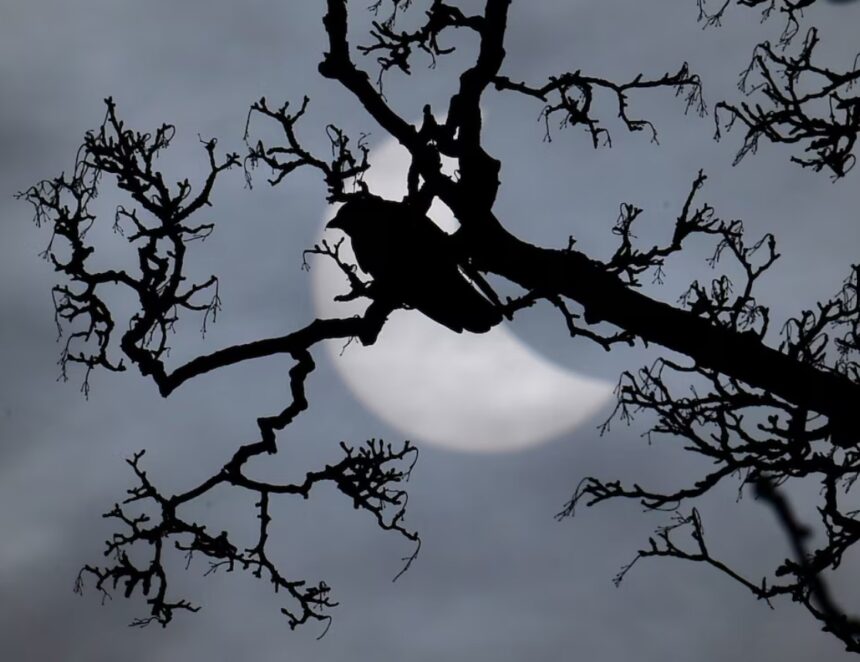
The recent solar eclipse on April 8, 2024, led to remarkable changes in avian behaviour, with some birds singing as if a new day had dawned.
- The recent solar eclipse on April 8, 2024, led to remarkable changes in avian behaviour, with some birds singing as if a new day had dawned.
Solar eclipse: Path of the Celestial Event
The total solar eclipse swept across North America, covering 2,500 miles (4,000 km) from Mexico’s Pacific Coast, through Texas, and up into Canada, affecting 14 US states. During the eclipse, the moon obscured the sun for a brief period, with totality lasting about four minutes at various locations.
Birds Respond to the Eclipse
While many spectators marvelled at the celestial phenomenon, scientists seized the opportunity to study its effects on birds, whose behaviours are significantly influenced by light. Research indicated that many species altered their vocal patterns, particularly those known for their dawn songs.
As the sunlight gradually returned after the eclipse, many birds engaged in their characteristic “dawn chorus,” mimicking the sounds of morning. However, the response varied among species; some remained silent, while others showed no change in their behaviour.
Insights from the Study
Liz Aguilar, a doctoral student at Indiana University and lead author of the study published in the journal Science, explained, “Light is one of the most powerful forces shaping bird behaviour, and even a four-minute ‘night’ was enough for many species to act as if it were morning again.”
Co-author Dustin Reichard, a biology professor at Ohio Wesleyan University, added that previous research had established the importance of light changes in influencing daily rhythms in living organisms, affecting hormone levels and gene expression.
Comprehensive Data Collection
This study marked a significant advancement in understanding birds’ behaviours during eclipses, drawing from two extensive datasets. Fourteen recording units were deployed around Bloomington, Indiana, capturing over 100,000 bird vocalisations. Additionally, nearly 1,700 participants across North America contributed more than 11,000 observations via an app named SolarBird, designed for public engagement in data collection.
Varied Responses Among Species
The research identified a total of 52 species around Bloomington, with 29 exhibiting notable changes in vocalisation patterns during the eclipse compared to a typical April afternoon. Aguilar noted the diversity in how different species responded: “Some have loud, elaborate dawn choruses, while others are much quieter. We found that species known for the most intense dawn choruses were also the ones most likely to react to the eclipse.”
For example, American robins, which typically sing before dawn, showed a significant increase in vocalisations—six times higher than on a regular afternoon—during and immediately following totality. In contrast, barred owls vocalised four times as much just after the eclipse, aligning with their usual activity peaks at dawn or dusk.
Interestingly, some birds, like the Carolina wren, were unaffected by the eclipse, showcasing the variety of responses. Aguilar explained, “It makes sense that not all species reacted the same way. Birds differ in how sensitive they are to changes in light.”
Future Directions in Research
The study opens avenues for further exploration into why certain species are more sensitive to light changes than others. Aguilar mentioned, “We looked for patterns among closely related species and also compared migratory versus resident birds, but we didn’t find any consistent differences.” This highlights the complexity of avian reactions to environmental factors, indicating a rich field for future research.