Demetris Skourides, Chief Scientist of Cyprus, launched a groundbreaking podcast series focused on the implications of artificial intelligence (AI) in our lives and workplaces.
Fearless Future: A New Dialogue on AI
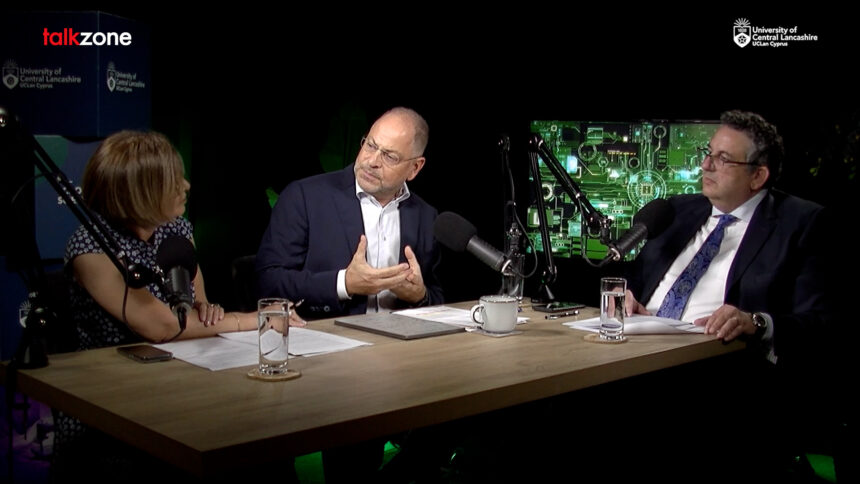
The podcast, titled “Fearless Future,” is produced in conjunction with UCLan Cyprus’ media studio and streamed live on LinkedIn. It positions itself as a first-of-its-kind platform in Cyprus, aimed at fostering discussions about the role of AI in everyday life and work environments. The inaugural episode, “The Future of Work in the Age of AI,” featured Skourides and Philippos Soseilos, CEO of PwC Cyprus, discussing extensive reports on how AI is reshaping the global workforce.
The conversation leveraged insights from significant publications, including PwC’s 2025 Global AI Jobs Barometer and McKinsey’s Superagency in the Workplace. Together, they sought to unravel the transformative potential of AI, rejecting the outdated notion of whether AI will alter our world and instead focusing on how, where, and to what end.
AI: Expansion or Replacement?
Skourides emphasised that the mission of “Fearless Future” is to shift the conversation from fear to human-first, AI-enabled transformation. He stated, “AI is not replacing opportunity; it’s redefining and expanding it.” The real challenge lies not in removing tasks but in redesigning roles to harness the strengths of AI effectively.
One pressing statistic highlighted was that over 90 per cent of today’s data was generated following the COVID-19 pandemic, indicating the rapid pace of digital acceleration. Companies can leverage AI to take over administrative burdens, allowing humans to concentrate on high-value tasks such as creativity and innovation. The key, Skourides urged, is to move at a pace that will not leave anyone behind.
Local Context: Cyprus’ AI Strategy
Cyprus’ transition to a knowledge-based economy is supported by the National AI Taskforce, which Skourides chairs. This initiative aims to align efforts across academia, industry, and government to ensure the nation effectively integrates AI technologies while enhancing digital skills. The 86% reliance on the service sector in Cyprus requires a proactive approach in developing infrastructure and workforce capabilities to adapt to AI advancements.
A pivotal component of this strategy is the “AI for Government” initiative, spearheaded by the Deputy Ministry of Research, Innovation and Digital, in collaboration with the Research and Innovation Foundation. This programme is designed to turn the public sector into a living laboratory where innovative companies can tackle real ministerial challenges through applied AI. Such initiatives exemplify Cyprus’ commitment to building a safe culture of experimentation where AI can thrive.
Addressing Cybersecurity in the Age of AI
As the AI landscape evolves, so too do the associated cybersecurity challenges. The reliance on digital systems underscores the need for robust security measures, particularly given recent legislative moves such as the NIS 2 Directive aimed at enhancing network security across the EU. With the increasing sophistication of cyber threats, organisations in Cyprus must not only adapt to AI but also ensure their systems are fortified against potential attacks.
Skourides noted that companies must align their technology adoption with investments in human capital and skill development to maximise AI’s benefits while mitigating cyber risks. The demand for data is projected to escalate, thus highlighting the importance of establishing clear governance and responsible AI deployment strategies both at a national and organisational level. This governance will facilitate a trustful environment where innovation can flourish without compromising security.
According to Soseilos, individuals must be encouraged to explore AI tools, which many are already integrating into their workflow despite hesitance. “Creating safe spaces for experimentation is essential,” he stressed. If roles merely become faster without added value, organisations risk stagnation.
The Path Forward: Collaboration and Lifelong Learning
Ultimately, the dialogue around AI in Cyprus must evolve into a collaborative effort. Skourides and Soseilos called for organisations to embrace adaptability, curiosity, and personal responsibility. They highlighted the pressing need for businesses to reflect on how AI can create value, manage risks, and shape a future where both individuals and organisations prosper.
Through “Fearless Future,” the intention is clear: promote ideas, encourage dialogue, and initiate actions that pave the way for a more innovative, inclusive society. Upcoming episodes will continue exploring how AI interacts with skills, innovation, and national strategies, with sessions planned for Japan, the UAE, and India this September.
In an age defined by rapid technological transformation, Cyprus stands at a crossroads, eager to embrace the myriad possibilities AI presents. However, this future hinges on a unifying vision that prioritises human potential and fosters a culture of continuous learning and collaboration.