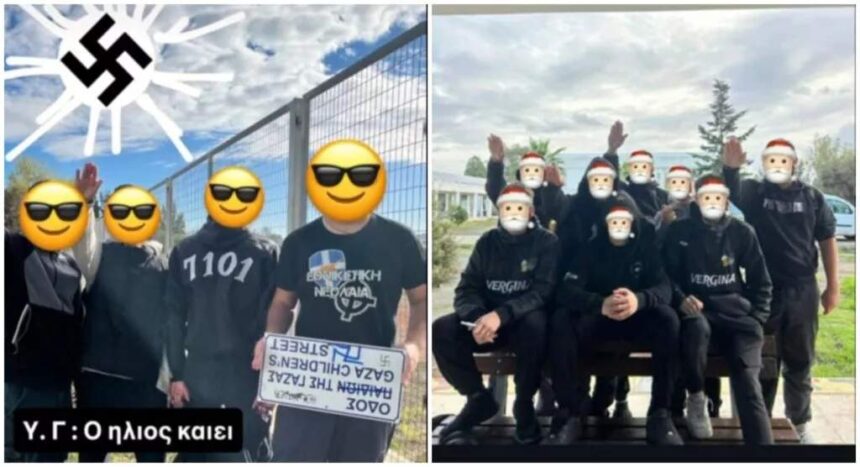
nazi organisation — More than 100 young people from Larnaca are reportedly part of a “Nazi organisation” that has sent members to Greece for training with extremist groups, according to Loizos Konstantinou, president of the Confederation of Secondary Education Parents’ Associations. This alarming claim highlights the emergence of a fascist cell operating within the Vergina Lyceum for over two years.
Konstantinou described a troubling “climate of terrorism” that has developed among students, pointing to the presence of swastikas that remained on school walls for months, reflecting negligence on the part of school authorities. “The number of the group is in the three digits,” he stated, indicating a significant presence within the student body.
He revealed that these students did not travel to Greece for leisure but visited a specific location linked to extremist organisations. This indicates a structured network beyond Cyprus, fuelling concerns about the international reach of such groups.
The situation escalated recently when members of the organisation were involved in an incident where stones were thrown at students holding a protest against the pseudo-state in Phinikoudes. This incident has led to complaints from parents, highlighting a pervasive culture of intimidation at the school.
Parents have voiced their apprehension over the two-year duration of these activities and the apparent inaction from both the school administration and the Ministry of Education. Initially, officials downplayed the seriousness of the issue, but Konstantinou insists that the existence of this group is not merely superficial. “They have penetrated into school, they have organised. A climate of terrorism also prevails among other children,” he remarked.
He expressed urgency in addressing the issue, noting that some students have made contact with extremist organisations abroad. “Not simply superficiality; we must handle it with particular care,” he warned, underscoring the need for immediate action to prevent the spread of these ideologies.
During discussions, Konstantinou clarified that while he was not specifically referring to the far-right political party ELAM, he cautioned against underestimating the intensity of neo-Nazism in Europe, suggesting it has deep roots that could extend into Cyprus.
Highlighting the gravity of the situation, he remarked, “Such actions, such behaviours, such perceptions have no place in our schools and in our society.” He pointed out that the wounds of fascism and Nazism are still felt globally, with Cypriots having fought for the Republic, many of whom are buried in sites abroad.
Konstantinou expressed frustration over the school’s failure to act against the visible symbols of hate. “When you see the swastika on the school wall and leave it there for two, three months, what is that?” he questioned, emphasising that the school administration should have acted swiftly to remove such symbols.
Many parents were reportedly unaware of their children’s involvement with the group, which raises concerns about the broader implications of such ideologies infiltrating the youth. “Maybe we have the snake in Cyprus,” Konstantinou suggested, warning that without intervention, these extremist views could proliferate.
The need for a comprehensive strategy to address these issues is urgent. “We must speak with all the children; it’s the responsibility of the school and the Ministry,” he stated, highlighting the importance of education in countering extremist ideologies.
Plans for a meeting at the Ministry have been set, with the specific case of the organisation being the primary focus. Konstantinou noted that while family responsibility is crucial, educational institutions also play a significant role in preventing radicalisation.
As the situation unfolds, the community is left grappling with the implications of these revelations. The presence of such extremist groups within schools poses a significant threat not only to the students involved but to the fabric of society as a whole.