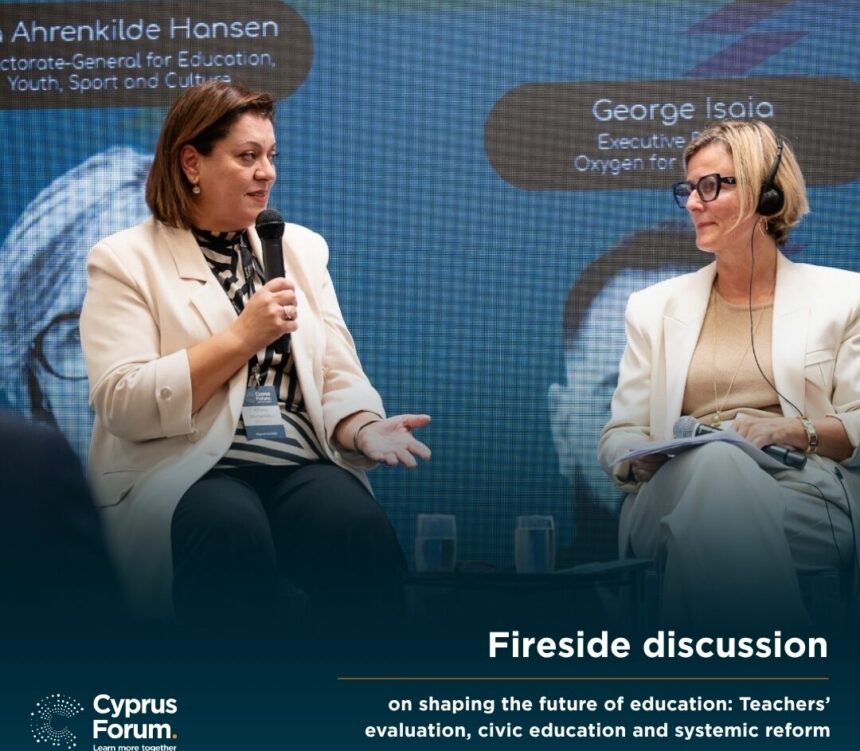
Cyprus must cultivate active citizenship from preschool age to prepare young people for democratic participation, according to Education Minister Athina Michaelidou. Speaking at the Cyprus Forum, she highlighted the importance of integrating citizenship education into the national curriculum, emphasising its role in shaping responsible future citizens.
Michaelidou pointed out that citizenship education is a fundamental priority that has been embedded across various subjects, particularly in civic education and life skills. “We cannot speak about life skills if we don’t start cultivating them early, from preschool education,” she stated. The minister believes that children should learn about their rights early on and embrace values such as justice, freedom, and free expression.
The initiative aims to move beyond theoretical knowledge, with teachers being pivotal in this educational shift. Training sessions focusing on citizenship issues have already commenced, and there is a commitment to enhance collaboration with specialists through workshops tailored for both students and educators.
Michaelidou also underscored the urgency of this initiative in light of the recent parliamentary decision to lower the voting age. “We cannot ask children to have opinions and participate democratically if we don’t prepare them properly during the 12 years of school and in preschool education,” she remarked, emphasising the need for a robust educational framework.
In tandem with promoting active citizenship, the minister addressed the importance of improving educational quality through a new teacher evaluation framework. This initiative is not intended as a punitive measure but aims to foster professional development, offering teachers pathways for career progression and recognition of excellence. “We all work for the children. When this is understood, then we can make the turn our education system needs,” she concluded.
The discourse on active citizenship coincides with broader concerns regarding the state of democracy in Europe. Pia Ahrenkilde Hansen, a senior official at the European Commission, cautioned that European democracy is facing increasing challenges from disinformation and electoral interference. Hansen advocated for greater investment in education and skills, asserting that the EU’s future hinges on empowering young people as active citizens.
<p"The battle for democracy in Europe starts in classrooms and even earlier, in preschool education," Hansen declared, praising Cyprus's efforts to incorporate citizenship into early education. She noted that this approach equips children with critical skills to navigate media landscapes and engage meaningfully in public life.
As part of the European Commission’s Union of Skills strategy, Hansen highlighted the necessity of investing in linguistic, numerical, scientific, digital, and citizenship skills to maintain Europe’s competitiveness. She pointed out that one quarter of EU teachers are nearing retirement, which heightens the need for an Agenda for Teachers and Trainers set to be presented in 2026.
In her remarks, Hansen commended Cyprus for its educational reforms, particularly in teacher evaluation, and expressed her optimism about the country’s upcoming EU presidency in 2026. She called upon member states to support a strong education budget and to actively participate in the forthcoming Summit on Education and Skills.
The Cyprus Forum serves as a platform for policymakers, educators, and civil society representatives to engage in discussions about democratic governance and civic participation. With Cyprus set to assume the rotating EU presidency in the latter half of 2026, the discussions at the forum are timely and crucial for shaping future educational policies.