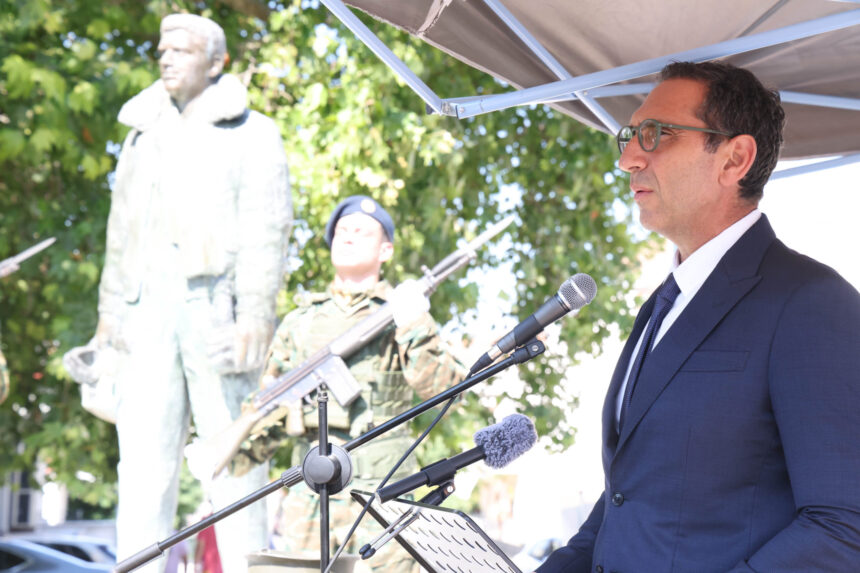
The Cyprus problem remains unresolved, with Interior Minister Constantinos Ioannou asserting that partition cannot be an acceptable solution. Speaking at an event commemorating the fallen and missing in Serres, Greece, Ioannou highlighted the enduring consequences of the Turkish invasion, which occurred 52 years ago.
Cyprus problem: Lasting Effects of the Turkish Invasion
Ioannou reflected on the ongoing struggles faced by the Greek Cypriot community, stating, “Fifty-two years later, the Greek Cypriot community continues to experience the tragic consequences of the barbaric Turkish invasion.” He emphasised the plight of refugees who have been unable to return to their ancestral homes due to the division of the island.
A Call for Reunification
During his speech, Ioannou made it clear that the government remains steadfast in its position against the current status quo, which he described as a fundamental violation of human rights. He referred to the situation as an “open wound” for many Cypriots, indicating the deep emotional and psychological scars that the prolonged division has inflicted.
Firm Stance on Occupation
Ioannou asserted that the government would not “compromise with the fait accompli of the occupation.” He articulated a vision for the future, stating, “Our position is firm and unchangeable. Our goal is the liberation, the reunification of Cyprus, the liberation from the occupation troops and the anachronistic guarantees.” This stance underscores the government’s commitment to addressing the root causes of the conflict rather than merely accepting the existing division.
Support from Greece and the International Community
In his remarks, Ioannou acknowledged the significant support Cyprus has received from Greece over the decades. He noted that Greece has stood by Cyprus for 52 years, reinforcing the bond between the two nations in their shared struggle against the division. This solidarity is viewed as crucial in the quest for a resolution to the Cyprus problem.
Military Contributions and Symbolic Value
Regarding the Greek frigate’s mission to Cyprus last March, Ioannou commented on its dual significance. He expressed that it not only served to bolster pride among Greek Cypriots but also aimed to defend Cypriot Hellenism against potential threats. “In addition to the symbolic value, it also had a practical contribution to the defence and defensive armouring of Cyprus,” he stated, highlighting the importance of military readiness in the face of ongoing tensions.
The Path Forward
As the anniversary of the invasion approaches, the sentiments expressed by Ioannou reflect a broader desire among the Greek Cypriot community for resolution and reconciliation. The ongoing challenges posed by the division of the island serve as a reminder of the need for continuous dialogue and negotiation.
Reflection on Historical Context
The history of Cyprus is marked by conflict and division, dating back to 1974 when tensions escalated following a Greek-led coup and subsequent Turkish invasion. Since then, the island has remained split, with the northern part governed by Turkish Cypriots and the southern part by Greek Cypriots. This historical backdrop adds layers of complexity to the current political landscape, shaping the perspectives and aspirations of both communities.
International Dynamics
The Cyprus problem is not solely a local affair but also involves international dimensions, including the roles of the United Nations and various geopolitical interests. The global community continues to monitor the situation closely, with calls for renewed efforts towards reconciliation and a comprehensive solution that respects the rights and aspirations of all Cypriots.
Future Prospects
While the path to reunification may be fraught with challenges, the commitment expressed by Ioannou and his government signals a determination to pursue a future where the island is whole again. The ongoing dialogue, bolstered by international support, may eventually pave the way for meaningful progress.