cost of — A marathon meeting on the Cost of Living Allowance (CoLA) has ended without agreement, raising concerns among unions who threatened to strike if the allowance was not reinstated. The discussions, held at the labour ministry, lasted four hours but failed to bridge the significant gap between union demands and employer positions.
Unions are advocating for a full return to 100 per cent of CoLA, with some flexibility on a gradual implementation. However, employers have firmly rejected this, pointing out that it was not part of previous transitional agreements.
During the talks, the government proposed three scenarios for consideration: linking CoLA to economic growth, fixing a specific percentage of payment, and establishing clear rules for its application. Despite these proposals, unions assert that employers are unwilling to budge from their stance, which keeps CoLA at its current level of 66.7 per cent.
Stratis Mattheou, the general secretary of the civil servants union Pasydy, expressed disappointment at the employers’ rigidity. He argued that inflation is currently low, thus the financial impact of restoring CoLA fully would be minimal. He cautioned that employers appear to be seeking to alter the fundamental philosophy of CoLA, which is designed to protect workers’ purchasing power.
Echoing these sentiments, Stelios Christodoulou, president of the Deok union, emphasised the importance of CoLA in safeguarding purchasing power. He warned that weakening this allowance could set a troubling precedent and damage labour relations. Christodoulou urged the labour ministry to either restore CoLA fully or provide a clear timetable for its reinstatement.
Estimations suggest that raising CoLA from 66.7 per cent to 80 per cent, and eventually to 100 per cent, would only increase costs by around 1.5 to 2 per cent. Notably, less than half of the workforce in Cyprus currently benefits from CoLA, despite an EU directive that advocates for collective agreements to cover at least 80 per cent of employees.
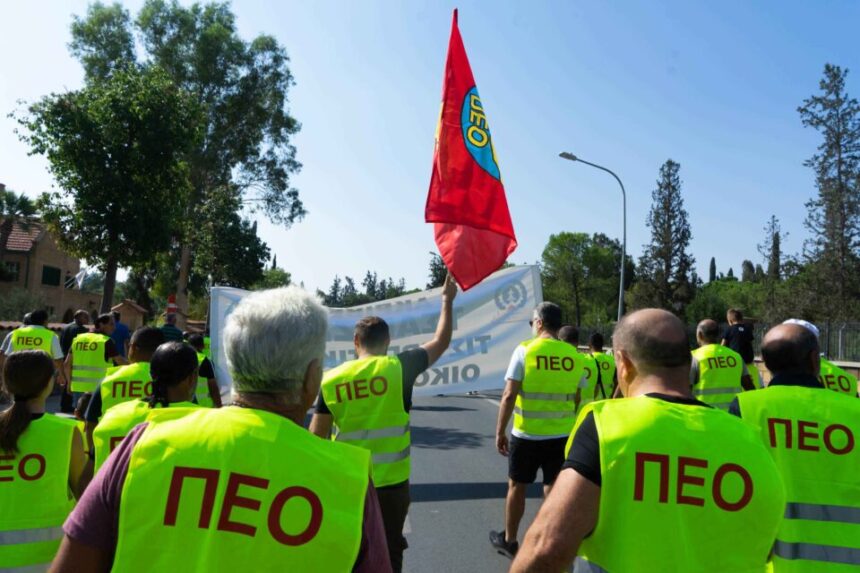
Last week, unions warned of potential strikes should the labour ministry fail to present an acceptable proposal. They are expected to reconvene on Monday to plot their next moves after the unsuccessful talks.
Employers also expressed dissatisfaction with the meeting’s outcome. Michalis Antoniou, director general of the OEV, noted that while the talks clarified positions, they did not yield a solution. He highlighted that previous agreements made in 2017 and 2023 did not stipulate CoLA being set at 100 per cent, and he cautioned against further transitional deals, arguing that they perpetuate uncertainty in labour relations.
Philokypros Rousounides, secretary general of Keve, acknowledged the wide gap in positions between the two sides. He reiterated the employer’s proposals to link CoLA to economic growth and establish clearer rules. While he recognised the need for modernising the system, which has remained unchanged since 1944, he warned that threats of strikes could lead to a stalemate.
Rousounides affirmed Keve’s commitment to finding a mutually acceptable solution that balances the need to protect workers’ purchasing power while ensuring business competitiveness and financial stability.