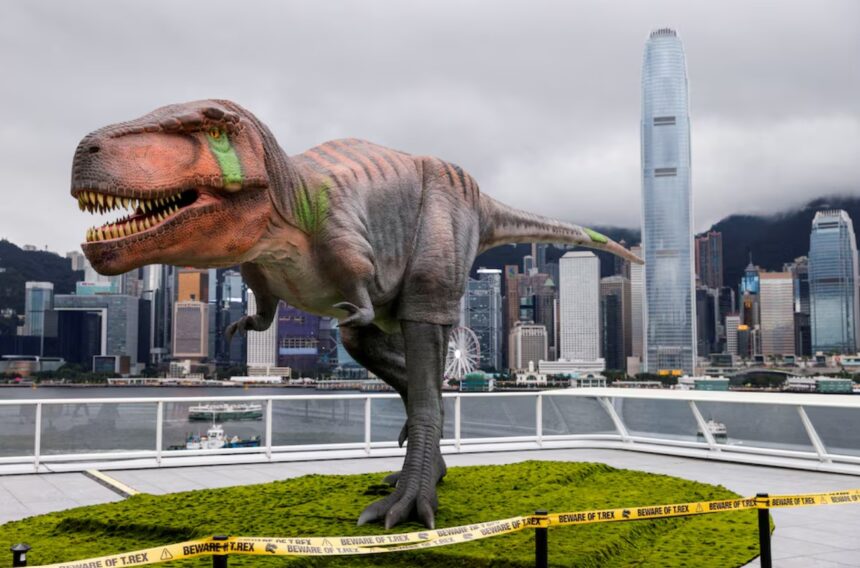
Tyrannosaurus rex possessed a unique combination of a massive skull and disproportionately small arms, a trait shared among many carnivorous dinosaurs. This peculiar anatomy has intrigued scientists and the public alike, leading researchers to investigate the evolutionary pathways that resulted in such a mismatch.
Tyrannosaurus rex: The Evolution of Skull Robustness
Researchers studying the evolution of theropod dinosaurs have documented that the robust skulls of these meat-eaters began to evolve first. In an environment where plant-eating dinosaurs grew larger, carnivorous species adapted by enhancing their bite force and skull structure to capture and subdue these bigger prey.
Key Findings from the Study
The study identifies five distinct lineages of theropods in which the combination of large skulls and reduced forelimbs independently arose. This phenomenon highlights the evolutionary advantages that drove these traits, helping meat-eating dinosaurs to thrive in their ecosystems.
Research Insights from University College London
Charlie Scherer, a doctoral student in paleontology at University College London and the lead author of the study published in the journal Proceedings of the Royal Society B, explained, “Body size in dinosaurs increased massively from the Triassic to the end-Cretaceous, so it’s likely that the increase in body size drove some theropods to shift towards using their heads more than their limbs in hunting.” Scherer emphasised that as forelimbs became less critical for hunting, natural selection favoured traits that enhanced skull strength.
The Role of Natural Selection
The researchers applied a new methodology to quantify skull robustness, analysing traits such as skull dimensions, bite force, tooth shape, and patterns of cranial bone fusion. They discovered that Tyrannosaurus rex had the most robust skull among studied theropods, followed closely by Tyrannotitan, another Cretaceous predator from South America.
Associations Between Skull Size and Arm Reduction
Interestingly, the study found a close association between the size of the skull and the reduction of forelimbs. The lineages investigated included:
- Tyrannosaurs, including T. rex
- Carcharodontosaurs, such as Carcharodontosaurus from Cretaceous Africa
- Megalosaurs, including Megalosaurus from Jurassic England
- Ceratosaurs, like Ceratosaurus from Jurassic North America and Europe
- Abelisaurs, including Abelisaurus from Cretaceous South America
These apex predators primarily relied on their strong jaws and large body size to tackle various large herbivorous dinosaurs, including sauropods and horned dinosaurs.
A Historical Perspective on Theropods
The evolutionary history of dinosaurs began approximately 230 million years ago, with theropods emerging as significant predators during the Jurassic and Cretaceous periods. Early theropods had well-developed arms suited for capturing prey, but this changed as their prey grew significantly larger.
Examples of Theropods with Long Arms
While many theropod lineages exhibited reduced forelimbs, some retained long and strong arms. For instance, Spinosaurus from Cretaceous Africa and Megaraptor from Cretaceous South America had notably large and mobile arms, suggesting a different hunting strategy compared to T. rex.
The Mystery of T. rex’s Tiny Arms
The tiny arms of Tyrannosaurus rex have long fascinated researchers and the public, even inspiring memes that joke about the dinosaur’s limited capabilities. Despite their reduced size, the exact function of these small arms remains unclear.
Scientific Speculation
Paul Upchurch, a paleontologist at University College London and a co-author of the study, raised intriguing questions about the purpose of T. rex’s diminutive arms. “Potentially, they did nothing with them – they were just useless,” he stated. This raises the question of why such arms persisted if they served no function. Upchurch suggested that genetic changes often lead to the reduction of anatomical structures that become unnecessary over time.
Genetic Complexity and Evolution
Upchurch explained the complexities of genetics in evolutionary biology. “Genetics is complicated, and very often genes have more than one role,” he noted. A gene responsible for a feature that is no longer useful might still play a vital role in another aspect of the animal’s physiology, thus allowing the feature to persist in a reduced form.
Continuing Research and Discoveries
The ongoing research into the evolutionary biology of dinosaurs like Tyrannosaurus rex continues to reveal fascinating insights into their adaptations. Understanding the relationship between their unique anatomical features and the environmental pressures they faced helps scientists piece together the puzzle of dinosaur evolution.