Researchers have developed a soft robot inspired by the elephant trunk, capable of performing delicate tasks like picking fruit while also being strong enough to assist in lifting patients.
- Researchers have developed a soft robot inspired by the elephant trunk, capable of performing delicate tasks like picking fruit while also being strong enough to assist in lifting patients.
Innovation Through Nature’s Design
The idea for this remarkable robot emerged from Lucia Beccai, a soft robotics expert at the Italian Institute of Technology in Genoa. Watching a documentary about elephants, she was struck by the extraordinary versatility of their trunks, which can perform a range of tasks from gently plucking a leaf to lifting heavy logs. This led to the question: could we emulate the functionality and anatomy of an elephant trunk in robotics?
PROBOSCIS: The Research Initiative
The initiative, named PROBOSCIS, is a five-year project funded by the European Union that unites biologists, engineers, and materials scientists. The aim is to create a universal robotic hand that can adapt to various shapes and textures without requiring significant hardware changes. Unlike current robotic systems, which often consist of rigid arms with discrete grippers, the goal is to achieve a more fluid, whole-body manipulation that mimics the trunk’s capabilities.
Understanding the Elephant Trunk’s Mechanics
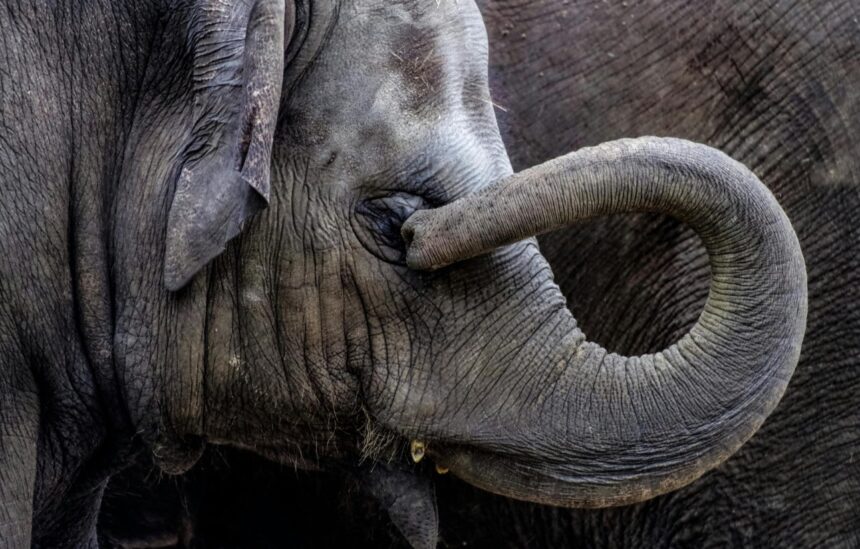
Elephant trunks are classified as muscular hydrostats, similar to octopus tentacles and human tongues. They comprise over 100,000 muscles and lack a bony structure, allowing for an incredible range of motion. This flexibility enables elephants to perform tasks with remarkable strength and precision, such as carrying loads of nearly 300 kilograms. Additionally, African elephants possess two finger-like protrusions at the tip of their trunks, enhancing their dexterity.
Advanced Techniques for Analysis
To investigate the elephant trunk’s functionality, Professor Michel Milinkovitch from the University of Geneva led a team that employed filmmaking techniques. The researchers used reflective markers to track the movements of elephants in a South African reserve as they interacted with various objects. High-speed cameras captured their efficient techniques for manipulating items of different shapes and sizes.
Revealing New Insights
Milinkovitch’s team discovered that elephants utilise a limited set of movements to achieve their goals, combining actions such as shortening, elongating, and bending different parts of their trunks. One particularly striking observation was the way elephants create temporary joints when reaching behind their heads, enabling them to swiftly and effectively grasp objects.
Translating Biology to Robotics
To bring these insights into the realm of robotics, Beccai’s team focused on the trunk’s tip, which is essential for delicate tasks. They employed 3D printing to integrate sensing capabilities and artificial muscles into a single, cohesive structure. By developing pneumatic actuators that inflate and deflate, the team designed a robot that can elongate, compress, and bend, mimicking the trunk’s movement.
Continuous Motion and Sensory Feedback
This soft robot is constructed from a mesh-like lattice that allows it to deform in multiple directions. The integration of optical sensors provides real-time feedback on touch and bending, facilitating seamless movement. Beccai emphasised the importance of using a single material throughout the design, which eliminates mechanical interfaces that often hinder motion continuity.
Towards a Universal Gripper
The prototype demonstrates a significant advancement towards creating a universal gripper that can handle both delicate and heavy items with ease. By addressing the design challenges faced by traditional robotic arms, the researchers are paving the way for more functional and versatile soft robots.
Insights into Control Mechanisms
One of the key takeaways from studying the elephant trunk is its control mechanism. While it contains thousands of muscles, elephants do not control each one individually. Instead, their brains coordinate a small number of muscle synergies, allowing the trunk’s structure to manage the remaining functions. This understanding could lead to designing future soft robots that prioritise functional synergies rather than individual actuators, potentially simplifying their operation and reducing energy consumption.
Potential Applications in Various Fields
Beccai envisions a wide range of applications for these soft robots, from harvesting soft fruits—a significant challenge in current robotics—to assisting with domestic tasks like sorting laundry and handling fragile dishes. Beyond household uses, these robots could play crucial roles in environmental efforts, such as sorting waste or working in delicate ecosystems with minimal disruption.
Transforming Healthcare with Robotics
Healthcare remains a primary focus for Beccai, who dreams of creating a robotic system that aids disabled or elderly individuals. A robot capable of lifting someone or delivering a meal while also being gentle enough to handle everyday objects could significantly enhance independence for many. Unlike traditional robots, the soft design would ensure that the machine feels approachable rather than intimidating.
A Vision for Future Robotics
Ultimately, Beccai’s ambition extends beyond merely improving robotic gripping technology. Her goal is to develop a robot that feels natural in its environment—strong when necessary and gentle when required. With the research project set to conclude in April 2025, the soft robotic arm stands as a promising example of how nature can inspire technological advancements in robotics.