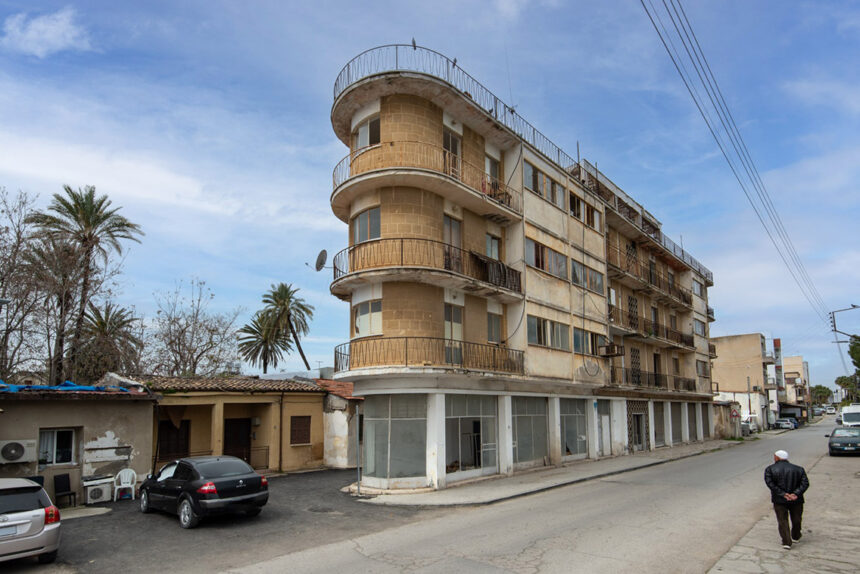
A new exhibition entitled Modern Nicosia is currently showcasing the city’s often overlooked modernist architecture at Mayor Lellos Demetriadou Square, located in the heart of the old town. The exhibition was inaugurated a week ago by Nicosia’s mayor, Charalambos Prountzos, alongside former European Union culture commissioner Androulla Vassiliou and attendees of the European Cultural Heritage Summit 2026.

Photo: cyprus-mail.com
Modern nicosia: Highlighting Architectural Heritage
The Modern Nicosia exhibition features a collection of photographs and drawings that illustrate significant examples of Cyprus’s architectural modernism, which can be found on both sides of the divided capital. This initiative is the result of extensive research by members of the Europa Nostra Heritage Hub in Nicosia, a group formed last year as part of the European Heritage Hub project, in collaboration with 20 partners and funded by the European Union.

Photo: cyprus-mail.com
Curators’ Vision
Coordinated by architect Natalie Neophytou and urban sociologist Özlem Unsal, the exhibition aims to shed light on the modern architectural legacy that has shaped Nicosia. Neophytou emphasises the importance of recognising these buildings as integral to the city’s heritage and history. “Modernism formed the urban fabric of the city that we know today,” she stated during the exhibition’s opening.
A Collaborative Effort
The research team, which included both Greek and Turkish Cypriot conservation architects, urban planners, architectural historians, and visual anthropologists, worked voluntarily for six months to gather data about the island’s leading architects from both communities. The exhibition showcases 40 selected buildings, including cinemas, restaurants, factories, churches, hotels, hospitals, shops, and apartment blocks from across the capital, with 20 located within the Venetian Walls and 20 outside.
Notable Architectural Examples
Among the highlighted structures is the Caglayan bar, built by Greek Cypriot chief mason Pavli, and the Pallas cinema near Paphos Gate, designed by Panayiotis Stavrinides. The Jerusalem Patriarchate office building on Ledra Street was crafted by architects Zembylas and Kythreotis, while the Colocassides estate, designed by Costas Vafeades and Dinos Fissentzides between 1965 and 1973, stands adjacent to Eleftheria Square.
Preserving Shared Heritage
The exhibition also features the Boyaci shops and apartments, attributed to Loucas Hadjilukas, completed in 1954, and the Oguz Basak house from the 1960s, designed by Ahmet Vural Behaeddin and Ercan Hifzi. Each of these buildings, constructed between the 1930s and the 1970s, is emblematic of modernist design and serves as a testament to the shared heritage of both communities.
Challenges Facing Nicosia’s Architecture
Despite their significance, many of these buildings are currently empty and at risk of demolition, as noted by Neophytou and Unsal. “We are losing more and more of them and this must end,” Neophytou cautioned. Unsal echoed this sentiment, stating, “It is crucial to reintroduce these buildings and raise awareness about their existence, as they showcase our shared heritage.” Their research revealed instances of collaboration between Turkish Cypriot families and Greek Cypriot architects in the design and construction of various buildings on both sides.
Commitment from Local Leaders
At the European Cultural Heritage Summit 2026, both mayors of Nicosia, Charalambos Prountzos and Mehmet Harmanci, expressed their commitment to preserving the city’s architectural heritage. In their speeches, they highlighted the importance of collaboration to revive the Nicosia Master Plan (NMP), a framework established in the 1970s by their predecessors.
Future Plans for Nicosia
Prountzos announced plans to re-establish the NMP and integrate cultural heritage into the city’s urban design. “Our number one step is to re-establish the Nicosia Master Plan and use an existing mechanism to plan for the city as a whole,” he said during the forum. Harmanci confirmed this commitment, revealing that efforts are underway to revive the bicommunal NMP team and develop a concrete strategy for the project.
Immediate Focus Areas
Both mayors have identified the Venetian Walls and the Green Line as priority areas requiring urgent attention. Harmanci warned of the consequences of neglecting the Walls, stating, “If we don’t renovate them urgently, we will lose them, and if we lose them, we will lose the spirit of Nicosia.” Prountzos echoed this concern, calling for a reintegration of the buffer zone into the city’s fabric.
Exhibition Details and Ongoing Efforts
The Modern Nicosia exhibition will remain in south Nicosia until June 10 and will then move to the north, specifically Iplikbazari Street, near the Rustem Bookshop and Evkaf, starting June 13. Europa Nostra has expressed strong support for the revival of the NMP, emphasising the significance of the Venetian Walls not just as a physical structure, but as a symbol of unity.
As the exhibition continues, it plays a crucial role in fostering appreciation for Nicosia’s modernist architecture and its shared heritage, reminding residents of the rich cultural tapestry that unites both communities.