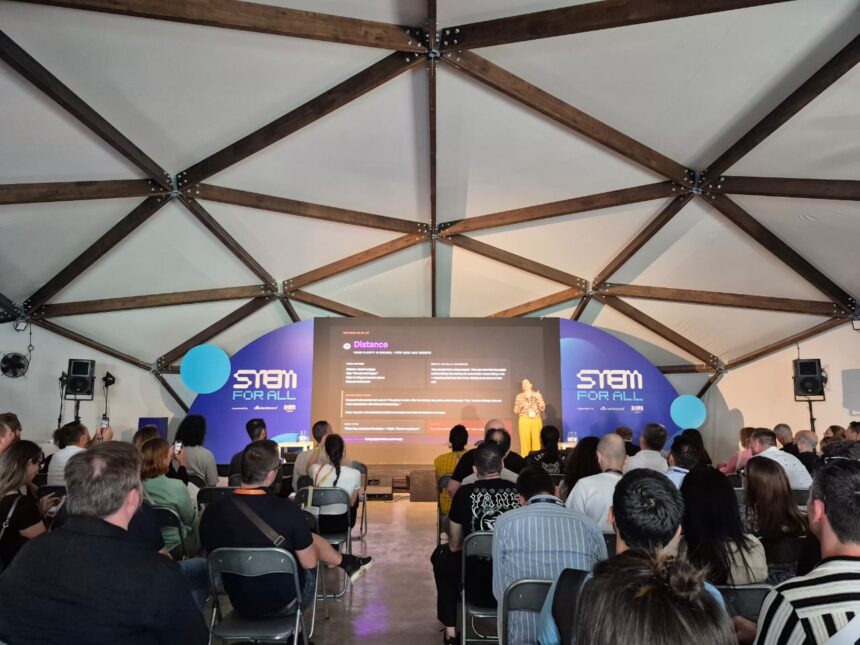
TheSoul Group COO Aleksandra Sulimko emphasised that organisations often struggle not due to a lack of tools or strategies, but because of how people react to uncertainty. Speaking at the Doers Summit in Limassol, her keynote titled ‘Mindset Is Not What You Think’ focused on the nuances of human behaviour in the face of rapid change, particularly in the realm of artificial intelligence.
Understanding Human Behaviour in Business
Sulimko pointed out that the real challenge in transforming businesses lies in recognising automatic reactions when faced with uncertainty. She argued that mindset transcends mere attitude or belief; it is fundamentally about behaviour under pressure. This perspective was shaped by her experiences across various fields, including emergency response, psychotherapy, and corporate leadership.
The Dynamics of AI and Productivity
During her address, Sulimko shared insights into TheSoul Group’s impressive scale, boasting 5 billion subscribers and 10 billion monthly views. She noted that while AI has significantly boosted individual productivity, many organisations have not seen a corresponding increase in value. This discrepancy, she contended, stems from a gap between individual speed and collective reaction, which is primarily influenced by human behaviour rather than technology.
The Reaction Problem
Sulimko proposed that many companies misinterpret the challenges posed by AI, suggesting that the core issue is not an ‘AI problem’ but a ‘reaction problem’. Even with advanced tools at their disposal, organisations can freeze, overanalyse, or cling to old habits when under pressure. The disconnect between corporate messaging and employee perception can exacerbate this issue, leading to feelings of fear and obsolescence among staff.
FOBO: The Fear of Becoming Obsolete
She highlighted this anxiety as FOBO, or the fear of becoming obsolete, which hampers creativity and speed within organisations. Employees often interpret corporate calls for speed and innovation as signals of their potential redundancy, further entrenching a culture of caution and protectionism. According to Sulimko, when individuals feel replaceable, they are less likely to take bold actions.
Patterns of Reaction Under Uncertainty
In her discussion, Sulimko outlined several automatic patterns that emerge when individuals face ambiguity. These include:
- Distance: Individuals may step back and disengage, waiting for clearer information, which can appear as indecisiveness.
- Control: Some may seek more data and information to feel secure, which can lead to over-analysis and inaction.
- Responsibility: Others might take on excessive workloads to prove their value, leading to burnout and inefficiency.
These patterns are not personality traits but survival strategies that can hinder progress if left unexamined. Sulimko stressed that awareness of these reactions is crucial for enabling positive change.
Creating a Culture of Awareness and Choice
To foster an environment conducive to transformation, Sulimko argued that organisations must cultivate awareness among their teams. This awareness can create a ‘pause’ between reaction and action, allowing individuals to make more informed choices. By understanding their initial reactions, employees can better navigate uncertainty and contribute to swifter organisational movement.
Transforming Mindsets for the Future
As she concluded her keynote, Sulimko challenged attendees to observe their first reactions when faced with AI-related uncertainties in the coming week. The emphasis on awareness, choice, and understanding human behaviour under pressure offers a pathway to unlocking the potential within organisations, allowing them to thrive in an era of rapid change.