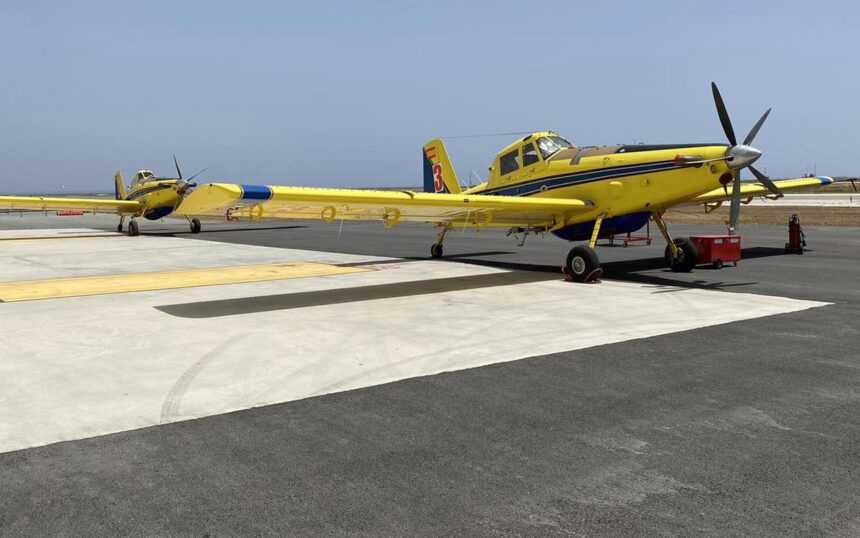
firefighting aircraft — The tender process for the purchase of three firefighting aircraft is currently under way, as highlighted by Andreas Gregoriou, permanent secretary of the ministry of agriculture and rural development. One of these aircraft will be financed through the Recovery and Resilience Facility.
- These changing conditions have direct ramifications for fire incidents, leading to alterations in their frequency and intensity. As a result, large-scale fires have become increasingly commonplace.
This initiative is part of a broader strategy aiming to acquire a total of ten government-owned aerial firefighting assets within the next five years, with an option to purchase an additional five aircraft.
Reflecting on the current fire season, Gregoriou noted that there are 13 primary aerial firefighting assets available, including nine fixed-wing aircraft and four helicopters. Additionally, helicopters from the National Guard and the police are on standby for secondary support as needed.
The role of technology in combating wildfires has become increasingly pivotal. A comprehensive plan is in place to enhance forest surveillance systems, improve early fire detection, and ensure real-time image transmission to operations centres. Gregoriou mentioned that phase one of this plan has been completed, which included the establishment of a basic wireless data transmission network, the installation of four fire detection sensors in forested areas, and the procurement of five drone systems.
Looking ahead, phase two of the programme will involve collaboration between the forestry department, the fire brigade, and the National Guard. The forestry department’s actions will include the installation of 15 additional automatic fire detection systems and the development of specialised risk prediction and fire simulation software. Furthermore, new observation balloons and mobile operations centres will be procured, alongside upgrades to existing drone systems and the department’s general operations centre.
To further bolster firefighting capabilities, new IT and network equipment will be supplied to both personnel and all new assets. With the high-risk fire period commencing, the Tetra telecommunications system has been introduced at the forestry department. Gregoriou stated, “This system will significantly improve internal communication, particularly interdepartmental cooperation as relates to fire management.”
In recent years, the department’s ground firefighting resources have seen substantial enhancement. From 2023 to date, 25 specialised all-terrain firefighting vehicles with a two-tonne water capacity have been acquired, alongside eight tracked bulldozers, four wheeled excavators, and six agricultural tractors. Additionally, 17 large fire engines with a six-tonne water capacity are expected to be delivered by 2026, with 12 funded through the Recovery and Resilience Facility.
Gregoriou also pointed out the challenges faced during fire seasons, attributing them to the combination of adverse weather conditions, the abandonment of rural areas, and changes in land use. He remarked on the impact of climate change on Cyprus, stating, “Unfortunately, climate change is observed in every corner of the planet, and it is no different in Cyprus. Temperatures are climbing and rainfall is decreasing.”
These changing conditions have direct ramifications for fire incidents, leading to alterations in their frequency and intensity. As a result, large-scale fires have become increasingly commonplace.