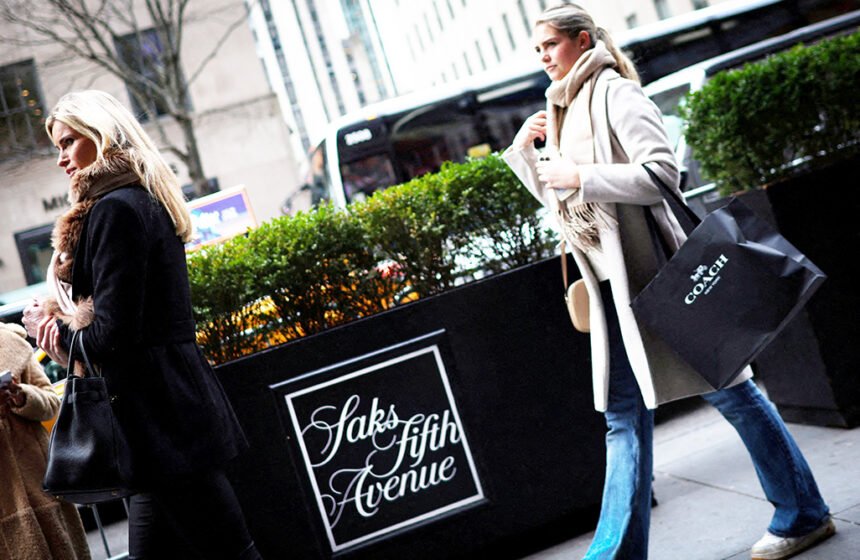
Saks Global, the renowned high-end department store conglomerate, filed for bankruptcy protection late on Tuesday, marking one of the most significant retail collapses since the pandemic. This decision comes less than a year after a major merger that aimed to create a luxury powerhouse by uniting Saks Fifth Avenue, Bergdorf Goodman, and Neiman Marcus.
The abrupt filing has raised questions about the future of these iconic brands. However, Saks announced on Wednesday that its stores would continue to operate for the time being, buoyed by a recently secured $1.75 billion financing package and the appointment of a new chief executive.
Despite its storied history and popularity among the affluent, Saks has struggled to regain stability in the aftermath of COVID-19. The surge in online shopping and the trend of brands selling directly to consumers have intensified competition, leaving Saks unable to recover fully. Compounding these issues, the company faced significant challenges last year, including delayed payments to vendors, which led to a reduced inventory.
Geoffroy van Raemdonck, the former CEO of Neiman Marcus, has taken over the reins from Richard Baker, who spearheaded the acquisition strategy that ultimately burdened Saks Global with debt. In recent filings with the U.S. Bankruptcy Court in Houston, Texas, Saks Global reported its assets and liabilities are estimated to be between $1 billion and $10 billion.
The original Saks Fifth Avenue, synonymous with luxury and exclusivity since its inception in 1867, is now faced with the daunting task of restructuring its debts. The court process aims to provide the retailer an opportunity to negotiate with creditors or potentially find a new owner. According to Saks, the core issue is not a lack of demand for luxury goods but rather challenges with inventory availability and vendor confidence.
The merger with Neiman Marcus added considerable debt just as global luxury sales were experiencing a downturn. Industry experts have suggested that the combination was ill-timed, as luxury brands were increasingly prioritising direct-to-consumer sales. “In a market where luxury brands are moving direct-to-consumer and shoppers expect personalisation and speed, that merger was always going to fail,” noted Brittain Ladd, a strategy and supply-chain consultant.
Saks Global, employing approximately 17,000 workers, had previously raised $600 million and restructured debt in mid-2025 to alleviate its financial burdens. However, ongoing issues with vendor payments and inventory shortages left the company with significant liquidity constraints as it entered 2026.
As stock levels dwindled, customers began to flock to competitors like Bloomingdale’s, which reported robust sales figures, further intensifying the pressure on Saks. “Rich people are still buying,” said David Swartz, a Morningstar analyst, “just not so much at Saks.”
In a bid to improve its financial situation, Saks Global sold the real estate of its Neiman Marcus Beverly Hills flagship store last month and was exploring the sale of a minority stake in Bergdorf Goodman.
The recently arranged financing deal aims to provide an immediate cash infusion of $1 billion through a debtor-in-possession loan, primarily from a group led by Pentwater Capital Management and Bracebridge Capital. An additional $240 million will be available through an asset-backed loan from the company’s lenders. Once Saks successfully exits bankruptcy, it expects access to $500 million in financing from the investor group.
Saks has requested a 45-day extension for submitting its financial statements, pushing the deadline to March 13, 2026. The filing indicates that several luxury brands are among the unsecured creditors, with Chanel owed approximately $136 million and Kering, the owner of Gucci, owed $60 million. In total, Saks Global anticipates having between 10,001 and 25,000 creditors.
As the luxury retail landscape evolves, industry experts believe this situation underscores an accelerating trend: luxury brands are increasingly distancing themselves from department stores and focusing on direct sales channels. This shift could signal a significant transformation within the sector in the coming years.