protests law — protests law — A debate in parliament about a controversial law regulating public gatherings quickly turned chaotic on Monday, with MPs clashing over recent pro-Palestinian protests and allegations of foreign influence on Cypriot politics.

Photo: cyprus-mail.com
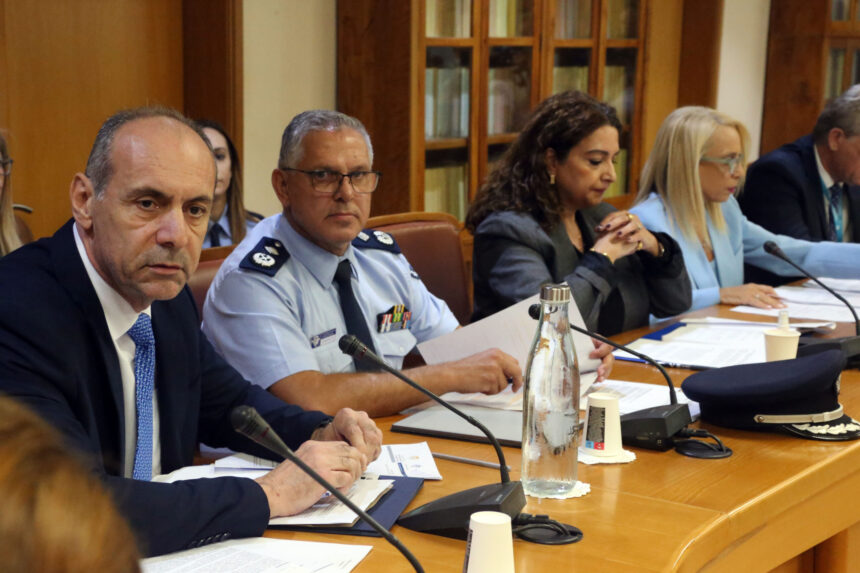
Originally intended to discuss the law enacted last July, which critics label draconian, the session devolved into heated exchanges as opposition party Akel voiced strong objections. The law has come under fire following a critical report from the Organisation for Security and Cooperation in Europe (OSCE) released last month.
Akel MP Giorgos Koukoumas sparked tensions when he referenced the clashes between police and demonstrators that took place outside the foreign ministry in Nicosia last Thursday. “I was there, should the police want to summon me as a witness,” he stated, refuting police claims that demonstrators obstructed the road.
His comments were met with resistance from Justice Minister Marios Hartsiotis, who insisted the discussion should focus on the law itself, not the protests. “We are not here to discuss last week’s protest or police conduct,” Hartsiotis snapped back.
Committee chair Irini Charalambidou, also from Akel, intervened, urging the minister to wait for his turn to speak. The atmosphere intensified further when Disy MP Onoufrios Koulla remarked, “Cyprus is a sovereign state,” prompting Charalambidou to retort, “Does Israel know that?” This exchange highlighted underlying tensions regarding accusations that Cyprus is bowing to Israeli influence.
In defence of Cyprus’s sovereignty, Diko MP Christos Senekis remarked, “We are no errand boys for Israel,” recalling a past administration where Cypriots suffered dire consequences for political alignments.
Amidst the turmoil, Deputy Police Chief Panicos Stavrou clarified the police’s stance during the pro-Palestinian demonstration, asserting that officers did not seek to disperse the gathering but aimed to guide demonstrators back onto the pavement. When they refused to comply, he stated, police employed “proportionate force.”
As the discussion attempted to refocus on the public gatherings law, Charalambidou noted her invitation to an OSCE delegation to visit Cyprus and present their findings. She underscored the vast difference between the succinct law, which spans just three pages, and the OSCE’s comprehensive 32-page report detailing observations and recommendations.
Hartsiotis countered the critics by arguing that the law does not contain prohibitive language. “Nowhere does the law contain the word ‘prohibit’,” he asserted, challenging any claims of a ‘terror law’ or oppressive measures. He maintained that the law grants organisers the right, rather than an obligation, to notify the police ahead of their events.
However, the minister acknowledged that certain aspects of the legislation could benefit from refinement, particularly a clause allowing authorities to disperse gatherings if violence erupts nearby. He compared Cyprus’s regulations to those in other European nations, explaining that in Greece, police hold the authority to ban protests, while in Germany, protests may be prohibited if deemed dangerous.
Hartsiotis illustrated the varying approaches across Europe, noting that in Belgium, local mayors must approve each demonstration, and in the Netherlands, organisers are required to inform municipalities ahead of time. These comparisons aimed to contextualise the law within broader European practices while defending its current framework.