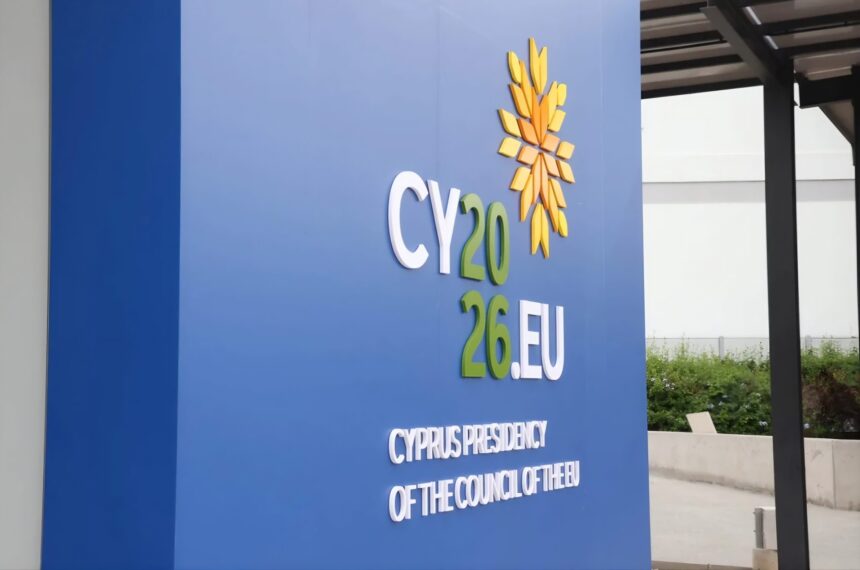
The ongoing Middle East crisis is set to dominate discussions at the upcoming European Council meeting in Cyprus, with energy prices and geopolitical stability high on the agenda. Scheduled for April 23 and 24, 2026, the informal gathering will be hosted by Cypriot President Nikos Christodoulides, bringing together heads of state from across the EU.
European Commission President Ursula von der Leyen has outlined the critical issues that will be addressed, emphasising the significant economic impact the conflict has had on Europe, particularly in terms of escalating energy costs. “For 44 days now, once again the Middle East has been engulfed in war, and these past six weeks have reminded us that peace cannot be taken for granted,” she remarked, highlighting the urgency of the situation.
Von der Leyen acknowledged that while a fragile ceasefire had been announced, uncertainty prevails as negotiations have stalled. She stressed the necessity for any future agreements to tackle Iran’s nuclear and ballistic missile programme and to restore safe navigation through the strategically important Strait of Hormuz. “The ongoing closure of the Strait of Hormuz is greatly damaging, and the restoration of freedom of navigation is of paramount importance for us,” she stated, underlining the critical nature of energy supply routes.
The European Commission has reported that the crisis has already cost the EU more than €22 billion in additional fossil fuel imports within just 44 days. “Forty-four days, €22 billion, not a single molecule of energy in addition,” von der Leyen noted, emphasising the heavy toll the conflict has taken on the European economy. She warned that even if hostilities were to cease immediately, disruptions in energy supply from the Gulf region are likely to continue.
In light of these challenges, EU leaders will focus on coordinated strategies to manage high energy prices and address broader geopolitical risks. Ahead of the meeting, the Commission is expected to present a series of proposals aimed at enhancing EU energy coordination and crisis response mechanisms. Von der Leyen remarked, “Unity is our strength,” referring to lessons learned from the 2022 energy crisis.
The upcoming discussions will include measures for improved coordination of gas storage, joint purchasing efforts, and the management of oil stock releases to mitigate competition among member states. Additionally, targeted and temporary support for households and businesses affected by soaring energy costs will be proposed. “The measures should be targeted to vulnerable groups, timely and temporary,” von der Leyen asserted.
Moreover, the Commission is exploring more flexible state aid rules, aiming to adopt a new temporary framework by the end of April. A significant focus will also be on reducing energy demand through efficiency measures such as building renovations and industrial upgrades. “The least expensive energy is of course the energy we do not use,” von der Leyen pointed out, advocating for smarter energy consumption.
Looking beyond immediate responses, EU leaders will deliberate on long-term structural reforms designed to lower energy costs. Von der Leyen highlighted the bloc’s vulnerability due to overdependence on fossil fuels, stating, “We are paying a very high price for our overdependency on fossil fuels.” She noted that while renewables and nuclear energy account for over 70 per cent of EU electricity generation, further investment is essential for a sustainable energy future.
The Commission is anticipated to push for expedited approval of its electricity grids package and an electrification strategy aimed at enhancing energy independence. “Electrifying Europe means making Europe more independent,” von der Leyen stated, advocating for a strategic shift towards cleaner energy sources.
Investment will be a crucial theme of the discussions, with von der Leyen urging member states to leverage EU funds effectively and encouraging increased private capital through a planned investment conference. The EU’s broader geopolitical response will also be on the table, particularly in relation to Russia’s war in Ukraine and the bloc’s overall security preparedness.
As the meeting approaches, leaders will also engage with regional partners to discuss the Middle East and explore potential avenues for cooperation, aiming to foster stability and security in the region.