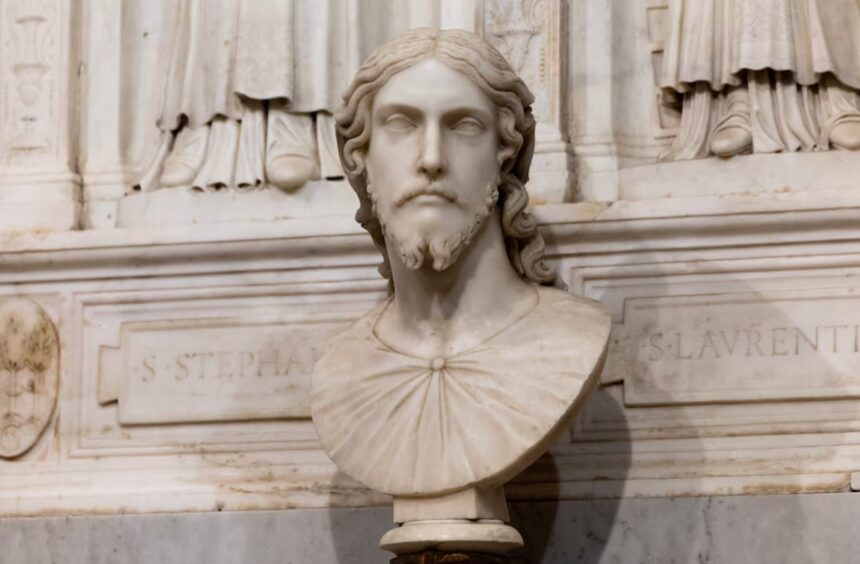
A marble bust that has long been obscured in a Roman basilica has been re-attributed to Michelangelo after nearly two centuries of anonymity. This remarkable sculpture, depicting Christ the Saviour, has been housed in the Basilica of Sant’Agnese fuori le mura, nestled along the historic Via Nomentana.
Once credited to the Renaissance master, the bust lost its identification in the early 19th century and remained unrecognised until recent investigations led by independent researcher Valentina Salerno. Her meticulous research, which draws upon archival documents rather than just stylistic analysis, has revitalised interest in this long-forgotten work.
Salerno, who is also part of the Vatican committee celebrating Michelangelo’s 500th birthday, unveiled her findings during a press conference. “We have lived here since 1412, and the monumental complex of Sant’Agnese always holds surprises — this is one of them,” remarked Franco Bergamin from the Order of Lateran Canons Regular.
Salerno’s approach is unique; she describes herself as an investigator rather than an art historian. “I am not an art historian — in fact, I don’t even have a university degree — but the strength of my research lies in its reliance on public archival documents,” she explained. This focus on documented evidence has challenged previous narratives surrounding Michelangelo’s later years, particularly the claim that he systematically destroyed his works.
Intriguingly, Salerno’s documents indicate that Michelangelo was careful in transferring his creations within a trusted circle after his death. “At Michelangelo’s death, every powerful ruler would have wanted to claim something of the master. But the artist carefully devised the transfer of the material in his possession so that his art could be passed on to his pupils and thus to future generations,” she said.
One particularly fascinating document describes a locked room, accessible only with multiple keys, designed to safeguard valuable materials. While this room was later cleared, the contents were tracked through subsequent transfers, revealing a discreet network through which unattributed works were moved to religious institutions and other secure locations.
The Sant’Agnese bust is believed to be part of this intricate process. Integrated into the basilica’s liturgical space, the sculpture has endured through centuries of renovations, remaining largely untouched until its recent rediscovery. Now, it graces an altar in a side chapel, protected by an alarm system to ensure its preservation.
Salerno’s findings not only breathe new life into the bust’s history but also lay the groundwork for a broader initiative to identify other forgotten works by Michelangelo. Her research aims to progressively return lost pieces to the artist’s oeuvre and share these significant findings with the international scholarly community.