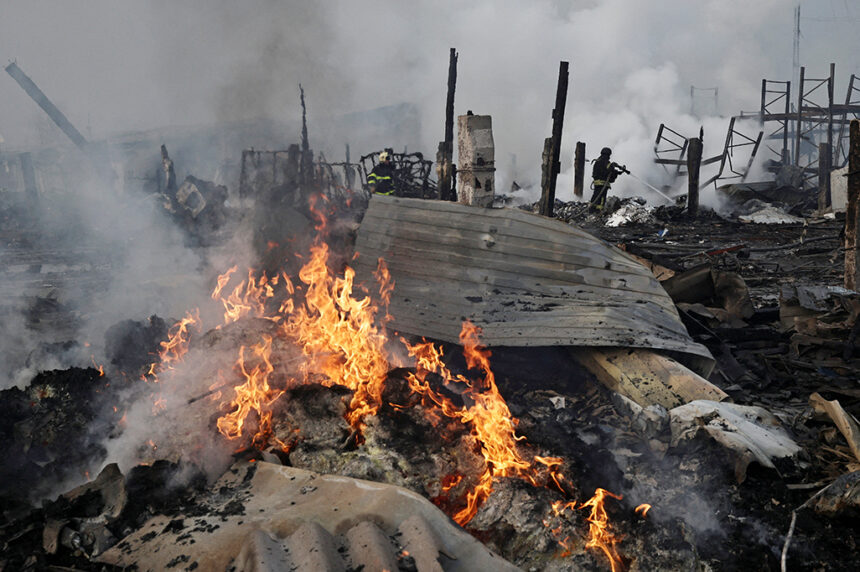
russian drone — A large-scale Russian drone and missile attack significantly disrupted Ukraine’s power and transport sectors, with officials reporting damage to facilities across eight regions. This escalation reflects a troubling trend as Russia intensifies its assaults on Ukraine’s energy infrastructure, particularly as winter approaches and the conflict nears its fourth anniversary.
According to the International Atomic Energy Agency (IAEA), the attacks have resulted in blackouts and forced the country’s nuclear power plants to reduce their output. Ukraine relies heavily on its three nuclear plants, which generate more than half of its electricity. The IAEA noted that the plants had to cut production due to the extensive military activities reported overnight.
The Ukrainian military provided a stark account of the situation, stating that Russia launched 653 drones and 51 missiles in a single night. Ukrainian forces successfully intercepted a significant portion of this assault, downing 585 drones and 30 missiles. However, the sheer scale of the attack underscores the persistent threat to Ukraine’s energy security.
Key regions affected included Chernihiv, Zaporizhzhia, Lviv, and Dnipropetrovsk, where power and heat generation facilities were targeted. The Ministry for Development of Communities and Territories reported that approximately 9,500 customers were left without heating and around 34,000 without water supply in the Odesa region. Additionally, port facilities in Odesa experienced attacks that led to parts of the infrastructure being de-energised, forcing operators to rely on backup generators.
Efforts to restore power are underway, with the energy ministry stating that emergency repairs are being conducted wherever safety allows. The situation remains precarious, with ongoing military activities complicating restoration efforts.
The railway infrastructure was not spared either; a crucial hub near Kyiv sustained significant damage, impacting both depot and railway carriages. Ukrzaliznytsia, the state railway company, reported several cancellations of suburban trains near both Kyiv and Chernihiv as a result of the strikes. Thankfully, there were no reported casualties from these attacks.
Ukrainian Foreign Minister Andrii Sybiha condemned the continued strikes on critical civilian infrastructure, highlighting Russia’s disregard for peace efforts. He urged that decisions to bolster Ukraine and apply pressure on Russia should not be delayed, particularly under the guise of ongoing negotiations.
In a statement, the Russian Defence Ministry claimed the strikes were a response to Ukrainian attacks on civilian targets, employing high-precision, long-range weapons, including Kinzhal hypersonic missiles and long-range drones. The ministry asserted that the targets included military-industrial enterprises and energy facilities supporting these operations.
Amid the chaos, Poland’s response included scrambling jets after sirens alerted citizens in Lubartow, although the Operational Command confirmed there were no violations of Polish airspace. This response illustrates the broader regional implications of the conflict, as neighbouring countries remain vigilant amid the escalating hostilities.