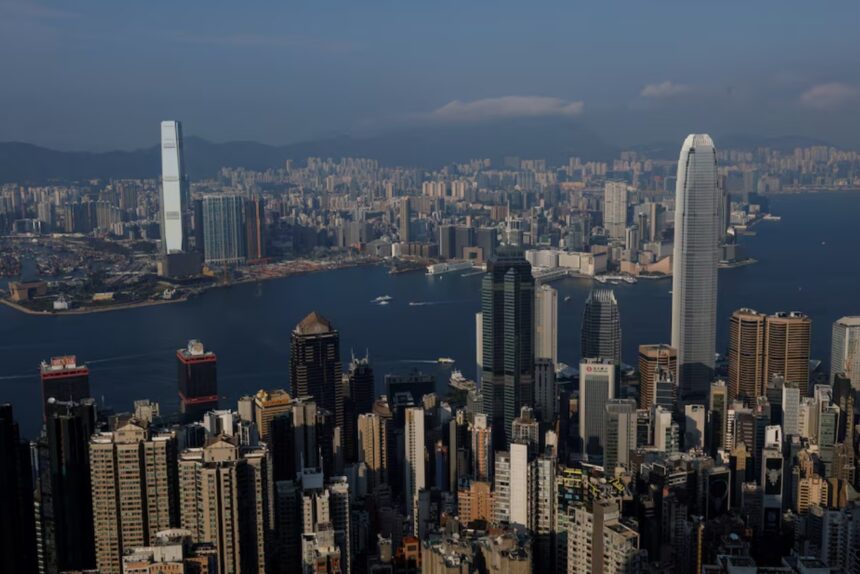
debt wall — Hong Kong developers face an escalating financial crisis as the looming debt wall reaches $7.1 billion next year, with bond maturities surging nearly 70 per cent. The city’s vital property sector, already struggling with declining sales and valuations, is bracing for more turbulence as the first developer defaults on bond coupons since the onset of China’s property debt crisis in 2021.
- Lai Sun Development (0488.HK) also faces pressure, with 4 million due next year. Both companies declined to comment on their situations, reflecting the uncertainty that hangs over the sector.
Last week, Road King (1098.HK) became a notable casualty, marking a significant moment for the industry. This follows earlier defaults by Emperor International (0163.HK), highlighting the mounting pressures on local property firms. Analysts warn that the already slim chances for a rebound in the commercial property sector are diminishing further, leaving many developers unable to meet their repayment obligations.
Property and related sectors are crucial to Hong Kong’s economy, contributing roughly a quarter of its GDP. With increasing non-payments, the repercussions extend beyond individual developers, impacting creditors such as HSBC (HSBA.L), which has substantial exposure to the struggling sector.
According to data from LSEG and calculations by Reuters, local developers’ bond repayments will rise dramatically from $4.2 billion this year to $7.1 billion in 2026. Edward Chan, an analyst at S&P Global Ratings, cautioned that the likelihood of more small developers defaulting in the next 12-24 months is increasing as banks tighten their lending. “It will be at a point where there is actually no chance for them to repay such loans,” Chan remarked.
Developers, primarily holding office and retail properties, are under severe strain due to falling asset valuations, which have plummeted more than 50 per cent since their peaks in 2019. With no recovery in sight, the pressure to liquidate assets only leads to further declines in valuations, creating a vicious cycle that affects even financially stable developers.
Among the major players facing significant repayment challenges is New World Development (0017.HK), one of Hong Kong’s top four developers. It has $168 million due next year and another $630 million in 2027. Despite averting default through an $11.2 billion debt refinancing deal in June, the company remains a notable risk to the financial landscape.
Lai Sun Development (0488.HK) also faces pressure, with $524 million due next year. Both companies declined to comment on their situations, reflecting the uncertainty that hangs over the sector.
The financial strain is evident in the banking sector as well. Hang Seng Bank (0011.HK) reported a staggering HK$2.5 billion charge related to commercial real estate in the first half of this year, a 224 per cent increase from the previous year. HSBC acknowledged a tripling of loans classified as high risk, totalling $18.1 billion as of June, though it emphasised that this classification does not automatically indicate defaults.
Despite rising concerns, Eddie Yue, head of Hong Kong’s de-facto central bank, reassured that the banking system remains well-capitalised, with sufficient provisions and financial strength to endure market fluctuations. However, some banks are adopting a cautious approach, refraining from categorising defaulted loans and delaying demands for immediate repayments from struggling developers.
Market observers note that this strategy aims to avoid exacerbating the crisis and worsening asset quality across the sector. JLL Hong Kong’s chair, Joseph Tsang, explained that banks are seeking to buy time for a potential market recovery, but curtailing lending to developers could also hinder broader economic activity.