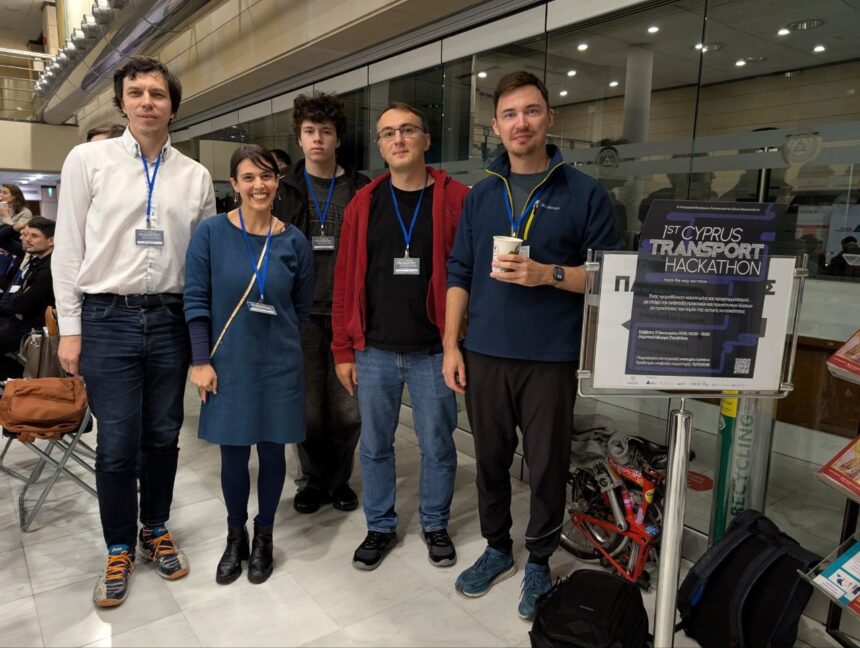
bus tracking — An innovative AI-driven approach to bus tracking emerged victorious at the inaugural Cyprus Transport Hackathon, addressing a critical issue in the island’s public transport system. Held on January 17, 2026, at the Strovolos municipal hall, this one-day event gathered 26 teams, each tasked with finding scalable solutions to ongoing urban mobility challenges.

Photo: cyprus-mail.com
This hackathon, co-organised by the Ministry of Transport, the Municipality of Strovolos, the University of Cyprus, and other key organisations, sought to reimagine transportation in Cyprus under the inspiring motto, ‘Hack the way we move’.

Photo: cyprus-mail.com
Among the problems teams tackled was the persistent unreliability of GPS tracking for buses, which has long frustrated both transport authorities and passengers. Igor Akimov, a member of the winning team, explained that GPS signals often become distorted or fail completely, causing buses to appear to ‘teleport’ on tracking apps, sometimes even inaccurately showing them in neighbouring countries.
Akimov elaborated on the nature of the issue, stating, “Yes, it usually happens because of a regional GPS jamming, as well as local discrepancies near embassies or bases.” Such failures not only disrupt the experience for passengers but also complicate operational processes for transit agencies. As he noted, the impact is significant, affecting scheduling, fuel auditing, and funding.
The team aimed to rectify this with an AI prediction system that leverages historical transport data and crowdsourced input from passengers. Rather than relying on static timetables, the model dynamically adjusts based on various data, including past bus movements, traffic conditions, and even local holidays.
During the hackathon, the team successfully developed a machine-learning model alongside its API and web/mobile integrations, all completed within a single day. Akimov recounted the challenges faced in adapting their solution to meet the official data format, which required significant adjustments due to local data peculiarities.
Despite the constraints of time, the team’s prior experience with transport data proved invaluable in constructing their solution. Akimov remarked, “Data is always a problem,” highlighting the necessity of government support for ensuring stability in the system year-round.
The winning project not only secured the €3,000 prize but also opened doors for further collaboration. Akimov emphasised that the real victory lies in the recognition of the problem’s urgency for transit operators and government bodies. Discussions during the hackathon have already led to commitments for better access to operational data, potentially paving the way for integration into existing systems.
Looking forward, the team aspires to roll out their AI solution as a public service accessible to all stakeholders, including government agencies and app developers worldwide. Akimov expressed optimism about the future, stating, “I hope so,” regarding the goal of making the system widely usable.
While the timeline for deployment depends on data availability, Akimov suggested that with well-prepared data, implementation could occur within 1-2 weeks. He noted that this solution is not limited to Cyprus; it could be adapted for use in other countries as well.
The hackathon also highlighted the vibrant ecosystem of developers working on public transport solutions in Cyprus. Akimov acknowledged the collective efforts of other independent developers, such as those behind the website busonmap, which offers real-time bus location services.
However, he pointed out that the adoption of these innovative solutions has faced hurdles, particularly in terms of governmental acceptance of pro bono initiatives. Despite this, the successful outcome of the hackathon may encourage a shift in attitude towards collaboration with the tech community.
Reflecting on their motivation to participate in the hackathon, Akimov mentioned that all team members are regular bus users. They seized the opportunity to contribute meaningfully to a cause that directly affects their lives and the lives of other citizens in Cyprus. “We want to make sure all the governmental bodies understand they are not alone!” he asserted, voicing the readiness of the tech community to assist.