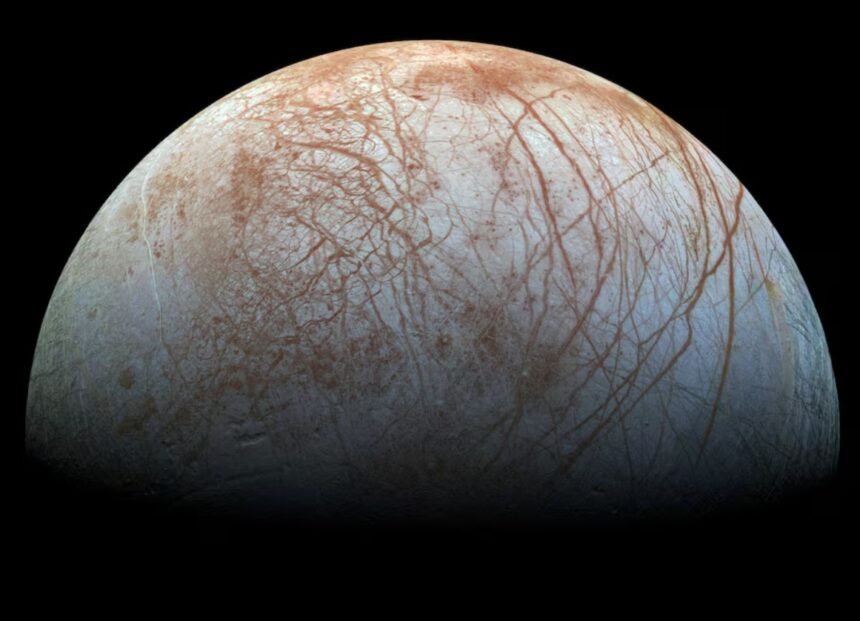
Jupiter’s moon Europa has long been considered a leading candidate in the quest for extraterrestrial life due to its vast subsurface ocean, but recent research raises significant doubts about its habitability.
- “In short, there probably isn’t the kind of geological activity happening on Io taking place deep within Europa,” Byrne concluded.
New Findings Challenge Previous Assumptions
A study published in the journal Nature Communications examines the potential for tectonic and volcanic activity on Europa’s ocean floor, which are crucial processes that contribute to the generation of essential nutrients and chemical energy for life. Researchers modelled the moon’s conditions and concluded that its rocky seafloor is likely too rigid to support such activity.
Key Factors in the Assessment
The research team, led by planetary scientist Paul Byrne of Washington University in St. Louis, analysed several factors including Europa’s size, the composition of its rocky core, and the gravitational forces exerted by Jupiter, the largest planet in our solar system. Their findings suggest that limited tectonic activity may render Europa’s seafloor inhospitable to life.
“On Earth, tectonic activity such as fracturing and faulting exposes fresh rock to the environment where chemical reactions, principally involving water, generate chemicals such as methane that microbial life can use,” Byrne explained. “Without such activity, those reactions are harder to establish and sustain, making Europa’s seafloor a challenging environment for life.”
Comparative Geological Activity
Byrne also highlighted the importance of geological activity for the emergence of life, drawing parallels with Earth’s hydrothermal vents. Life on Earth may have originated in these dynamic environments, which provide a rich source of chemical energy. However, Europa appears to lack similar features.
“Based on our findings, the seafloor would probably not contain major tectonic landforms, such as long ridges or deep troughs. There would likely not be any underwater volcanoes or seamounts, and we would not have any hydrothermal activity such as black smokers,” said Christian Klimczak, a geologist from the University of Georgia and co-author of the study. “Having said that, I hope I will stand corrected one day.”
Europa’s Characteristics and Composition
With a diameter of approximately 1,940 miles (3,100 km), Europa is slightly smaller than Earth’s moon. Beneath its icy shell, estimated to be 10–15 miles (15–25 km) thick, lies an ocean potentially 40–100 miles (60–150 km) deep. This makes Europa the fourth largest of Jupiter’s 95 recognised moons and suggests that its ocean may contain twice the volume of water found in Earth’s oceans.
Despite its challenges, Europa does possess some characteristics deemed essential for supporting life. According to Byrne, “There are three major factors thought to be critical for supporting life: liquid water, organic chemistry and energy.”
“Europa’s subsurface ocean satisfies the first requirement. We’ve identified organic chemicals on this moon’s exterior icy shell, and there may very well be such chemicals inside the ocean. So that’s the second requirement. And Europa’s particular orbit means that Jupiter drives tidal heating within Europa – requirement three,” he added.
Future Exploration Plans
In 2024, NASA launched the Europa Clipper spacecraft, which is set to conduct a series of close flybys beginning in 2031. This mission aims to gather more data to assess whether Europa has conditions suitable for life.
“While geology operates similarly across the solar system, every planetary body that we have explored has been found to have some unique processes. Given what we know about Europa, it is still the best place to look for extraterrestrial life,” Klimczak stated.
The Effects of Jupiter’s Gravitational Forces
Jupiter’s immense gravitational pull affects its numerous moons in various ways. For example, Io, which is the innermost large moon, is known to be the most volcanically active body in the solar system. This is due to strong tidal forces generated by Jupiter and other moons, which create internal friction and heat.
However, Europa’s position further from Jupiter means that the impact of tidal heating diminishes rapidly with distance. Although there is sufficient tidal heating to prevent Europa’s ocean from freezing solid, the calculations suggest that it is not enough to cause significant tectonic deformation of the ocean floor.
“In short, there probably isn’t the kind of geological activity happening on Io taking place deep within Europa,” Byrne concluded.
A Glimpse into Europa’s Past
The study focused solely on Europa’s current conditions, but there are indications that the moon may have been much more geologically active in the distant past. Byrne speculated that, billions of years ago, Europa could have been a habitable environment before conditions changed and the chemical energy necessary for life became depleted.
“There are reasons to think that Europa might once have been much more geologically active than it is today, albeit a few billion years ago,” he said. “So perhaps for a time that world really was just not habitable but actually inhabited, before those conditions changed.”