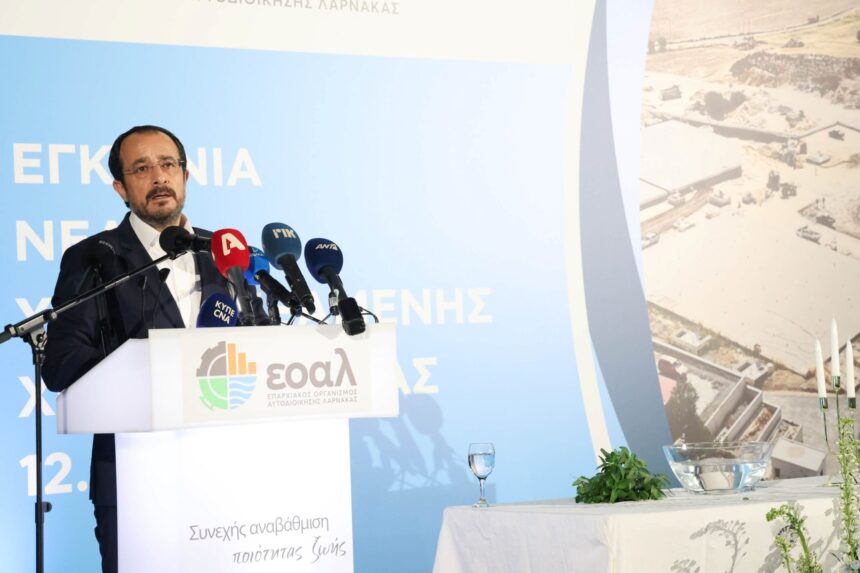
Cyprus aims to achieve water self-reliance by 2028 through the installation of two permanent desalination units. President Nikos Christodoulides announced this ambitious plan on Tuesday during the inauguration of a new water reservoir in the Larnaca district. He emphasised the government’s commitment to addressing water scarcity and managing water resources effectively.
- This conflict highlights the ongoing debate surrounding the government’s approach to water management and the urgency of implementing sustainable solutions.
Water self-reliance: Strategic Importance of Water Management
“The effective treatment of water scarcity and the rational management of water resources are of utmost importance and a strategic priority for the government,” President Christodoulides stated. He highlighted the challenges posed by climate change, noting that climate models predict a temperature increase in Cyprus that could reach twice that of other regions. Additionally, he pointed out that average annual rainfall has decreased by approximately 10 to 15 per cent since the mid-1990s, further exacerbating water issues on the island.
Expansion of Desalination Facilities
To combat these challenges, the Council of Ministers recently agreed upon the establishment of three more desalination units, expected to be operational by summer 2026. These units are projected to increase the water supply from desalination by 32 per cent, significantly bolstering Cyprus’ water resources.
In addition, President Christodoulides announced plans to launch studies for two permanent desalination units powered by renewable energy before the end of 2025. He stated, “With the operation of two additional permanent desalination units, our goal is for Cyprus to be able to cover 100 per cent of its water needs by 2028 instead of the current 70 per cent.” This strategic move marks a significant step towards enhancing the island’s resilience against water shortages.
Infrastructure Developments
The construction of additional tanks and reservoirs is also on the agenda, akin to the new facility in Larnaca. This infrastructure is deemed crucial for the entire island as it seeks to improve its water storage capabilities and management practices.
President Christodoulides underscored Cyprus’ vulnerability to climate change, emphasising the necessity of building water resilience given the likelihood of longer and more frequent droughts. He pointed to ongoing projects in areas such as Polis Chrysochous and Kokkinokremmos, which are integral to safeguarding the water supply across Cyprus. He also mentioned an additional 31 water-related projects scheduled for 2026, further reflecting the government’s proactive stance on water management.
Current Water Supply Challenges
Despite these optimistic plans, Cyprus currently faces significant challenges in water management. The island’s dams are operating at merely 11 per cent of their capacity, raising concerns about the effectiveness of current water policies and management strategies. This situation has drawn sharp criticism from various sectors, including political opposition.
Political Reactions and Criticism
In a recent meeting of the House agriculture committee, Disy MP Kyriacos Hadjiyianni expressed his dissatisfaction with the government’s actions, labelling it a “disability government” for not addressing the water crisis more effectively. His comments sparked a heated exchange with the permanent secretary of the agriculture ministry, Andreas Gregoriou, who defended the administration’s efforts, insisting that Cyprus had “not been left without water.”
This conflict highlights the ongoing debate surrounding the government’s approach to water management and the urgency of implementing sustainable solutions.
Looking Ahead: A Sustainable Future
The government’s commitment to enhancing water self-reliance through desalination and renewable energy sources illustrates a forward-thinking approach to one of Cyprus’ most pressing challenges. By 2028, the aim is for Cyprus to not only meet its water needs but to do so sustainably, ensuring that future generations have access to this vital resource.
As plans unfold, the success of these initiatives will depend on effective implementation and community support. The ongoing dialogue between government officials and citizens will be crucial in navigating the complexities of water resource management and achieving the ambitious goals set forth by President Christodoulides.