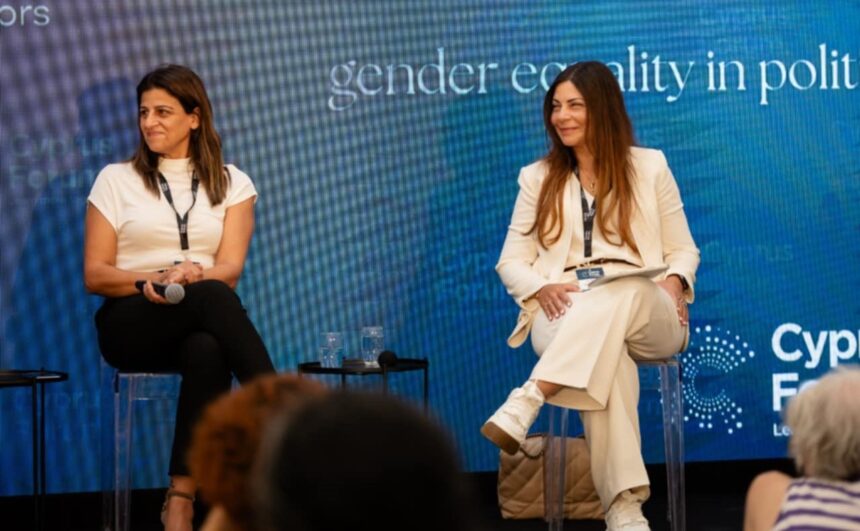
Gender equality in politics cannot be achieved without systemic reforms that dismantle cultural barriers, ensure safe participation and embed accountability, speakers at the Cyprus Forum said on Thursday.

Photo: in-cyprus.philenews.com
- In closing, Evangelides quoted activist Angela Davis: “I am no longer accepting the things I cannot change. I am changing the things I cannot accept.”
Commissioner for Gender Equality Josie Christodoulou, CFA board member Dr. Stella Mourouzidou Damtsa, and advocate and Secretary of the Board of ACCEPT LGBTI Stefanos Stavros Evangelides highlighted structural obstacles holding back women’s political representation. They urged closer cooperation between government, political parties, business, and civil society.
Christodoulou pointed out that progress remains uneven, with women accounting for 37% of ministers and deputy ministers, yet only 14% of MPs and none of Cyprus’s members of the European Parliament. She remarked that representation at the local authority level is also very low, stating, “When we are missing the experiences of half the population, it means that we do not represent society in its entirety.”
To boost female participation, Christodoulou proposed a holistic approach. Suggestions included reconciling family and professional life through workplace childcare, establishing a political academy for women and young people, and ensuring safe conditions free of harassment and toxic rhetoric. “Women who are less risk takers than men — why should they risk their careers, their family life, their health, in order to enter politics?” she asked.
Dr. Mourouzidou Damtsa presented research illustrating the benefits of diverse teams, highlighting improvements in decision-making and profitability. However, notable gaps persist, with women representing only 19% of managers in Cyprus compared to 37% in the EU. She also noted the gender pension gap in Cyprus stands at 39%, significantly higher than the European average of 29%. “A woman who also lives longer than men has to make her pension last longer,” she remarked.
Emphasising the importance of mentorship programmes, Mourouzidou Damtsa identified them as crucial pathways for younger women to enter leadership roles. She also pointed to pending legislation, such as the EU Pay Transparency Directive, set to take effect in 2026, as an opportunity to narrow pay and pension disparities. “Companies should hire on merit, not gender, and measure inclusion with clear metrics — just as we track ESG,” she stated.
Christodoulou noted that Cyprus is preparing to transpose EU rules on gender quotas for listed companies, describing it as “a precedent we can use for other issues as well.” However, she stressed that quotas must be paired with cultural change. “If we don’t dismantle stereotypes and patriarchal structures, we are just fixing part of the system. Quotas by themselves will not work,” she asserted.
The panel also explored global political trends, with Evangelides warning that leaders such as Donald Trump and Jair Bolsonaro have rolled back diversity programmes by framing them as elitist or divisive. In response, Christodoulou suggested that diversity advocates must engage in self-criticism. “Perhaps we treated DEI as a box-ticking exercise without substantial change. We need to recreate our own narrative,” she said, emphasising that women are “not a minority but half of the population.”
Mourouzidou Damtsa addressed misconceptions surrounding diversity policies, asserting that DEI was created to enforce meritocracy. She encouraged individual contributions towards shifting mindsets, stating, “Each of us should open doors, share knowledge and challenge biases.”
In closing, Evangelides quoted activist Angela Davis: “I am no longer accepting the things I cannot change. I am changing the things I cannot accept.”