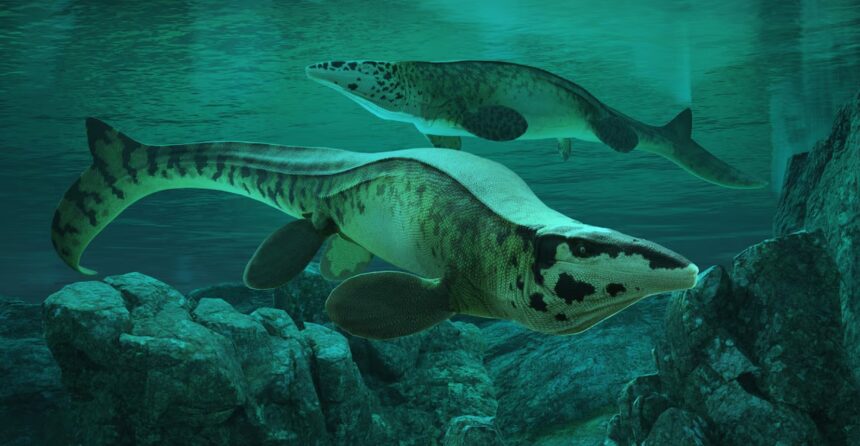
Tylosaurus rex stands out as the T. rex of the sea, an apex marine predator that roamed the oceans during the Cretaceous Period. This formidable marine reptile rivalled its land counterpart not only in size but also in ferocity.
- “I’m impressed by modern Komodo dragons,” Zietlow added, “I can barely imagine what it would have been like to be near something many times bigger and even more hateful – said with love.”
Recent research has identified Tylosaurus rex as a distinct species following an extensive examination of fossil records. Key characteristics defining this marine giant include its massive size, serrated teeth designed for efficient flesh-cutting, and robust musculature in its jaws and neck, enabling it to overpower large prey.
Tylosaurus rex: A Glimpse into the Past
Around 66 million years ago, Tyrannosaurus rex dominated the land of Western North America. In contrast, Tylosaurus rex ruled the waters about 80 million years ago, inhabiting an inland sea that sliced through North America. This seafaring predator was equipped with a streamlined body, elongated snout filled with large teeth, four paddle-like flippers, and a powerful tail that facilitated swift movement through the water.
Fossil Discoveries and Distinct Characteristics
The Tylosaurus genus has been known since the 19th century, with various species identified, including Tylosaurus proriger. A genus groups closely related species sharing similar traits, akin to how lions and tigers belong to the same genus yet are distinct species.
The largest specimen of Tylosaurus rex, affectionately named Bunker and housed at the University of Kansas Biodiversity Institute and Natural History Museum, measures approximately 43 feet (13.2 metres) long. Initially classified as Tylosaurus proriger, Bunker was re-evaluated and reclassified as Tylosaurus rex based on its unique anatomical features.
Impressive Size and Strength
Paleontologist Amelia Zietlow, the lead author of a study published in the Bulletin of the American Museum of Natural History, remarked on the impressive size of Tylosaurus rex, noting that its skull alone measures 5 feet 7 inches (1.7 metres) long. This significant size illustrates the reptile’s dominance in its aquatic environment.
Relation to Modern Reptiles
Tylosaurus rex belongs to the mosasaur group, marine reptiles that evolved from land-dwelling lizards to become apex predators in the oceans during the last 30 million years of the dinosaur age. Present-day monitor lizards, including the Komodo dragon, are considered some of the closest living relatives to Tylosaurus rex.
“I’m impressed by modern Komodo dragons,” Zietlow added, “I can barely imagine what it would have been like to be near something many times bigger and even more hateful – said with love.”
Size Comparisons with Modern Predators
Ron Tykoski, a co-author of the study and vice president of science at the Perot Museum of Nature and Science in Dallas, emphasised the sheer size of Tylosaurus rex, stating it would have been twice the length of today’s largest great white sharks. “Imagine standing, or more appropriately swimming, next to a 35 to 45 foot (10.7 to 13.7 metres) long marine Komodo dragon,” he said. “Would you say that would be pretty danged impressive?”
Geographical Distribution of Fossils
The fossils attributed to Tylosaurus rex primarily originate from north and central Texas, while Bunker was discovered in Kansas. The holotype specimen, which is the fossil utilised to formally designate a species, is housed at the Perot Museum.
A Name with Significance
The name Tylosaurus rex translates to “king of the tylosaurs,” paying homage to its land counterpart, Tyrannosaurus rex, which is recognised as an extraordinary creature in its own right. Though these two T. rexes did not coexist, their evolutionary paths intersected in remarkable ways.
Apex Predators of Their Time
While Tyrannosaurus rex preyed on the largest animals on land, Tylosaurus rex mastered hunting in the sea. “Strong muscles and serrated teeth suggest that Tylosaurus rex was preying on other large animals, likely other marine reptiles and large fish, and ripping them to pieces,” Zietlow explained. The Tylosaurus species were known for their wide-ranging diet, not limited to any specific type of prey, but rather focused on consuming other animals.