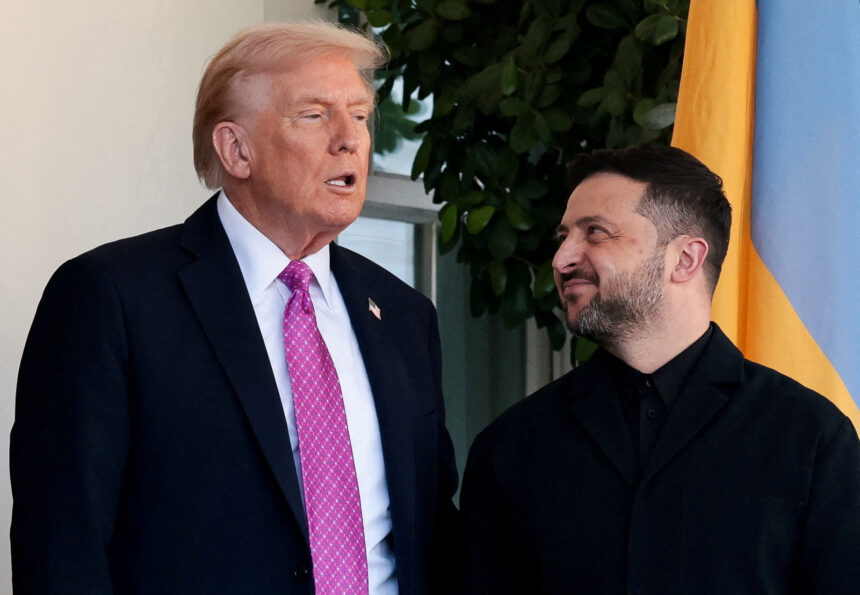
The focus keyword, Zelenskiy, is at the centre of discussions as he seeks military support from United States President Donald Trump during a pivotal White House meeting. Zelenskiy arrived in Washington with a clear agenda: to secure arms that would bolster Ukraine’s military capabilities amidst a protracted conflict with Russia that has now entered its third year.
During their meeting on Friday, Trump appeared hesitant about the prospect of providing long-range Tomahawk missiles to Ukraine. Instead, he suggested that such military support may be unnecessary if he can broker a peace deal with Russian President Vladimir Putin, whose summit is set to occur in the coming weeks.
Zelenskiy’s urgent plea for increased military aid comes against the backdrop of escalating hostilities in Ukraine, where Russian forces have gained ground this year. While speaking to reporters, Zelenskiy candidly expressed the challenges of negotiating a ceasefire, stating, “We want this. Putin doesn’t want [it].” He underscored the urgency of his request by mentioning that Ukraine is prepared for an offensive, equipped with thousands of drones but lacking the essential Tomahawk missiles.
Trump’s response to Zelenskiy was mixed. While he acknowledged the request for Tomahawks, he framed the discussion within the broader context of his role as a potential mediator between Ukraine and Russia. Trump remarked, “We’d much rather have them not need Tomahawks,” suggesting a preference for diplomatic solutions over military escalation.
The dynamics of this meeting were further complicated by Trump’s upcoming summit with Putin. Analysts have raised concerns regarding the implications of Trump’s conciliatory tone towards Russia, questioning whether it might delay or diminish the likelihood of military assistance to Ukraine. A spokesperson for the European Union has welcomed the talks, emphasising the importance of dialogue in achieving peace in Ukraine, yet there remains trepidation that a deal could ultimately favour Moscow.
In the lead-up to the meeting, Trump had noted that he had spoken with Putin, hinting that there are ongoing discussions about the situation in Ukraine. However, the details of that conversation have not been disclosed, leaving the international community speculating about the nature of Trump’s engagement with the Kremlin.
Despite the ongoing conflict, where Russia has reportedly occupied nearly 20% of Ukraine, Zelenskiy remains hopeful that a peace agreement can be reached. He highlighted the need for constant pressure on Russia’s military capabilities, stating that while Tomahawk missiles would not be a panacea, they would significantly level the playing field. Mykola Bielieskov, a senior analyst at the Ukrainian non-governmental organisation Come Back Alive, echoed this sentiment, emphasising that the goal is to disrupt Russia’s military-industrial complex rather than expect an immediate collapse of Russian forces.
The situation is fluid, and the Trump administration has shown signs of frustration with Putin in recent days. There have been indications that the U.S. may consider bolstering Ukraine’s military support, including the much-debated Tomahawk missiles. However, the internal debate within the administration remains unresolved, with some officials cautioning that no decision has yet been finalised.
As the geopolitical landscape evolves, the interplay between military support, diplomatic negotiations, and the ongoing conflict in Ukraine continues to capture the attention of investors and analysts alike. With the spectre of a peace summit looming, the coming weeks will be crucial in determining the trajectory of U.S. foreign policy in the region and its implications for global stability.