Worker bees build a ‘royal palace’ for the honeybee queen, a revelation that changes our understanding of how one bee rises to the role of colony matriarch. Traditionally, it was believed that the diet of royal jelly alone determined which larvae would develop into queens. However, new research highlights the significance of the specially constructed wax chambers created by worker bees as a crucial factor in this transformation.
Royal palace: New Insights into Queen Bee Development
The study, published in the journal Nature, reveals that the physical and chemical properties of the wax chambers play an essential role in shaping the future queen. Kai Wang, a scientist at the Institute of Apicultural Research at the Chinese Academy of Agricultural Sciences, noted, “A royal diet means nothing without a royal palace.” This statement underscores the intricate relationship between the environment and nutrition in determining a bee’s role within the colony.
Engineering the Perfect Environment
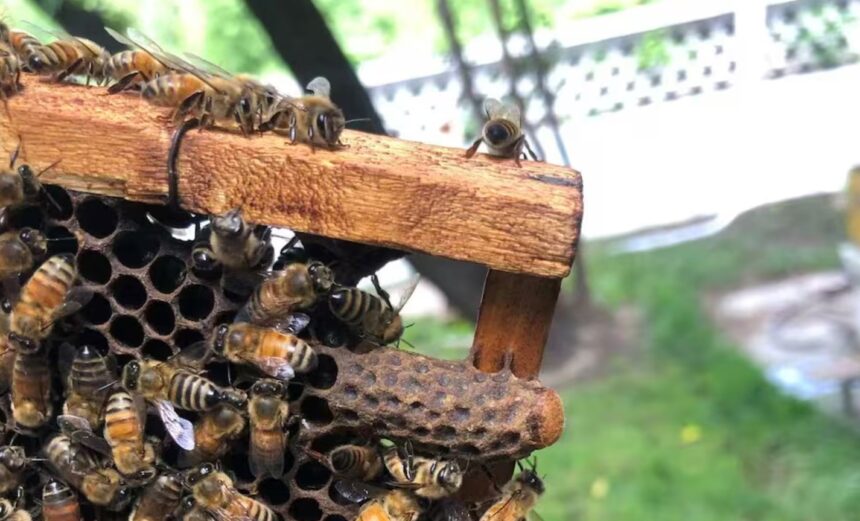
Honeybee nests, primarily constructed from wax secreted by female workers, feature hexagonal cells for various purposes, including food storage and rearing offspring. Notably, the colonies also build unique chambers for future queens, which resemble peanut shells and hang downward from the comb. Previously regarded as simple containers, these chambers are now understood to function as actively engineered “smart incubators.”
The Role of Wax Characteristics
The research indicates that the chambers designated for future queens possess distinctive physical and chemical characteristics. The wax used is softer and melts at a higher temperature, providing conditions that promote the larva’s development toward becoming a queen. Wang explained that the softer walls allow the larva to expand, while the unique chemical “perfume” emitted by the wax may act as a hormonal trigger for development.
Findings on Larval Survival
Interestingly, larvae raised in the traditional worker cells, even when fed royal jelly, experienced poorer survival rates and lower success in developing into queens. This suggests that the specific “smell and feel” of the royal wax is vital for the survival and transformation of the larvae. The study highlights the importance of both nutrition and environmental factors in the developmental pathway of honeybee queens.
Temporary Roles of Worker Bees
The study also reveals fascinating insights into the worker bees responsible for constructing these royal chambers. Contrary to assumptions that these bees belong to a specialised caste, Wang describes them as “ordinary, flexible young workers.” These bees momentarily take on this critical role, exhibiting short-term shifts in gene expression that enable them to process the high-melting-point wax. They maintain their everyday hive tasks, such as feeding nestmates and inspecting other cells, while performing this specialised job.
Challenging Long-Standing Beliefs
Wang’s findings challenge the previously accepted notion that the nutritional aspect of royal jelly was the sole determinant in the making of a queen. He emphasised the need to further explore the specific elements of the wax that trigger the necessary changes in the larvae’s DNA, stating, “The next step is to find the molecular switch: which specific chemical scent or physical touch actually tells the queen larvae’s DNA, ‘You are the queen.’”
Implications for Beekeeping and Ecology
The implications of this research extend beyond understanding bee biology; they could also aid beekeeping practices. Boris Baer, a professor of pollinator health at the University of California, Riverside, highlighted the importance of healthy queens for maintaining robust colonies. Managed honey bees are crucial for pollinating over 80 major agricultural crops, and insights into how colonies naturally produce high-quality queens could bolster efforts to support resilient bee populations amid declining colony health reports.
The Honeybee Colony as a Superorganism
Wang’s research underscores the concept of the honeybee colony as a “superorganism,” where collective efforts shape the future of the colony. As he poignantly summarised, “Eating well is important, but living in the perfect home is what truly changes your destiny.” This perspective highlights the intricate interplay between individual bees and their environment in determining the structure and success of the hive.
Looking to the Future
The study opens avenues for further research into other social insects, suggesting that similar mechanisms may exist in termite mounds and wasp nests. The intricate wax nests of stingless bees may also reveal secrets about how colonies manage their development. As we deepen our understanding of these relationships, we may uncover more about the complex social structures and life cycles of these remarkable insects.