sea wrecks — sea wrecks — UNHCR, the International Maritime Organisation (IMO), and the International Chamber of Shipping (ICS) have jointly issued a revised rescue guide aimed at addressing the alarming number of shipwrecks involving refugees and migrants at sea. The guide, titled Rescue at Sea: A guide to principles and practice in the context of refugee and migrant movements, arrives at a critical juncture as tragic incidents continue to highlight the urgent need for enhanced international cooperation to avert further loss of life.
The updated guide delineates the humanitarian and legal responsibilities of all entities involved in maritime rescue. It emphasises that rescuers must provide assistance to those in distress without discrimination, ensuring that they are safely disembarked in secure locations.
This release coincides with the 75th anniversary of the 1951 Refugee Convention, a moment the organisations say reinforces the moral and legal imperative to save lives at sea. Elizabeth Tan, Director of UNHCR’s Division of International Protection and Solutions, stated, “The revised Rescue Guide is a practical tool to help uphold one of the clearest moral and legal duties at sea: to rescue refugees and migrants in distress and bring them to safety.”
Tan further articulated the collective commitment of UNHCR, IMO, and the shipping industry to assist states in their primary role of safeguarding lives at sea. She asserted, “Nobody risks their life at sea, or that of their family, unless desperate to find safety and stability in the absence of safer pathways.” She firmly believes that the tragic shipwrecks are not inevitable and can be prevented.
According to UNHCR data, the Mediterranean Sea remains one of the deadliest routes for migrants, with 1,953 individuals reported dead or missing in 2025 alone. Similarly, the South and South-East Asia route saw 892 fatalities, marking it as the deadliest passage for Rohingya refugees attempting perilous sea crossings. The Western Africa Atlantic route also recorded 424 lives lost last year, illustrating that the dangers extend far beyond the Mediterranean.
The revised guide builds on the previous edition released in 2015, offering enhanced clarity on legal standards and practical procedures necessary for swift rescues and secure disembarkation. It underscores the importance of ensuring that rescued individuals are taken to locations where they won’t encounter serious risks, including the threat of refoulement.
Available in six languages—Arabic, Chinese, English, French, Russian, and Spanish—the guide serves as a global resource for shipmasters, ship owners, state authorities, insurance companies, and various stakeholders involved in rescue operations.
IMO Secretary-General Arsenio Dominguez highlighted the ongoing humanitarian tragedy of lives lost at sea, while also acknowledging the critical contributions of coast guards, navies, and search and rescue agencies. He remarked, “We must recognize the tireless efforts of coast guards, navies, search and rescue agencies, and merchant vessels in rescuing individuals in distress at sea—preventing an even higher death toll.” Dominguez asserted that established legal obligations need to result in concrete actions, and the revised guide provides necessary clarity for governments and practical steps for maritime crews.
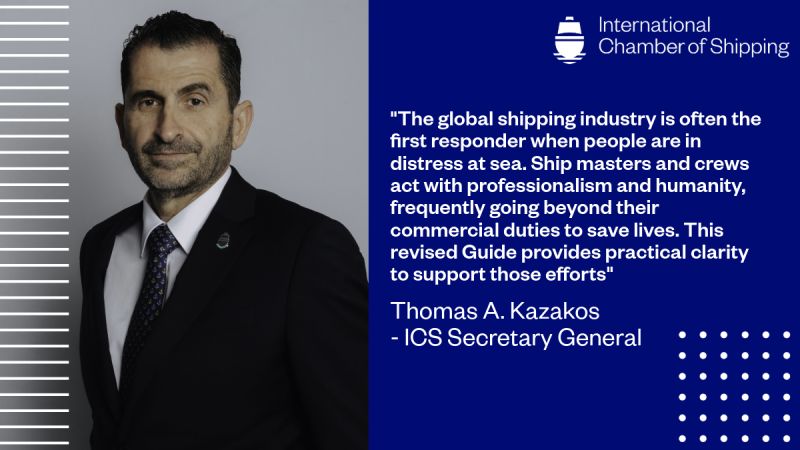
ICS Secretary General Thomas A. Kazakos affirmed the global shipping industry’s role as a primary responder to distress situations at sea. “Ship masters and crews act with professionalism and humanity, frequently going beyond their commercial duties to save lives,” he noted. Kazakos concluded that the revised guide aids in ensuring that rescues are conducted safely, predictably, and in compliance with international law, reinforcing the collective responsibility among states and stakeholders for timely disembarkation.