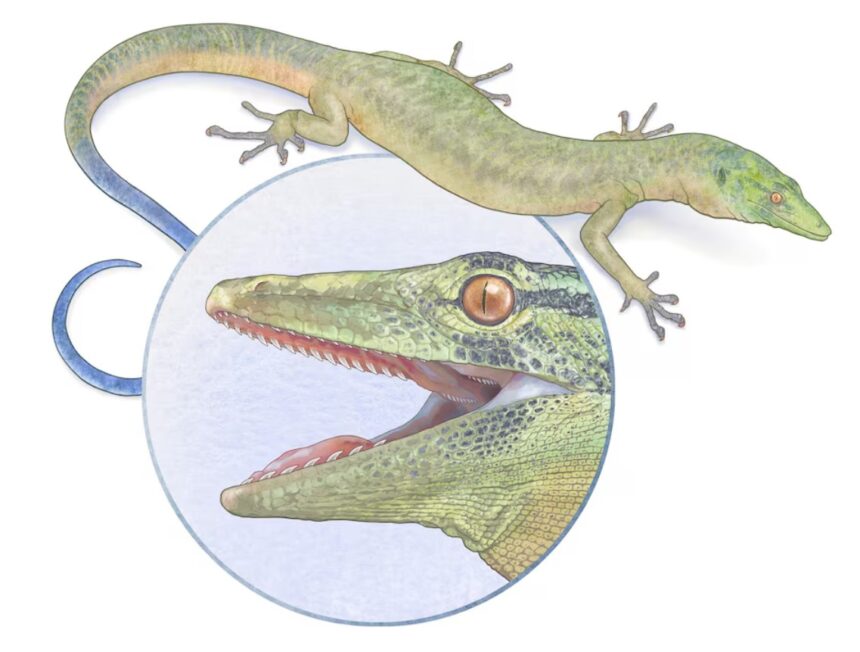
The newly discovered fossil of a small reptile, Breugnathair elgolensis, has scientists intrigued due to its unique mix of snake and lizard characteristics. This fascinating creature lived in Scotland during the Jurassic Period, approximately 167 million years ago, and its discovery raises important questions about the evolutionary history of these reptiles.
Breugnathair elgolensis: A Formidable Predator
Measuring around 12 inches (30 cm) in length, including its tail, Breugnathair inhabited an environment akin to a mangrove swamp, characterised by tropical conditions that were significantly warmer than today’s Scotland. Its diet likely included a variety of prey, such as insects, small mammals, amphibians, and other lizards. Researchers believe this reptile was a formidable predator in its ecosystem.
Mosaic of Features
Breugnathair exhibits a striking combination of features that blur the lines between snakes and lizards. Its teeth are sharply curved and hook-like, reminiscent of those found in snakes. The method of tooth implantation into its jaws, along with the inward-leaning angle of the teeth, further indicates snake-like adaptations. However, its body and head proportions are more akin to lizards, featuring well-developed limbs.
Evolutionary Enigma
Paleontologist Roger Benson, from the American Museum of Natural History, describes Breugnathair as either a lizard-like ancestor of snakes or a member of a more primitive lizard group that independently evolved snake-like features due to a predatory lifestyle. The evidence is so closely balanced that researchers have yet to determine which of these alternatives is correct. This ambiguity underscores the complexity of early squamate evolution.
Insights into Squamate Evolution
Breugnathair is considered one of the oldest relatively complete fossils from the squamate group, which includes both lizards and snakes. The study, published in the journal Nature, reveals the intricate evolutionary pathways that may have led to the development of snakes. The earliest known indisputable snakes date to approximately 110 million years ago, during the Cretaceous Period, when they had already evolved distinct long bodies and reduced limb structures.
Unanswered Questions
Despite the insights gained from Breugnathair, many questions remain. Researchers are still uncertain whether snakes evolved their long, characteristic bodies or their distinctive head and jaw traits first. Additionally, the precise ecological context in which snakes first emerged is still a mystery. Benson mentions that while DNA evidence indicates that snakes are related to iguanas, monitor lizards, and certain other lizard groups, Breugnathair does not share many features with these relatives.
A Surprising Discovery
Instead, Breugnathair displays primitive characteristics that are more closely aligned with some of the earliest lizards, as well as traits found in contemporary groups like geckos and skinks. This surprising revelation challenges existing assumptions about the lineage of snakes and suggests a more intricate evolutionary history.
Fossil Discovery and Significance
This remarkable fossil was discovered on the Isle of Skye, near the coastal town of Elgol. The scientific name, Breugnathair elgolensis, translates to “false snake of Elgol,” reflecting its intriguing blend of traits. If Breugnathair is not part of the snake lineage, it may have represented an evolutionary dead end, with its snake-like hunting methods arising separately in a group that eventually became extinct.
Future Research Directions
As researchers continue to study Breugnathair, they hope the findings will guide future excavations and analyses of fossils to better understand snake ancestry. Susan Evans, a co-leader of the study and a paleontologist at University College London, emphasises that this discovery may ultimately aid in identifying what traits to look for in future fossils.
The exploration of Breugnathair revitalises interest in the early evolutionary history of reptiles and highlights the complexities of their development. As scientists unravel the mysteries surrounding this creature, they may uncover new insights into the origins of snakes and their adaptations.