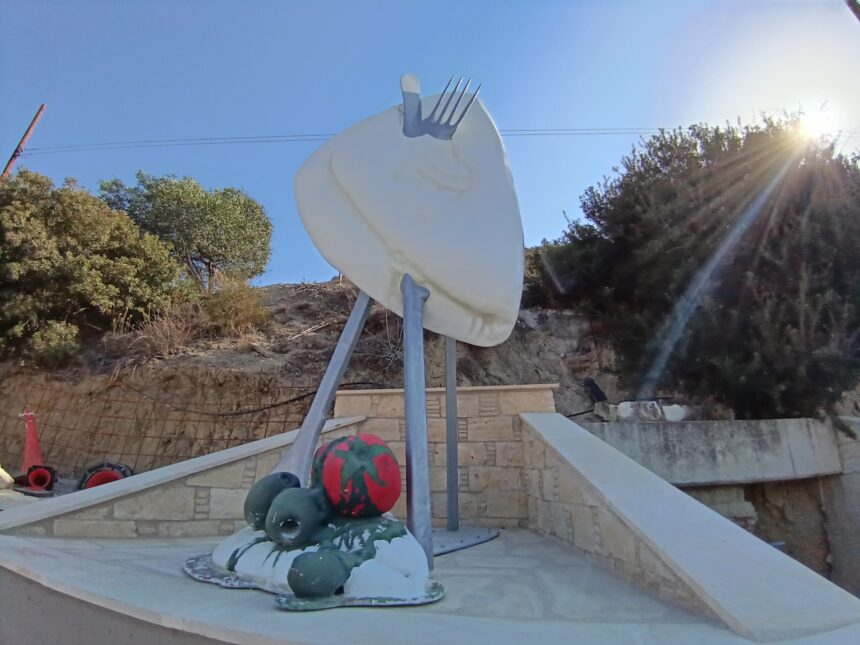
The recent unveiling of a halloumi statue in Pissouri has reignited the long-standing debate over the origins of this beloved cheese. The monument, located at the entrance of the village’s new House of Halloumi museum, has drawn significant attention online and raised questions about branding and heritage in a community proud of its culinary traditions.

Photo: cyprus-mail.com
Controversy Surrounding Halloumi’s Name
The controversy has its roots in the use of the name ‘Pissourkotiko,’ which some local producers argue implies that halloumi originated in Pissouri. Iakovos Kesses, owner of Kesses dairy in nearby Avdimou, has voiced concerns regarding the branding. “Christis used the name ‘Pissourkotiko’ without asking anyone,” Kesses stated. “Halloumi didn’t start in Pissouri; it was made across Cyprus.”

Photo: cyprus-mail.com
Kesses highlighted that halloumi has been produced in various forms across the island, including districts like Famagusta, Limassol, and Nicosia. “In all districts, they made different kinds of halloumi: there was no ‘first’ halloumi of Pissouri,” he added, emphasizing the diverse heritage of the cheese.
Growing Fame of Pissouri
As Pissouri garners attention for being the only village in Cyprus with a dedicated halloumi statue, many are questioning why this village has become the focal point for a product that is integral to the entire island. The statue, made of fibreglass and donated by Swedish residents Paul and Christian, now serves as a landmark guiding visitors to the museum, which boasts stunning views of the surrounding hills.
Community leader Panayiotis Mavroudis addressed the origins of halloumi directly, stating, “Halloumi does not start in Pissouri. Pissouri just has its own type of halloumi. Everyone in Cyprus makes halloumi.” His remarks highlight the shared cultural significance of the cheese, irrespective of its geographical ties.
Perceptions of the Statue
The unveiling of the statue has sparked a mixture of curiosity and critique on social media, reminiscent of the discussions that arose when other food monuments, such as the giant potato in Xylophagou and the giant strawberry in Dherynia, were erected. Mavroudis remarked, “A statue or a decorated potato is not a monument for me. It does not offer anything substantial for the tourist.” He believes that the focus should be on the new museum and its potential to educate visitors about halloumi.
“The important thing is not the statue,” he continued. “It’s to open the workshop and have them do good work. If the workshop functions well, allowing visitors to see the process and taste the halloumi, then it is worthwhile.”
Tourism and Cultural Significance
Lia Anastasiou, the interior designer of the House of Halloumi museum, emphasised that the aim is to create an engaging introduction to local culture. “It is not the usual boring museum, as you can see from the huge halloumi outside,” she said, highlighting the need for an immersive experience.
Maria Parperi, an incoming tourism agent, noted that visitors are increasingly seeking hands-on activities. She echoed Mavroudis’ sentiments about the workshop, asserting that demonstrations of halloumi production, paired with tasting sessions, could enhance visitors’ experiences significantly. “Pissouri has always been part of the Cypriot tradition, but halloumi didn’t start there,” she reiterated.
Acknowledging the Diverse Production
Panicos Hadjicostas, a halloumi production adviser at Lefkonitziatis dairy, confirmed that while Pissouri has a genuine tradition in halloumi production, it is not exclusive. He explained, “Major production is done through organised dairy industries, and there are also new producers entering the sector.” This diversification has contributed to halloumi’s status as Cyprus’ top agricultural product.
The Future of Food Monuments in Cyprus
The rise of food monuments in Cyprus has captured national attention, with Culture Deputy Minister Vasiliki Kasianidou asserting that such structures can support cultural identity when developed thoughtfully. “Food monuments can be connected to a more organised strategy of cultural identity or remain isolated initiatives,” she explained to the Cyprus Mail.
However, she cautioned that some monuments have appeared without official approval, which raises questions about their legitimacy and impact on local culture. “Approval from authorities, like town planning and the antiquities department, is necessary to cover part of the cost and ensure legality,” she concluded.
As the debate over halloumi’s origins continues, the statue in Pissouri serves as a reminder of the complex interplay between local pride, cultural heritage, and the broader narrative of Cyprus’ culinary identity.