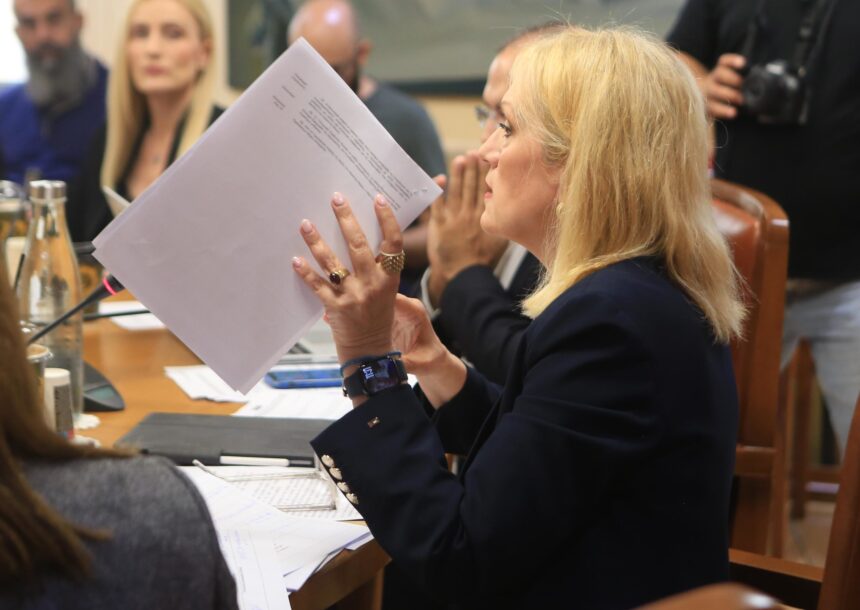
protest law — The Organisation for Security and Cooperation in Europe (OSCE) is set to examine a contentious protest law in Cyprus, as announced by House Human Rights Committee chairwoman Irene Charalambides during a tumultuous parliamentary session.

Photo: in-cyprus.philenews.com
The invitation comes in the wake of clashes over the violent suppression of a pro-Palestine protest that took place last week. Charalambides, who also holds a vice-presidential position at the OSCE, highlighted that the committee had sought the organisation’s opinion on the law governing assemblies and marches, which was passed by parliament in July.

Photo: in-cyprus.philenews.com
In September, the OSCE delivered a detailed 32-page opinion addressing concerns about vague terminology in the legislation and excessive responsibilities placed on protest organisers. Emphasising the need for clarity, the OSCE recommended merging categories of spontaneous and emergency assemblies, setting explicit limits on police intervention, and ensuring the right to assemble without the threat of imprisonment.
During the session, tensions escalated when parliamentarian Giorgos Koukoumas referenced the recent protest against the Gaza flotilla, prompting sharp exchanges with Justice Minister Marios Hartsiotis and fellow parliamentarian Christos Senekis. Koukoumas expressed concerns that the law and its implementation posed significant problems for demonstrators.
Hartsiotis defended the law’s philosophy, asserting that it does not prohibit assembly and only requires organisers to inform authorities of planned demonstrations. He stated, “Nowhere in the law does the verb ‘prohibited’ appear. Where is the terror law? The junta? The silencing?” He insisted the law was designed to facilitate rather than hinder protests.
In response to the OSCE’s opinion, Hartsiotis pointed out that many of its recommendations were already reflected in existing legislation. He noted inaccuracies in the OSCE’s assessment, particularly regarding police authority to cancel protests or arrest demonstrators, which he claimed do not exist in the law.
Despite his criticisms, Hartsiotis expressed openness to potential amendments, including those related to organiser notification timing and clarifications on the treatment of isolated acts of violence during protests. He reiterated that the legislation’s core principles remain intact, stating, “We will proceed with necessary improvements and are open to dialogue.”
The session highlighted the deep divisions surrounding the law, with Koukoumas asserting that the previous protest served as a trial run for the law’s application. Deputy Police Chief Panicos Stavrou defended the police’s actions during the protest, clarifying that their aim was to guide demonstrators rather than dissolve the gathering.
Hartsiotis contrasted Cyprus’s regulations with those of other European nations, noting that countries like Greece and Germany impose stricter controls over protests. He questioned the consistency of the opposition’s stance, pointing out that members of the same political party had submitted contradictory proposals regarding the law.
The ongoing debate reflects broader tensions in Cypriot society over the balance between maintaining public order and protecting the right to peaceful assembly, particularly in the context of global events that resonate locally.