ai focus — Nvidia and AMD’s focus on artificial intelligence is creating supply challenges for high-performance computing, particularly for nuclear security work at Sandia National Laboratories.
- ai focus — Nvidia and AMD's focus on artificial intelligence is creating supply challenges for high-performance computing, particularly for nuclear security work at Sandia National Laboratories.
At Kirtland Air Force Base in New Mexico, liquid-cooled supercomputers are engaged in critical simulations to support the US government’s nuclear arsenal. For over a decade, the chips powering these essential tasks have primarily come from Nvidia and AMD, two giants in the semiconductor industry.
However, as both companies pivot towards AI, the managers at Sandia are facing uncertainty regarding their access to the necessary computing power for precision scientific work. Steve Monk, who leads Sandia’s high-performance computing team, expressed concerns about the current pressures on computing capabilities and the supply chain, saying, “The pressure we’re feeling right now is on the computing front and also from the supply chain.”
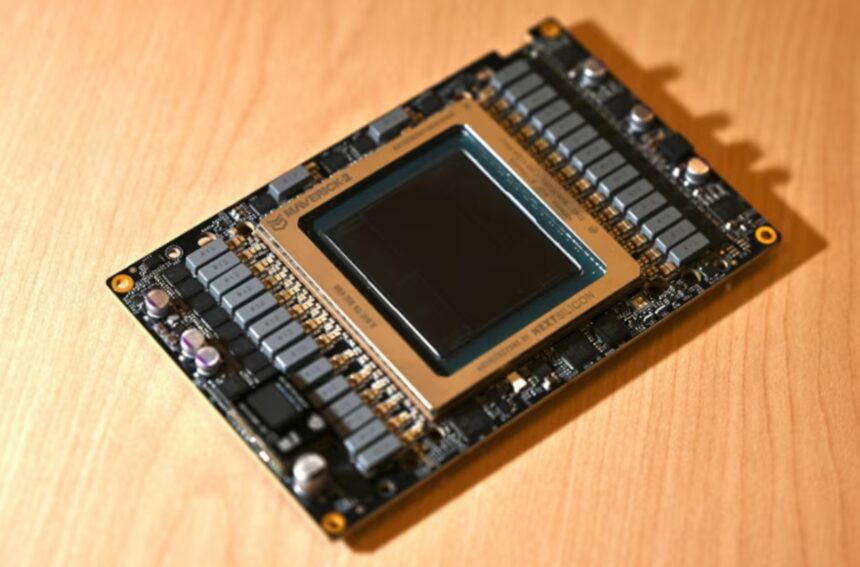
This shift in focus has opened the door for smaller semiconductor firms to enter the market. Among them is NextSilicon, an Israeli startup whose technology is currently under evaluation at Sandia. The lab’s collaboration with NextSilicon reflects a broader strategy to ensure access to diverse computing solutions, especially as traditional suppliers adapt their offerings to AI.
A major technical challenge for Sandia involves double-precision floating point computation, which is vital for accurate calculations in physics simulations. While Nvidia and AMD have historically excelled in this area, their recent developments for AI applications have diminished their double-precision performance, raising red flags among scientists. Ian Cutress, chief analyst at More Than Moore, highlighted that many in the high-performance computing sector are concerned about Nvidia’s Rubin chips, which may not meet the same standards as previous models.
Despite these concerns, Nvidia maintains its commitment to scientific computing. Daniel Ernst, the company’s senior director of supercomputing products, stated their goal is to develop a balanced chip that can serve both scientific and AI needs. Yet, the changing landscape has prompted Sandia to explore alternative solutions, including testing chips from NextSilicon that employ a novel computing architecture distinct from the conventional GPUs and CPUs offered by larger companies.
Recent advancements have been promising. On Monday, Sandia, along with NextSilicon and Penguin Solutions, announced that their collaborative systems passed a significant technical milestone. This success positions NextSilicon’s chips as contenders for future government applications, pending further testing on more complex nuclear security problems.
NextSilicon’s technology boasts the ability to perform efficient double-precision computing while dynamically reprogramming itself for enhanced performance. Its data flow architecture significantly reduces power consumption by minimising data movement, which is crucial for high-demand applications like those at Sandia.
Historically, Sandia has played a pivotal role in advancing computing technologies. It was instrumental in promoting liquid cooling systems for chips, a concept that has now become standard in the industry. James Laros, a senior scientist at Sandia, emphasised the importance of collaboration with smaller firms like NextSilicon, stating, “We have to keep available options to complete our mission, because the mission is not optional.”