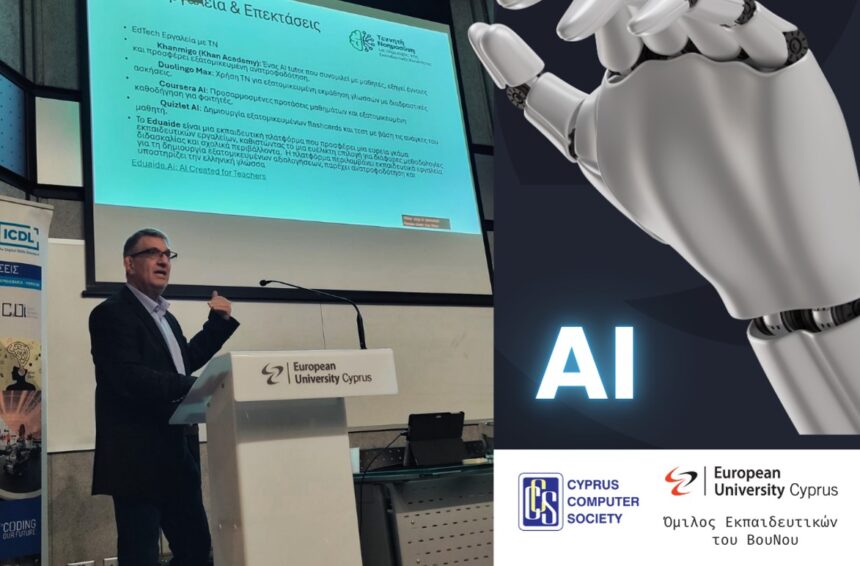
Artificial intelligence was the focal point of a recent public lecture in Nicosia, where educators and technology professionals gathered to explore its potential to support teaching and learning. The European University Cyprus hosted the event titled “Artificial intelligence as an ally of the educational community,” aiming to foster dialogue on how education systems can adapt in the face of rapid technological advancements.
Engaging Discussions on AI in Education
Held earlier this month, the lecture drew a diverse audience, including educators, school administrators, students, and members of the technology sector. The packed Amphitheatre B demonstrated a growing interest within Cyprus’ educational community in understanding how artificial intelligence can be responsibly integrated into classrooms.
Insights from a Seasoned Educator
Michalis Tortouris, a respected educator with extensive experience in both secondary and tertiary education, led the presentation. He is known for his contributions to computer science and educational innovation. During his talk, Tortouris provided an optimistic yet realistic perspective on the role AI can play in enhancing the educational landscape.
Historical Context and Modern Applications
Beginning with a brief historical overview, Tortouris traced the conceptual origins of artificial intelligence back to Aristotle, before discussing its contemporary characteristics and applications. He highlighted how AI can enhance personalised learning experiences, allowing students to progress at their own pace through tailored content and immediate feedback.
Promoting Inclusion and Equality
Tortouris emphasized AI’s potential to foster inclusion and equality in education. He explained that accessibility tools, translation functions, and voice support can enable students with learning difficulties, disabilities, or language barriers to engage meaningfully in the classroom. This perspective aligns with the growing recognition of the need for equitable educational practices in a diverse society.
Ethics and Responsibility in AI Integration
The ethical implications of integrating AI into education formed a significant part of the discussion. Tortouris stressed the importance of guiding technology use, insisting that educators must serve as the moral compass in ensuring safe, transparent, and privacy-respecting applications of AI. As educational institutions adopt new technologies, maintaining ethical standards becomes paramount.
Practical Applications for Educators
During the lecture, Tortouris introduced a range of practical applications for educators, including intelligent worksheets, visual content creation tools, voice assistants, and adaptive learning platforms. These resources can be readily incorporated into teaching practices, providing educators with new ways to enhance their students’ learning experiences.
A New Era for Education
Looking to the future, Tortouris articulated a hopeful view of AI’s role in education, asserting that it does not threaten traditional teaching methods but rather helps them evolve. “The artificial intelligence is not the end of education as we know it, but the beginning of a new era where the educator remains the guide, the mentor and the moral compass of learning,” he stated. His remarks resonated with the audience, reinforcing the belief that AI can be a valuable ally in educational settings.
Commitment to Continuous Professional Development
Tortouris further noted that the meaningful use of AI in education requires pedagogical wisdom, critical thinking, and a commitment to ongoing professional development. As technology continues to change the educational landscape, educators must remain adaptable and informed about the tools at their disposal.
Engaging Audience Participation
The lecture concluded with dynamic audience engagement, during which attendees discussed the practical challenges and opportunities that AI presents for schools and universities. Participants shared insights on how technology can serve as a valuable ally when applied with vision, responsibility, and a human-centred approach.
Collaborative Efforts in Education
This event was co-organised by the Cyprus Computer Society, the European University Cyprus, and the group Educators of Vou.Nou, highlighting the collaborative efforts in the educational sector to explore the integration of artificial intelligence. As interest in AI continues to grow, discussions like these will be crucial in shaping the future of education in Cyprus and beyond.