The Maritime Cyprus 2025 Conference has concluded, highlighting innovation and regulation as pivotal forces in shaping the future of shipping.

Photo: cyprus-mail.com
- The Maritime Cyprus 2025 Conference has concluded, highlighting innovation and regulation as pivotal forces in shaping the future of shipping.
On Wednesday, the final day of the event, discussions centred on maritime safety, climate resilience, and technological advancements. European Commissioner for Fisheries and Oceans, Costas Kadis, opened the day with a keynote address, underscoring the European Union’s commitment to supporting the green and digital transitions in shipping.

Photo: cyprus-mail.com
Kadis commended Cyprus for its role as a maritime services hub, aligning closely with the EU’s vision for sustainable ocean governance through the European Ocean Pact. He outlined forthcoming initiatives, including a European Maritime Industrial Strategy and an EU Port Strategy, aimed at enhancing competitiveness and fostering investment in renewable technologies.
Maritime cyprus: Addressing Climate Resilience in Shipping
The conference featured a panel led by Phillip Belcher, Marine Director at INTERTANKO, focusing on climate resilience within the shipping industry. The discussion included insights from Manuela Tomassini of the European Maritime Safety Agency, Jan Othman from Wärtsilä, and Gavin Allwright, Secretary General at the International Windship Association.
Panelists explored the balance between decarbonisation goals and practical adaptation strategies. They emphasised the need for global consistency, technology-neutral regulations, and investment in seafarer training to facilitate the transition to new fuels and propulsion systems.
Navigating a Rapidly Changing Environment
In a separate session moderated by Sean Moloney, industry leaders discussed how shipowners can adapt to the intertwined challenges of decarbonisation, digitalisation, and geopolitical pressures. Mark O’Neil, President and CEO at Columbia Shipmanagement, along with other experts, highlighted the necessity for closer integration between owners and managers amidst evolving compliance and safety demands.
The importance of seafarer welfare was a recurring theme, with panellists advocating for a modern portrayal of seafaring as an attractive and secure profession. They argued that investment in people and adaptability to new technologies will be crucial for future ship management.
Technology’s Transformative Role
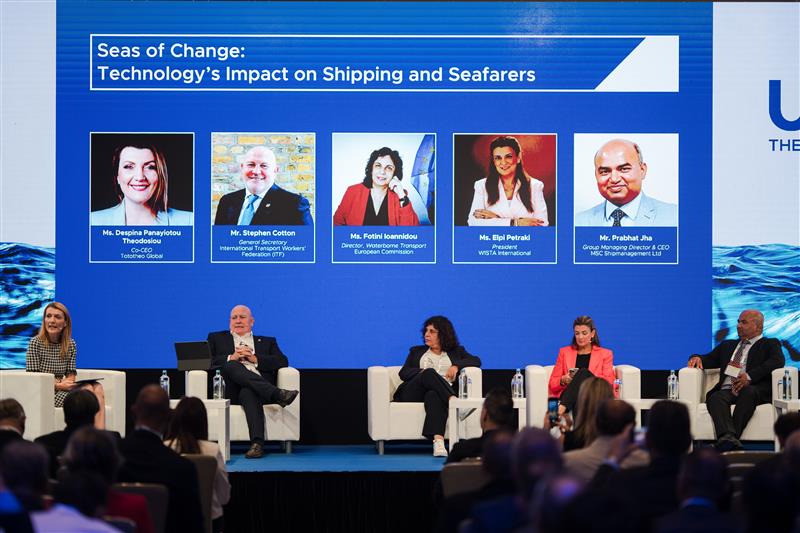
The day also featured a session titled “Seas of Change: Technology’s Impact on Shipping and Seafarers,” led by Despina Theodosiou, Co-CEO at Tototheo Global. Participants, including Stephen Cotton from the International Transport Workers’ Federation and Fotini Ioannidou from the European Commission, examined the implications of digitalisation and automation on seafarer welfare and training.
Speakers agreed that while technology can enhance operational efficiency, it must not replace the human element. They stressed the importance of standardised systems and inclusive workforce development to ensure equitable access to technology and protect the wellbeing of seafarers.
The Future of Shipping Finance
In a presentation on shipping finance, Konstantinos Petropoulos from Piraeus Bank discussed the evolving landscape shaped by geopolitical fragmentation and regulatory tightening. He acknowledged the increasing role of Asian lenders while noting that Greek and Cypriot banks view shipping as strategically important.
Petropoulos pointed out that uncertainty regarding a clear pathway for the green transition presents both challenges and opportunities for growth in sustainable investment. He underscored the need for adaptability, transparency, and responsible lending to maintain financial stability in a volatile environment.
Funding Strategies for a Sustainable Future
The final panel, moderated by Alexandros Damianidis from Watson Farley & Williams, focused on funding strategies for the next era of shipping. Industry leaders discussed how shipowners, lenders, and fund managers are adapting their financing approaches in light of tightening regulations and ESG expectations.
Panelists concurred that liquidity remains available for well-structured projects, yet smaller owners face increasing challenges in meeting compliance standards. They highlighted the rising significance of sustainability-linked loans and alternative funding models, emphasising that flexible approaches will be vital as market conditions change.
As the Maritime Cyprus 2025 Conference wrapped up, over one thousand delegates reflected on the importance of collaboration and innovation in addressing the maritime industry’s future challenges. Participants left with a shared commitment to fostering a sustainable and resilient global maritime sector.