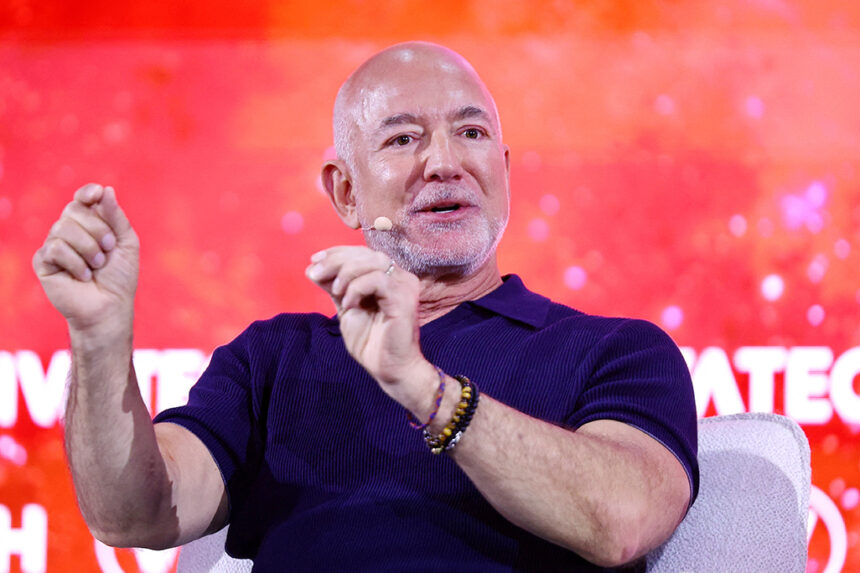
Artificial Intelligence will lead to labour shortages, not the replacement of humans, according to Amazon founder Jeff Bezos during his address at the VivaTech technology conference in Paris on Wednesday.
Labour shortages: A Vision for the Future
In his optimistic remarks, Bezos outlined a future where technology, particularly AI, enhances human capabilities rather than undermines them. He expressed confidence that the advancements in AI would generate new opportunities and alleviate existing barriers that limit human productivity.
The Role of AI in Employment
Bezos addressed the prevailing concerns about AI replacing jobs, stating, “I know there’s a lot of concern that many people have, including many smart people, that AI is going to make humans redundant and so on. I totally disagree with this point of view. And I think, in fact, AI is going to create a labour shortage.” His comments come amidst a backdrop of significant job cuts in various sectors as companies integrate AI technologies to improve efficiency.
Job Cuts Linked to AI
Recent reports highlight a startling trend: U.S.-based employers announced 97,006 job cuts in May alone, with AI linked to 40% of these layoffs, according to Challenger, Gray and Christmas, a global outplacement firm. This raises questions about the immediate impact of AI on the workforce. A Reuters/Ipsos poll revealed that half of Americans fear the rise of AI could threaten their jobs or those of someone in their household.
Resistance to AI Integration
Resistance to AI adoption is surfacing across various demographics, from new entrants in the job market to established unions. South Korean carmakers and Hollywood scriptwriters have expressed concerns about the implications of AI, advocating for more cautious and considered approaches to its integration within their industries.
Bezos on Human Potential
Despite the job cuts associated with AI, Bezos remains optimistic about the potential for human creativity and labour. He argues that there are “endless” tasks for people to undertake and that AI will help eliminate obstacles currently hindering productivity. He believes that the integration of AI could lead to a renaissance of human endeavour, creating more fulfilling job opportunities.
Amazon’s Job Reduction Strategy
Reflecting on his own company, Amazon has also seen a reduction in its workforce, trimming approximately 30,000 corporate roles since late last year. This decision has been partly attributed to the efficiency gains from AI tools. Amazon’s CEO Andy Jassy has previously indicated that increasing automation through AI will inevitably lead to corporate job losses.
Bezos’ Space Aspirations
During his talk, Bezos also discussed his ambitions in space exploration through his venture Blue Origin. He envisions a future where space travel becomes reliable and affordable, allowing for the relocation of polluting industries off Earth. “If space travel gets reliable enough and inexpensive enough, and we can get materials from asteroids and near-Earth objects and the moon, then this garden planet can be returned to its pre-Industrial Revolution state,” he remarked.
Competing with SpaceX
Bezos’s vision for Blue Origin positions it as a competitor to Elon Musk’s SpaceX, which is also making headlines for its ambitious plans to colonise the moon and Mars. In a recent interview, Musk discussed the potential for creating cities on other planets and even launching AI data centres into space. The competition between these two tech giants reflects a broader ambition for space exploration and technology advancement.
Recent Developments at Blue Origin
Accompanying Bezos at the conference was Blue Origin CEO David Limp, who announced that the reconstruction of the firm’s launch pad for the New Glenn rockets is underway in Florida. This follows a significant explosion incident in May, showcasing the challenges the company faces as it strives to make progress in the aerospace industry.
Public Sentiment Towards AI
As AI continues to evolve, public sentiment remains mixed. While some embrace the potential benefits, such as improved efficiency and new job creation, others remain cautious about the societal implications and the risk of job displacement. The discourse surrounding AI is likely to continue as more industries explore its applications.
Looking Ahead
Bezos’s predictions about AI creating labour shortages rather than rendering humans obsolete may offer a glimpse into a future where technology complements human effort. As organisations navigate the complexities of AI integration, the balance between innovation and job security will be a critical factor in shaping the future workforce.