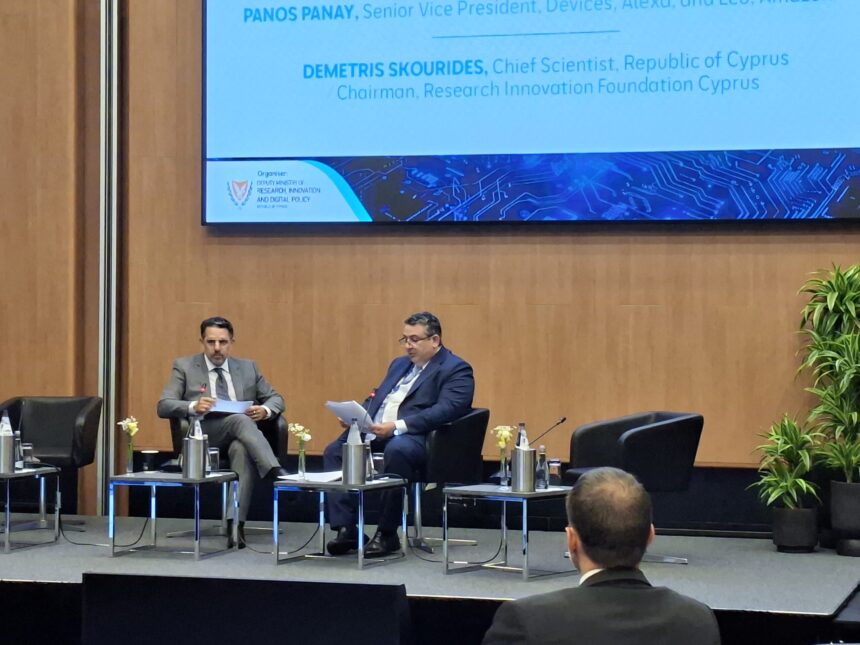
Amazon executive Panos Panay emphasised the importance of speed and connectivity for Cyprus, stating that human ingenuity is the new currency in the age of artificial intelligence. Speaking at the ‘Shaping the Next Digital Frontier’ conference in Nicosia on Wednesday, Panay urged European nations, particularly Cyprus, to leverage technological innovation to create real-world impacts.

Photo: cyprus-mail.com
The conference was part of the Cyprus Presidency of the Council of the European Union and was moderated by Demetris Skourides, chief scientist and chairman of the Research and Innovation Foundation of Cyprus. Panay, who oversees a variety of Amazon products including Alexa, Kindle, and Fire TV, argued that the ultimate goal of technology should be to simplify and enhance people’s lives.

Photo: cyprus-mail.com
“Is this going to make my customer’s life easier? It’s that simple,” Panay stated, highlighting that meaningful technology must address basic human needs rather than just introducing novelty. He noted that the fundamentals of learning and communication have not changed significantly over centuries, and technologies that facilitate these activities hold greater value.
Panay explained that a product’s long-term success can often be gauged within the first three months of its launch. The initial 30 days reveal how users engage, while patterns of increasing or declining usage by the 60-day mark indicate whether the product is likely to become integral to users’ lives.
“We have a tendency to project our instinct but you need to be able to listen to the customer,” he warned, stressing that understanding customer needs is crucial for product success. He cautioned against innovations that merely introduce change without delivering real benefits, stating, “People love to jump on the next invention and it often fails because it doesn’t make life better, just different.”
Addressing the complexities of evaluating emerging technologies, Skourides raised the issue of adoption cycles for paradigm-shifting innovations. Panay responded that innovators must be attuned to usage signals and adapt accordingly. He used autonomous vehicles as an example, affirming that the core objective remains unchanged: “It’s just that you are no longer driving, just get in and go,” he explained, adding that safety must always be a priority in such technologies.
Reflecting on his experience with Microsoft’s Surface devices, Panay shared the challenges faced during its development. He described it as a difficult period characterised by uncertainty, asserting that understanding the customer’s needs was crucial. “Once you deliver it’s in the customer’s hands,” he remarked, underscoring the importance of innovation and speed in product development.
Panay encouraged organisations to avoid perfectionism, stating, “Speed beats perfection at the moment, which is hard to admit.” He suggested that governments could emulate startup ecosystems to enhance agility in delivering solutions to citizens. “You have to ship, you have to put products in people’s hands,” he urged, reinforcing the need for practical application of technology.
During the conversation, the topic of artificial intelligence arose, with Panay asserting that AI should serve as a tool for human empowerment rather than a replacement for human capabilities. He argued for the removal of barriers preventing broader AI adoption, stating that users do not need to understand the underlying models. “Let the scientists and policymakers work things out,” he said, while acknowledging the current moment as ripe for creativity and innovation.
Panay discussed Amazon’s investment in low Earth orbit satellite connectivity, known as Amazon Leo, aimed at improving global connectivity. “All this capital expenditure is due to the need for great connectivity and connecting the world,” he explained, noting that billions lack effective communication access. He highlighted the transformative potential of space-based internet, stating, “Internet from space, either as primary or backup, changes everything.”
As Cyprus seeks to establish itself as a digital hub, Panay emphasised the need for collaboration between government, academia, and industry. He praised Cyprus for its entrepreneurial spirit and commitment to innovation, suggesting that this synergy could provide speed advantages over larger economies. “Speed matters, especially in this AI frontier era,” he declared.
Looking ahead, Panay rejected the notion that the era of significant technological breakthroughs is nearing its end. He described the current period as the beginning of a transformative generational change, stating, “We are at the beginning of a generational change, not the middle, not the end.” In closing, he expressed enthusiasm for the potential of human ingenuity, stating, “What excites me most from human ingenuity is what can come in five years’ time.”