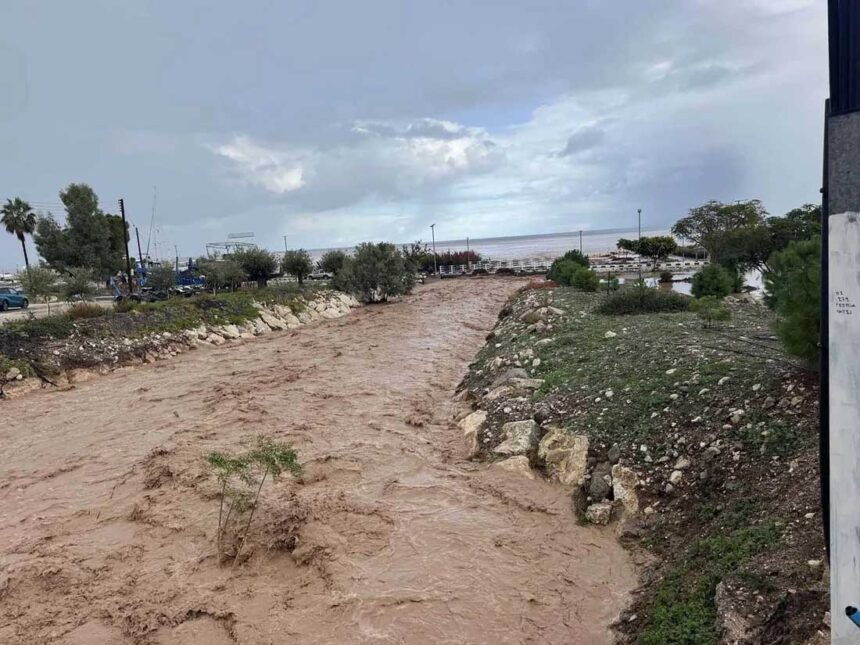
Cyprus must shift its perspective on rainwater, viewing it not as a nuisance but as a valuable resource. On December 9, 2025, Storm Byron delivered heavy downpours that overwhelmed drainage systems in Nicosia and Limassol. Streets flooded, traffic ground to a halt, and emergency services were called into action. Yet, just 48 hours later, millions of cubic metres of stormwater flowed untreated into the Mediterranean, while Cyprus’ reservoirs sat at a mere 12 per cent capacity, down from 26 per cent the previous year.

Photo: cyprus-mail.com
The government’s 2026 budget allocates €142-147 million for purchasing desalinated water, a 23 per cent increase from 2025, reflecting the dire state of water resources. Cyprus’ agriculture ministry has declared a water emergency, underscoring the urgency of finding sustainable solutions.

Photo: cyprus-mail.com
This week, as Cyprus hosts the EU’s Informal Meeting of Environment and Climate Ministers, discussions centre on the European Water Resilience Strategy. President Nikos Christodoulides has asserted that “water resilience is not an abstract concept for us; it is a daily reality.” However, despite hosting these vital conversations, Cyprus lacks mandatory rainwater harvesting infrastructure at home.
Current urban planning practices are still entrenched in outdated drainage principles, designed to rapidly divert rainwater away from urban areas. Each new building, road, and parking lot is constructed with the intention of quickly draining rainwater into storm drains, ultimately leading it to the sea. This approach is wasteful, especially given that Cyprus experiences significant rainfall during winter, concentrated in intense bursts.
The recent Storm Byron exemplifies this issue. When 50mm of rain fell in a few hours, existing drainage systems struggled to cope. A simple calculation reveals the scale of the problem: a 100 square metre hard surface in Nicosia can shed approximately 31,000-35,000 litres of water annually. In Limassol, with an average rainfall of 445mm, that figure rises to about 40,000 litres. When multiplied across thousands of buildings, the resources lost become staggering.
Take, for instance, the new Astromeritis-Evrychou highway, which has around 275,000 square metres of paved surface. With average annual rainfall of 330-340mm, this road could shed over 80 million litres of runoff each year. If redirected into bioswales and infiltration zones instead of conventional drains, this water could support 20-25 hectares of vegetation, enhancing biodiversity and aiding aquifer recharge.
This isn’t merely a result of poor policy; it stems from institutional inertia within urban planning. Engineers, planners, and contractors have been trained in 20th-century drainage principles, perpetuating a mindset that views rainwater as a nuisance rather than a resource. The legislation that could mandate modern practices is lacking. The €142-147 million allocated for desalination illustrates a flawed economic model: producing water at high costs while allowing natural rainfall to go to waste.
Desalination, costing approximately €1.00-1.50 per cubic metre, is energy-intensive and accompanied by substantial operational expenses. Cyprus faces a nationwide water loss of 29 per cent, with Nicosia’s ageing distribution pipes losing as much as 40 per cent of water before it reaches consumers. This inefficiency results in over 200 million cubic metres lost annually due to deteriorating infrastructure.
In contrast, rainwater harvesting presents a cost-effective solution. The capital costs of collection and storage can be amortised over decades, with minimal operational expenses. An annual collection of 35,000 litres from a 100 square metre roof represents free water. Experts estimate that tens of millions of cubic metres of rainfall are lost each year from developed areas, and systematic capture through rooftop cisterns and other methods could significantly reduce reliance on desalination.
International studies support this approach, showing benefit-cost ratios of 3:1 to 5:1 over twenty years by avoiding desalination costs and reducing flood damage. The logic is clear: why continue to manufacture expensive water while allowing free rainwater to flow unused into the sea?
Beyond the economic implications, there are tangible costs associated with urban flooding. Property damage, lost revenue for businesses, and the need for emergency services add significant burdens to the state. Insurance coverage for climate-related damage remains limited in Cyprus, leaving property owners at risk.
Examples from other regions illustrate what modern practice looks like. In Tucson, Arizona, Brad Lancaster implemented a “Slow, Spread, Sink” methodology, effectively reducing municipal water consumption by 75 per cent. In Singapore, the Active, Beautiful, Clean Waters Programme has retrofitted urban projects to reduce peak runoff while enhancing public spaces. Berlin and Melbourne have introduced regulations requiring certain percentages of permeable surfaces in new developments. These practices are not experimental; they are standard in water-conscious cities.
Cyprus has an opportunity to align its domestic policy with the European water resilience discussions taking place this week. Other Mediterranean nations are grappling with similar challenges, and Cyprus can lead by example. The technical solutions are already proven; what’s needed is the will to implement them.
Currently, there is no comprehensive Water Harvesting Act in Cyprus, nor is there legislation moving through parliament. The 2025 Green Construction Directive offers a bonus for rainwater systems but lacks mandatory requirements. This legislative gap must be addressed to ensure that new construction demonstrates water capture and infiltration capacity.
The delay in implementing these systems compounds the problem. The longer Cyprus waits, the more costly retrofitting becomes. With aquifer depletion already evident, the urgency for action is clear. As Storm Byron demonstrated, rainwater is a resource that, if harnessed, can alleviate the water scarcity crisis rather than exacerbate it.
Ultimately, Cyprus must confront outdated practices and fragmented responsibilities within urban water management. A shift towards requiring rather than merely encouraging modern infrastructure is essential. The water falls whether Cyprus chooses to catch it or not; the question remains whether future storms will be seen as threats or opportunities to harness a vital resource.