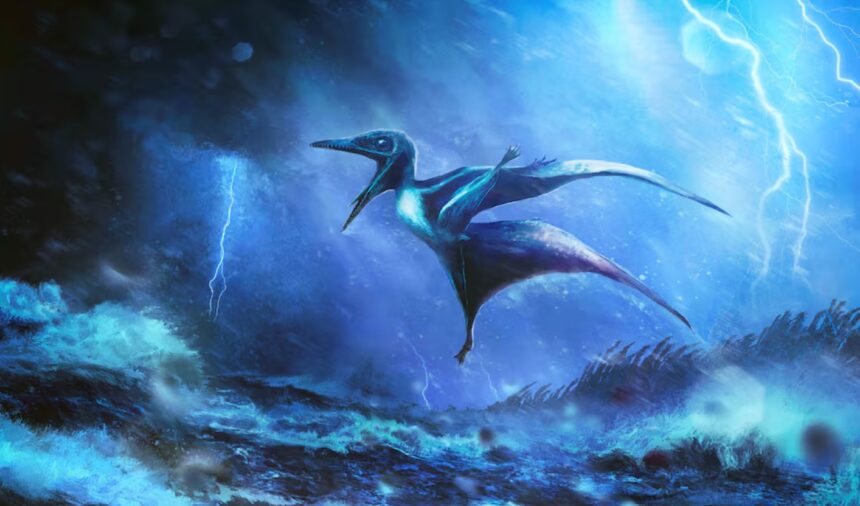
baby pterosaurs — baby pterosaurs — The story of baby flying reptiles is told through fossils that reveal the tragic fate of young pterosaurs caught in a tropical storm about 150 million years ago. As this fierce tempest brewed over a chain of islands bordering the ancient Tethys Ocean, a baby Pterodactylus was swept away by powerful winds, leading to its untimely demise.
The hatchling, already capable of flight, faced insurmountable odds against the storm’s ferocity. The winds were so strong that they broke the humerus, the essential upper arm bone that supported its fragile wing. This injury rendered the creature helpless, and it was ultimately flung into a lagoon, where it drowned and was buried under layers of mud.
Scientists, while examining well-preserved fossils of two separate baby Pterodactylus individuals, identified injuries consistent with this kind of storm-related trauma. These fossils, discovered in different locations in Bavaria, Germany, were a serendipitous find for researchers. Rab Smyth, a paleontologist at the American Museum of Natural History and lead author of a recent study published in Current Biology, described how they stumbled upon these injuries during their analysis.
Nicknamed Lucky and Lucky II, the hatchlings were unfortunately victims of nature’s wrath but became invaluable to scientific understanding. These fossils provide insights into the anatomy of young pterosaurs and the dynamics of life in the Jurassic Period. Pterosaurs, the flying relatives of dinosaurs, were the first vertebrates to achieve powered flight, a feat that would later be mirrored by birds and bats.
The two fossils in question belonged to extremely young hatchlings, estimated to be just days or weeks old, and had wingspans measuring less than eight inches (20 cm), small enough to fit in a human palm. Their delicate bones, still in the early stages of development, were pivotal in determining their age.
Analysis of the fossilised remains revealed significant clues about their final moments. The fractures observed in their upper arm bones suggested they experienced intense pressure, likely due to the storm’s winds or waves rather than an accident or predator attack. Smyth explained, “This kind of injury is unusual because it doesn’t look like the result of a crash, a fall or an attack by a predator.”
Before the storm struck, the hatchlings may have been engaged in typical behaviours such as practising flight, foraging for insects, or simply resting on the islands. With their weight barely a few grams, they stood little chance against the violent winds. The storm likely transported them miles from their natural habitat, leading them into the lagoon.
While a broken wing might not have been immediately fatal, the rapid sinking of the hatchlings indicated they inhaled water and drowned. Their swift burial in fine sediments shielded them from scavengers, allowing their bones to be preserved in lifelike positions. This exceptional preservation provides a vivid snapshot of their final moments.
Pterodactylus, although relatively small, had an adult wingspan of about three feet (one metre). They possessed uniquely short and broad wings, a lightweight body, and a long, pointed beak lined with conical teeth. Intriguingly, even at such a young age, the hatchlings exhibited the same fundamental wing structure as adult pterosaurs, suggesting they were capable of powered flight shortly after hatching.
The insights gleaned from these fossils also shed light on the broader ecosystem of the Jurassic Period. Smyth noted, “It’s easy to imagine the prehistoric world as just a stage for giant animals to stomp across, but these environments were as changeable and challenging as ours are today.” In a world dominated by large creatures, these tiny pterosaurs navigated a landscape filled with hazards, underscoring the fragility of life for small animals.
These findings provide a poignant glimpse into the lives of the smallest creatures during a time when giants roamed the Earth. As researchers continue to study these remarkable fossils, they unravel the delicate balance of life and death that characterised the Jurassic era.