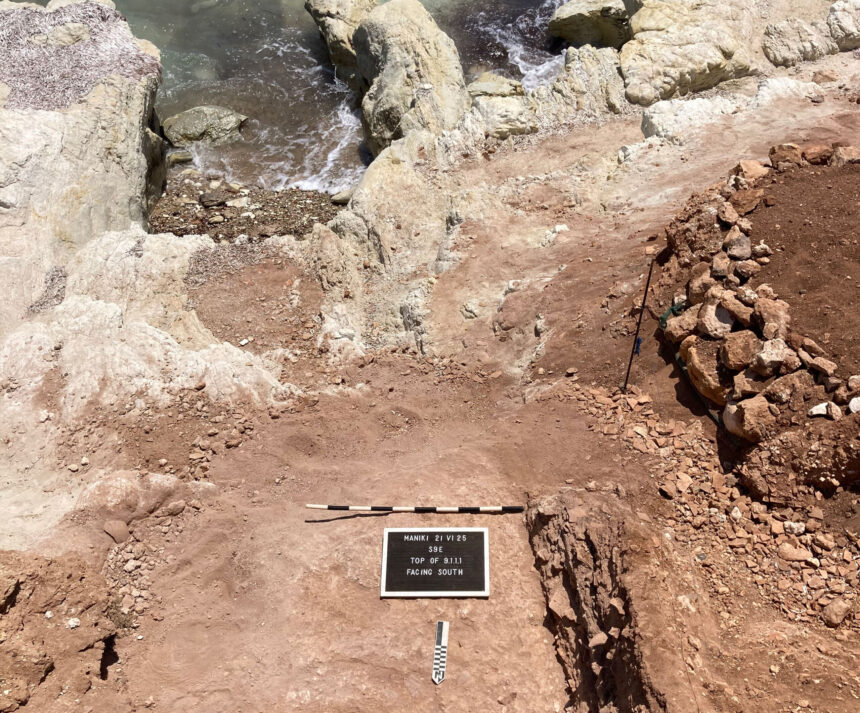
justinian-era harbour — justinian-era harbour — Excavations at the ancient port of Peyia have uncovered a sprawling harbour that dates back to the reign of Byzantine Emperor Justinian. The antiquities department announced these remarkable findings on Wednesday, highlighting the significant archaeological contributions made during the New York University (NYU) excavation programme scheduled for completion in 2025.
During this six-week interdisciplinary project, which combined survey work with excavation and specialist studies, the focus was on the ancient harbour. Alongside this, surface surveys were conducted at the nearby Peyia necropolis.
Justinian-era harbour: Unveiling Ancient Infrastructure
According to the antiquities department, the discoveries include over 700 kilograms of Late Roman amphora fragments, which reveal insights into the port’s construction and operation during the 6th century AD. These amphorae were part of a substantial archaeological layer created to level the steep coastal cliff, facilitating the building of port infrastructure.
This monumental construction effort enabled the transportation of large quantities of marble, column shafts, and capitals that were essential for the basilicas erected at Cape Drepano under Justinian’s rule.
Trade Insights from Amphora Fragments
The amphora assemblage, meticulously identified and catalogued by Professor Stella Demesticha from the University of Cyprus, predominantly features Late Roman 1 types produced locally in the Paphos region and in Cilicia, alongside imports from ancient Palestine. Notably, sixty-eight preserved red ink inscriptions on these vessels provide valuable avenues for future research into trade and administrative practices during Late Antiquity.
Collaboration Across Borders
The excavation mission is directed by Joan Breton Connelly, a classics professor at NYU, and involves an international team of scientists and students from NYU, the University of Cyprus, and the Cyprus Institute. Their collaborative efforts extend beyond the harbour investigations.
Research is also ongoing on a Hellenistic tomb discovered by the NYU team in 2018. This tomb, which contains pottery dating from the 1st century BC to the 5th century AD, is being studied by Professor Jolanta Mlynarczyk of the University of Warsaw. Meanwhile, Dr Rebecca Gerdes from Cornell University is analysing Roman cooking vessels for organic residues, which may provide insights into funerary or banquet practices of the time.
Continuing Discoveries from the Tomb
Despite being looted multiple times through the 20th century, precious objects were found in situ within the tomb. Dr Marianna Dagi from the Museum of Fine Arts in Budapest is studying these artefacts in collaboration with specialists from the Cyprus Institute. Their work aims to shed light on the cultural and historical significance of the items.
Additionally, ongoing research on human skeletal remains is being led by Dr Efi Nikita from the Cyprus Institute. Her team is examining these remains alongside animal bones, analysed by Dr Paul Croft of the University of Cyprus. The findings indicate evidence of ritual offerings or meals associated with funerary practices in the ancient community.
Broader Archaeological Context
The surface survey of the necropolis and an informal survey of Cape Drepano were led by Professor Thomas Tartaron of the University of Pennsylvania. He is preparing comparative research based on surveys conducted from 2018 to 2025, aiming to contextualise these discoveries within a broader archaeological framework.