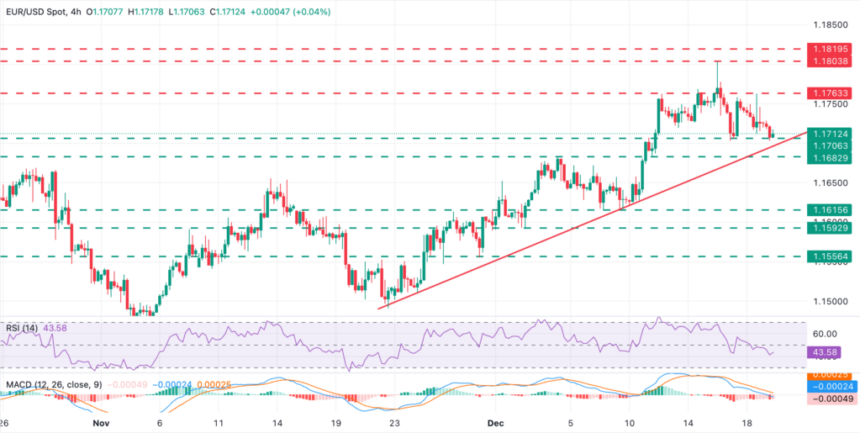
euro declines — euro declines — The euro-dollar currency pair extended losses for the fourth consecutive day on Friday, with EURUSD trading at 1.1715, indicating a slight decline as the week draws to a close. This follows a notable rally of nearly 2% over the preceding three weeks.
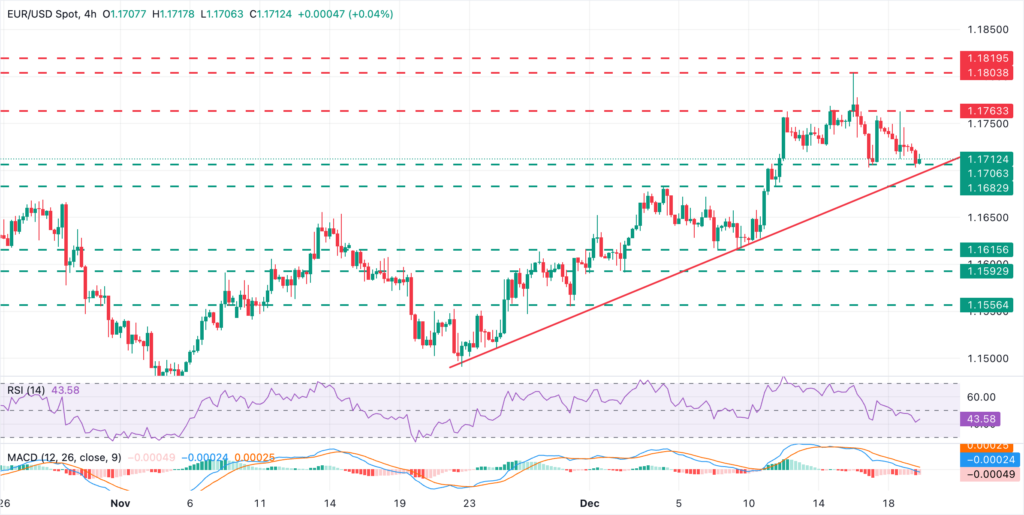
Photo: financialmirror.com
The recent downturn for the euro can be traced back to Thursday’s European Central Bank (ECB) meeting, where interest rates were held steady at 2%. ECB President Christine Lagarde’s comments did little to inspire confidence, as she refrained from committing to a specific rate path. The unanimous decision, coupled with a lack of discussion on potential rate changes, has led to speculation in the market being deemed unfounded.
Interestingly, the ECB also adjusted its economic growth outlook, projecting an increase to 1.4% for 2025 and 1.2% for 2026. This upward revision, however, seems to be overshadowed by immediate market reactions to monetary policy decisions.
Over in the United States, November’s Consumer Price Index (CPI) revealed an unexpected decline in inflation, with the year-on-year rate easing from 3.0% in September to 2.7%. This data, however, comes with a caveat, as it reflects only the second half of the month, coinciding with Black Friday sales, which could distort the figures.
On the German front, the GfK Confidence Survey indicated a further deterioration in sentiment, with January’s reading dropping to -26.9, falling short of market expectations. Additionally, the German Producer Prices Index showed factory inflation stalling in November, which decreased from a 0.1% rise in October to a 2.3% contraction year-on-year, underperforming against a market consensus of a 2.2% decline.
In France, Prime Minister Lecornu announced that parliament will miss the year-end budget approval deadline, necessitating a special rollover law. This fiscal hurdle poses additional challenges for the euro, particularly in light of the ECB’s decision to maintain rates at 2.00% and the upward revisions to growth and inflation forecasts for 2026.
Analysts at BBH FX noted that while rising wage pressures add some support for the euro, the failure to address public finances in France could lead to further fiscal stress, acting as a headwind for the currency. They commented, “The ECB’s updated macroeconomic projections reinforce the belief that the bank is in a strong position to keep rates on hold for the foreseeable future, with the next move likely being a hike.”
As the market digests these developments, the interplay of ECB policy and inflation data from the US continues to shape the landscape for the euro-dollar currency pair. The ECB’s recent decisions suggest a cautious optimism regarding economic growth, yet the prevailing uncertainties in fiscal policies across Eurozone members could temper any immediate bullish sentiment in EUR/USD trading.