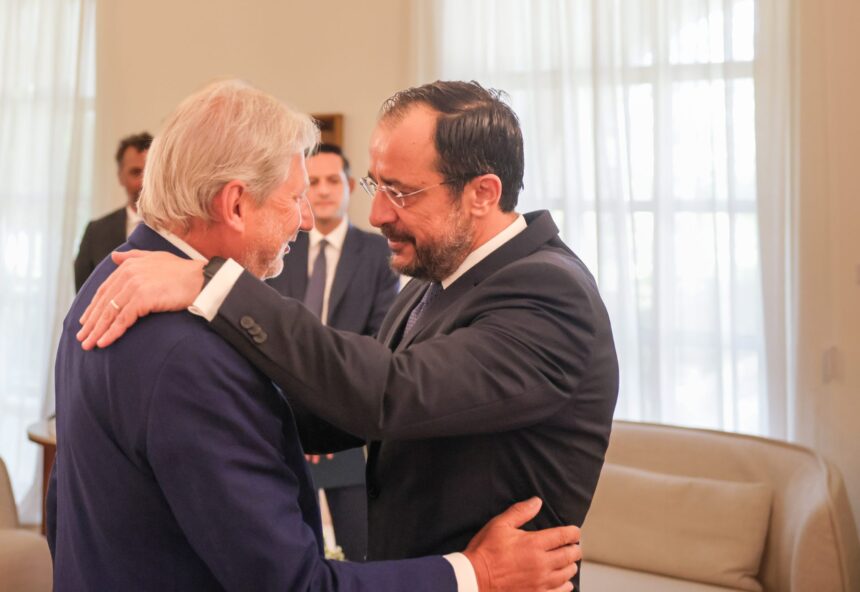
The European Union will support efforts towards a Cyprus solution but will not take on the role of mediator, stated Johannes Hahn, the EU’s envoy for Cyprus, in recent interviews.
- The European Union will support efforts towards a Cyprus solution but will not take on the role of mediator, stated Johannes Hahn, the EU’s envoy for Cyprus, in recent interviews.
Cyprus solution: EU’s Role in the Cyprus Peace Process
Hahn emphasised the significance of the Cyprus issue for the EU, describing it as crucial for the effective implementation of EU policies and the promotion of its values, alongside ensuring stability and security in the Eastern Mediterranean. He remarked, “The situation in Cyprus is a very important issue for the European Union as a whole.”
Commitment to Resuming Negotiations
The EU envoy noted that there is a promising opportunity for progress, as both the Greek Cypriot and Turkish Cypriot leaders have expressed their commitment to re-engaging in negotiations under the United Nations framework. Hahn stated, “Both should understand that their approach towards each other is an investment, not a concession.” This sentiment reflects a mutual acknowledgment of the need for cooperation to achieve a lasting resolution.
EU Assistance and Financial Support
EU involvement currently includes various forms of assistance aimed at aligning the north of Cyprus with EU regulations, particularly in light of potential future accession following reunification. Financial support, averaging €34.4 million annually, is a key instrument for fostering reunification efforts, designed to help mitigate economic disparities between the two communities.
Focus on Sustainability and Standards
In addition to economic support, Hahn highlighted the importance of environmental sustainability and the ‘green transition’. Aligning Turkish Cypriot products with EU standards is a central component of the ongoing harmonisation process. Legal experts have been engaged to assist the Turkish Cypriot community in ensuring that draft legislation is compatible with EU law.
Future Negotiations and UN Framework
When questioned about specific EU contributions that might facilitate an agreement between the two sides, Hahn indicated that these would become clearer once formal negotiations are resumed. He reiterated that any settlement should be achieved within the established UN framework, advocating for a bicommunal, bizonal federation that respects political equality.
EU’s Commitment to Confidence-Building Measures
Hahn underlined the EU’s commitment to supporting informal processes led by the UN and implementing confidence-building measures. One notable initiative is the full implementation of the pan-Cypriot protected designation of origin (PDO) for halloumi/hellim, with remaining administrative issues expected to be resolved shortly.
Facilitating Trade and Renewable Energy Initiatives
Additionally, the EU is working to facilitate trade across the Green Line and is exploring the establishment of a bicommunal photovoltaic park in the buffer zone, which would be co-financed by the European Commission. Hahn expressed the EU’s willingness to explore financing potential memoranda of understanding that the leaders have identified with the UN Secretary-General, should they agree to advance these initiatives.
The Importance of Compromise
Emphasising the need for compromise, Hahn stressed that the current momentum towards a solution should not be squandered. He stated, “This is a very good time to do so, and both I and the EU will provide all the necessary support. It is time to deliver.” His remarks encapsulate the EU’s supportive stance while clarifying its non-mediation role in the Cyprus peace process.