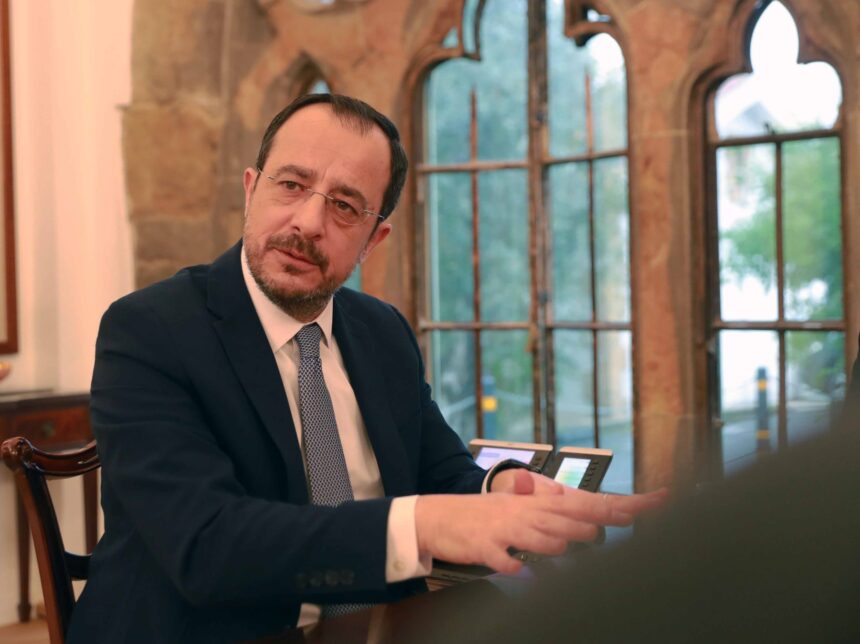
President Nikos Christodoulides is ready to restart negotiations, as Cyprus will take on the European Union’s rotating presidency in January. In a recent interview with Euronews, he outlined key priorities for Cyprus during its term, focusing on enhancing the EU’s strategic autonomy and strengthening connections with the Middle East.
Restart negotiations: Strategic Autonomy as a Priority
Christodoulides emphasised the importance of strategic autonomy for the European Union, which he defined as a move towards reducing dependencies on external global powers. He noted, “As a European Union, we were dependent on our security from the United States. As a European Union, we were dependent on energy from Russia. As a European Union, we are dependent on our raw materials from China.” This perspective signals a shift towards a more self-reliant EU.
Support for Ukraine and Planned Visit to Kyiv
As part of Cyprus’s commitment to international support, Christodoulides announced plans to visit Kyiv on December 4, ahead of the presidency. His visit aims to demonstrate continued support for Ukraine amidst the ongoing conflict. “We need to continue supporting Ukraine,” he stated, reinforcing Cyprus’s dedication to aiding the war-torn nation despite acknowledging that the conflict is unlikely to reach a resolution soon.
Concerns Over EU Enlargement
Addressing the topic of EU enlargement, Christodoulides expressed apprehension regarding the potential for candidate countries to lose interest in joining the EU if tangible progress is not made. He highlighted Montenegro as a candidate with the greatest potential for advancement during Cyprus’s presidency, indicating that increased efforts will be made to ensure progress in this area.
Cyprus’s Role in Middle East Peace Efforts
In addition to its focus on EU matters, Cyprus has played an active role in Middle East peace initiatives. Christodoulides referenced Cyprus’s participation in a recent ceasefire signing ceremony in Sharm El-Sheikh. He stated, “Cyprus presented a very specific plan to help implement the 20-point Gaza peace plan of President Trump,” showcasing the nation’s commitment to fostering peace in the region and its strong relationships with various stakeholders.
Reunification Negotiations and Cyprus’s Division
On the sensitive issue of Cyprus’s division, President Christodoulides rejected Turkish President Erdogan’s proposal for a two-state solution. He asserted that any resolution must adhere to a “bi-zonal, bi-communal federation” as outlined in UN Security Council resolutions. His stance reflects a commitment to a unified Cyprus, steering away from the current division.
Optimism Following Turkish Cypriot Leadership Change
Following the recent election of Tufan Erhurman as the Turkish Cypriot leader, Christodoulides expressed optimism, deeming it “a positive development.” He indicated his readiness to resume reunification negotiations “even next week” if Erhurman supports the federation model. “The current status quo cannot be the solution to the Cyprus problem,” he asserted, emphasising the urgency of finding a resolution.
Looking Ahead
As Cyprus prepares to take on the presidency of the EU, the government appears focused on fostering unity, both within the EU and in relation to the Middle East. Christodoulides’s commitment to strategic autonomy, support for Ukraine, and efforts towards Middle East peace are indicative of a proactive approach. His willingness to restart negotiations on Cyprus’s reunification underscores a hopeful outlook for the island’s future.