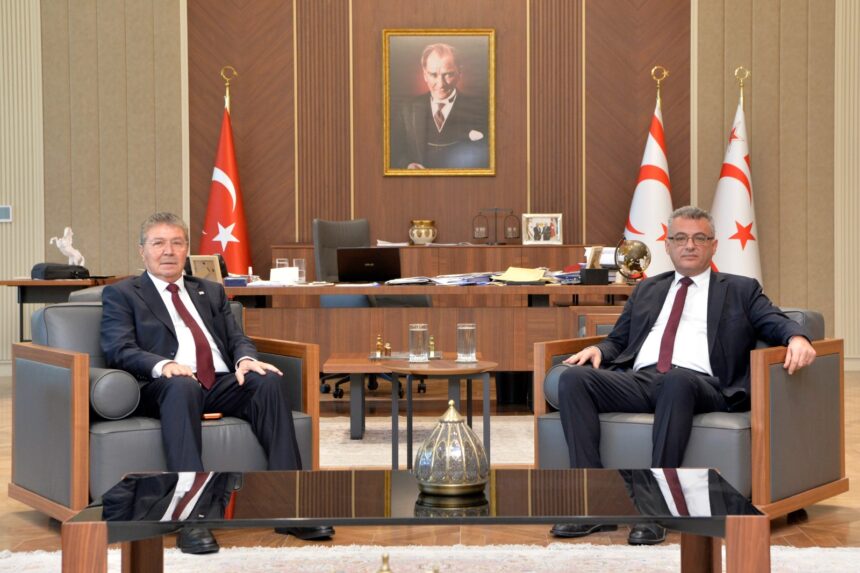
Turkish Cypriot leader Tufan Erhurman met with the north’s ‘prime minister’ Unal Ustel on Monday, where tensions regarding the Cyprus problem were palpable. The meeting occurred at Erhurman’s official residence in Ayios Dhometios, Nicosia, amidst Ustel’s vocal dissent over Erhurman’s approach to the longstanding issue.
Ustel has openly rejected the idea of a federal solution, advocating instead for a two-state model, a position he reiterated just a day prior during a scathing critique of President Nikos Christodoulides. He stated emphatically that a resolution to the Cyprus problem can only be achieved through recognition of two sovereign states, asserting that any reference to a federative solution is a denial of Turkish Cypriot rights.
“The statements that ‘referencing United Nations resolutions determines the form of solution’ are a clear admission that no solution option other than a federation will be accepted,” Ustel remarked. He added that this approach seeks to impose a unilateral model on the Turkish Cypriot populace, disregarding their historical claims and aspirations.
Ustel’s stance is firmly aligned with that of Turkey’s leadership, as he noted the support from President Recep Tayyip Erdogan for the two-state solution. He described his position as “clear, unambiguous, and indisputable,” emphasising that it is rooted in the Turkish Cypriot people’s struggle for existence.
The discord between Erhurman and Ustel has been brewing since Erhurman’s meeting with political party leaders following discussions with Christodoulides and UN envoy Maria Angela Holguin. Ustel expressed dissatisfaction with Erhurman’s handling of the situation, particularly regarding the UN’s reference to “political equality,” which he felt was interpreted as a nod towards a federative framework.
In a bid to prepare for further discussions, Erhurman is planning an enlarged meeting involving both sides of the island, alongside the three guarantor powers: Greece, Turkey, and the United Kingdom, and the UN. He emphasised the need for prior agreements on several contentious points before such a meeting could take place.
Holguin’s upcoming visit to the island next month is seen as a pivotal moment, with Erhurman indicating that it would be more suitable to hold the enlarged meeting afterwards, contingent on any meaningful progress made during her contacts. He outlined four key points that must be addressed before substantive discussions can begin, which include the acceptance of political equality and a time-limit on negotiations.
Erhurman remarked that while there is consensus on some aspects, particularly political equality, the discussions cannot advance until all parties agree on this foundational point. He reiterated that without a shared understanding of the solution model, there can be no effective negotiation.
The political landscape in Northern Cyprus remains fraught with complexities, and the differing visions for the future of the island highlight the ongoing rift between Erhurman and Ustel. As both leaders navigate their positions, the prospect of a comprehensive resolution to the Cyprus problem appears increasingly challenging.