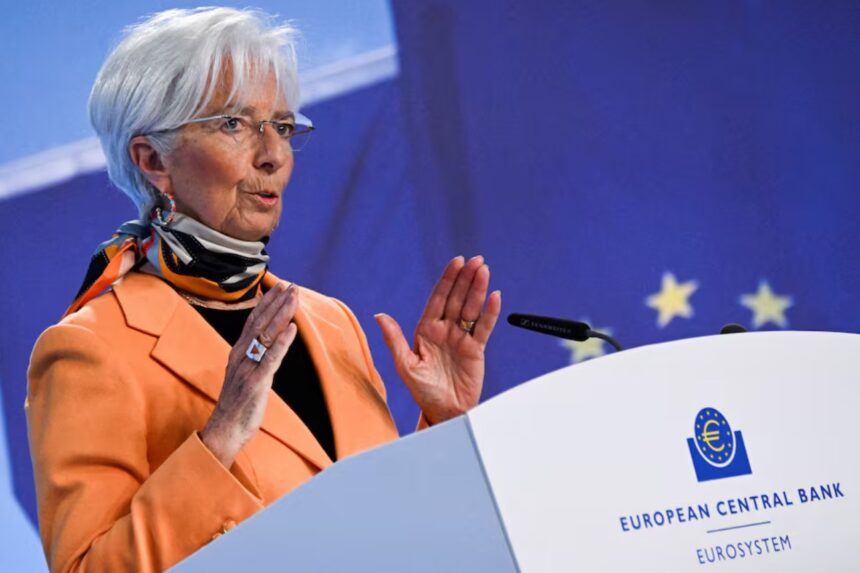
The European Central Bank (ECB) has decided to keep interest rates steady at 2 per cent for the third consecutive meeting, reflecting a period of low inflation and consistent growth across the eurozone.
Ecb: Steady Course Amid Global Trade Tensions
In a statement released on Thursday, the ECB indicated that it sees no immediate need for changes in its monetary policy, despite ongoing trade turbulence. The central bank, which serves the 20 countries that share the euro, had previously cut rates by a total of 2 percentage points leading up to June but has refrained from further adjustments since then.
The ECB’s outlook remains positive, with inflation currently meeting its target—an achievement that contrasts sharply with the positions of the US Federal Reserve, the Bank of England, and the Bank of Japan.
Policy Flexibility Remains Key
While the ECB has kept its options open, the Governing Council reiterated that future decisions will be influenced by incoming economic data rather than a predetermined policy path. “The Governing Council’s assessment of the inflation outlook is broadly unchanged,” the ECB stated, highlighting the robust labour market and solid private sector balance sheets as critical factors in maintaining economic resilience.
During a news conference at 1345 GMT, ECB President Christine Lagarde remarked that the current policy is in a “good place,” adding that small, temporary deviations from the inflation target could be tolerated. However, she was careful not to dismiss the possibility of future policy easing, particularly in light of the unpredictable nature of US tariffs, which can have ripple effects on the eurozone economy.
Economic Indicators Point to Resilience
Recent data suggests that the eurozone’s economy is holding up better than anticipated. The gross domestic product (GDP) grew by 0.2 per cent in the most recent quarter, surpassing the ECB’s earlier predictions of stagnation and exceeding economists’ forecasts of only 0.1 per cent growth. This positive performance is largely driven by stronger-than-expected results from Spain and France.
Furthermore, early indicators for the fourth quarter hint at a potential uptick in growth. A recent Purchasing Managers’ Index survey indicates that business activity is on the rise, and sentiment in Germany, the region’s largest economy, is improving. This growing optimism among businesses is attributed, in part, to a decrease in uncertainty surrounding tariffs.
Challenges Remain on the Horizon
Despite these encouraging signs, caution remains essential as the eurozone grapples with challenges such as declining industrial output and a significant drop in exports to the United States. Moreover, there is increasing evidence that China is redirecting goods it cannot sell in the US to European markets, putting additional pressure on local industries.
Another factor weighing on inflation is the strong euro, which has stabilised in recent weeks. However, a hawkish stance from Federal Reserve Chair Jerome Powell following a recent rate cut may limit any further appreciation of the euro.
Future Outlook and Market Expectations
Looking ahead, the uncertainty surrounding the economic outlook raises questions about whether the current stability can be maintained. ECB Chief Economist Philip Lane has suggested that risks of undershooting inflation could bolster the case for a “slightly lower” policy rate. Market pricing currently reflects a 40 to 50 per cent chance of an additional rate cut by June next year.
Nevertheless, most economists anticipate that rates will remain unchanged, assuming that uncertainty diminishes and households continue to benefit from substantial savings. Additionally, Germany’s commitment to increasing public spending is expected to support economic growth.
While inflation may undershoot the ECB’s target in the coming year, forecasts suggest it will eventually rebound. The ECB has indicated its willingness to accommodate temporary deviations from its inflation goals, although the true test of this flexibility may not emerge until December, when the bank releases new economic projections, including initial estimates for 2028.