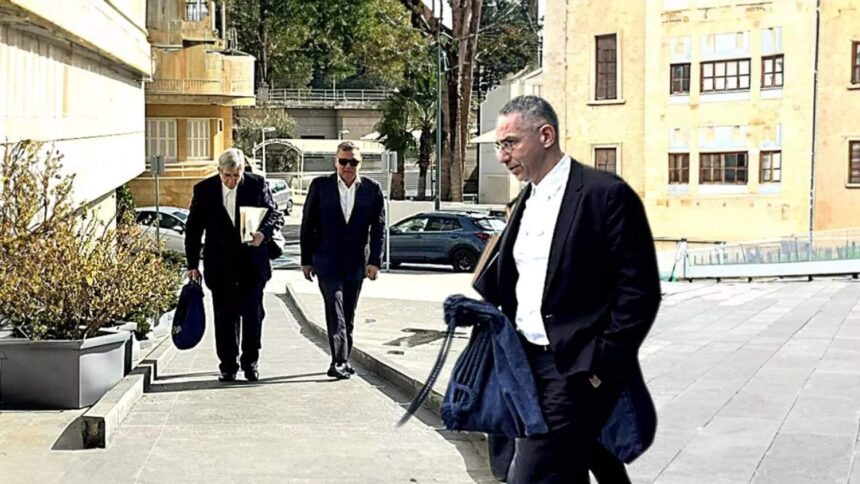
The focus keyword is Nikos Sykas, as the DISY MP faces police questioning following the Supreme Court’s decision to lift his parliamentary immunity in light of domestic violence allegations.
- The focus keyword is Nikos Sykas, as the DISY MP faces police questioning following the Supreme Court's decision to lift his parliamentary immunity in light of domestic violence allegations.
- The woman described how Sykas made derogatory remarks before they went out on New Year's Eve. Upon returning, she reported that he assaulted her and threatened her.
The Supreme Court’s ruling allows authorities to proceed with questioning Sykas regarding accusations made by a former partner. The complainant had alleged that during a series of incidents on New Year’s Eve in Greece, Sykas subjected her to offensive comments, physical violence, and threats.
After the alleged events, the woman provided medical evidence from Limassol General Hospital and photographs to support her claims. An opinion from an Athens lawyer indicated that the alleged actions constituted criminal offences under Greek law.
Just five days after filing her complaint, on 6 January, she returned to the police to withdraw her statement. The withdrawal was attributed to the stress and psychological pressure she felt due to the case’s publicity and Sykas’s status as a public figure.
The Supreme Court noted that the withdrawal does not halt the investigation, emphasising that authorities are obligated to investigate allegations of domestic violence. The court’s decision was informed by a sworn statement from the chief investigator, which detailed the complainant’s account from 31 December 2025 to 3 January 2026.
The woman described how Sykas made derogatory remarks before they went out on New Year’s Eve. Upon returning, she reported that he assaulted her and threatened her.
The court’s application to lift Sykas’s parliamentary immunity addresses four specific offences: violence, psychological violence, assault causing actual bodily harm, and threats. Assistant Attorney General Savvas Angelides argued that the case is unrelated to Sykas’s parliamentary duties, necessitating the removal of immunity for all stages of the proceedings.
Sykas’s lawyer, Christos Pourgouridis, did not oppose the lifting of immunity but expressed concern about the implications of the withdrawal on the case’s outcome, asking the court to consider this factor without contesting the statement-taking process.
The court’s ruling highlighted a European legal tendency toward a restrictive interpretation of parliamentary immunity, asserting that it should not protect MPs from criminal law in cases that do not pertain to their official duties. “It is understood that parliamentary immunity cannot be used as a shield protecting the MP from the applicable criminal law of the state,” the court noted.
In its findings, the court indicated that sufficient evidence exists to implicate Sykas in the alleged offences. However, it reiterated the presumption of innocence that applies to all accused individuals at this stage of proceedings. The court clarified that a prima facie case does not need to be established at this point; rather, they were only required to ascertain that the application to lift immunity was not arbitrary.
The judges deemed the allegations serious, considering both their nature and the circumstances surrounding them. Importantly, they concluded that the offences being investigated were unrelated to Sykas’s political activities, whether within the House of Representatives or beyond, which was a significant factor in their decision to permit the questioning.