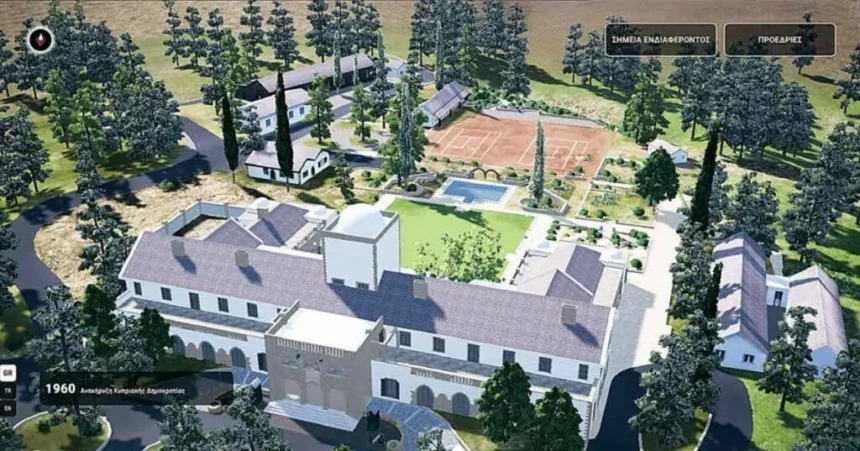
Cyprus’s Presidential Palace has a rich history that reflects the island’s evolution from British rule to a symbol of its modern identity. The Cyprus Institute’s Virtual Environments Lab recently unveiled a digital “time machine” that explores the palace’s transformation from 1878 to today. This innovative project employs 3D modelling and historical archives to recreate both the original wooden Government House and the grand stone structure that succeeded it.

Photo: in-cyprus.philenews.com
Presidential palace: The Beginnings of Government House
In July 1878, Sir Garnet Wolseley became the first British High Commissioner of Cyprus. Initially residing at the Metochi of Kykkos Monastery, he later moved into a prefabricated wooden residence imported from abroad. This building, which was renamed Government House in 1925, met a tragic fate during the anti-colonial uprising in 1931 when it was set ablaze, leaving only ashes behind.
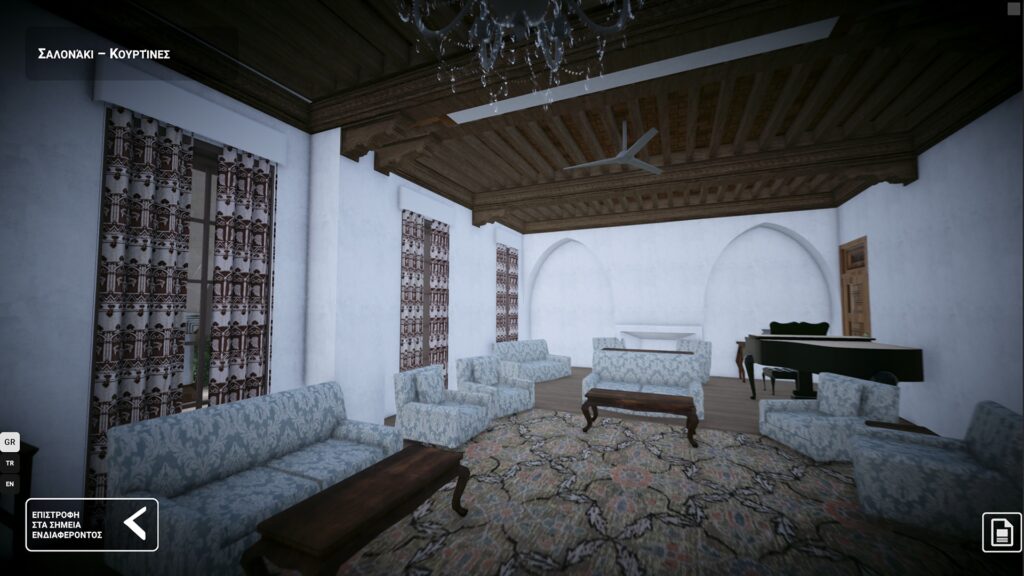
Photo: in-cyprus.philenews.com
New Beginnings: The Rebuilding of the Palace
Following the destruction of Government House, the British embarked on a new architectural venture that would not only serve governmental purposes but also celebrate local craftsmanship and traditional Cypriot architecture. Architects were tasked with touring the island to incorporate specific motifs into the design of the new building.
- The columns on both the ground and upper floors were inspired by those at the Acheiropoiitos Monastery near Lapithos.
- The proportions of the central tower reflect the historic Kolossi Castle.
- While the original architectural plans featured a pyramid roof, a Byzantine dome was ultimately chosen to provide an ecclesiastical touch.
- The southern façade showcases eight unique gargoyles, four of which honour the project’s lead craftsmen, while the other four represent the island’s primary animals: the ox, donkey, camel, and sheep.
Construction Materials and Design Elements
For durability, builders sourced soft grey-yellow sandstone from Gerolakkos and Limassol limestone for the interior fireplaces and stairs. The palace’s main entrance is a remarkable feature that replicates the door of the Agios Chrysostomos Monastery on the Pentadaktylos range. It consists of 288 interlocking wooden pieces crafted from six different tree species, all meticulously joined without nails or screws.
Interior Design and Cultural Significance
Inside the Presidential Palace, visitors can admire intricately carved beams, cane-reed mats, and hand-embroidered curtains that showcase traditional Cypriot patterns. Each detail speaks to the island’s rich heritage and the craftsmanship that has been preserved through generations.
Historic Diplomatic Moments
The palace has also played a pivotal role in international diplomacy. On 7 May 1974, it hosted a crucial meeting between US Secretary of State Henry Kissinger and Soviet Foreign Minister Andrei Gromyko. Their three-hour discussion in what is now the Cabinet Room was instrumental in reaching a regional agreement regarding the Middle East crisis, just days before the island faced a turbulent coup d’état.
The Aftermath of the Coup
Following the 15 July 1974 coup that targeted President Makarios, the palace was left in ruins. While the interior was gutted by fire, the external walls remarkably remained standing. Reconstruction efforts were funded by Greece, and the palace reopened in 1979, reinstated as the official residence and office of the President of Cyprus.
Embracing Heritage Through Technology
First Lady Philippa Karsera Christodoulides spearheaded the interactive project to ensure that every visitor—including students, citizens, and foreign dignitaries—gains a meaningful understanding of Cyprus’s rich heritage. Cyprus Institute President Stavros Malas referred to the palace as a “living witness” to modern history, emphasising the initiative’s goal to connect citizens with their history through virtual and augmented reality.
Celebrating Two Decades of the Cyprus Institute
The launch of this digital platform coincides with the 20th anniversary of the Cyprus Institute. This innovative endeavour aims to make the island’s intricate history accessible to a new generation, bridging the gap between past and present.
Recent Visitors and Events at the Palace
The Presidential Palace continues to be a focal point for significant events. It recently welcomed Pope Francis, where President Nicos Anastasiades extended a warm reception. Additionally, the palace marked the 20th anniversary of Cyprus’s accession to the EU, featuring remarks from President Nikos Christodoulides and European Commission President Ursula von der Leyen.
As the Presidential Palace evolves, it stands not only as a government building but also as a testament to the enduring spirit and history of the people of Cyprus, reflecting their journey through centuries of change.