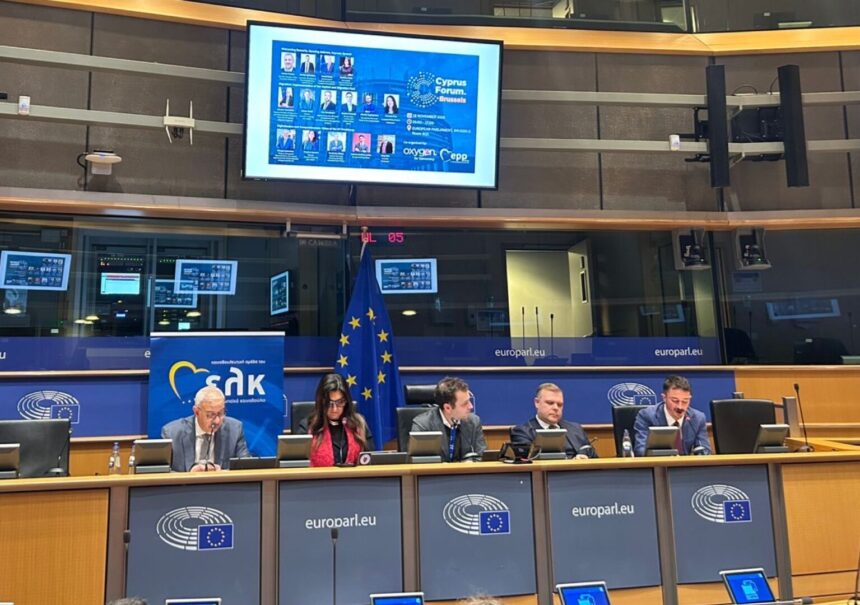
Cyprus sets its sights on a robust digitalisation agenda as it prepares to assume the rotating Council Presidency of the EU. At the Cyprus Forum Brussels 2025, a high-level panel convened to discuss the vision of the Cypriot Presidency on digitalisation and competitiveness, emphasising the importance of digital transition in shaping Europe’s future.
Digitalisation: A Comprehensive Legislative Agenda
The discussion at the forum highlighted a crowded legislative landscape, including the forthcoming Digital Omnibus, the Business Wallet initiative, and significant cybersecurity reforms. These initiatives aim to enhance Europe’s competitiveness in an increasingly digital world.
Leadership from Key Officials
The panel featured prominent figures including Giorgos Ioannides, the Deputy Permanent Representative of Cyprus to the EU, and Despina Spanou, Deputy Director-General for Networks & Technology at the European Commission, along with Tzvetoslav Mitev, Director for Data Economy & Public Administration. Eddy Wax from Euractiv moderated the session.
Cyprus’s Commitment to Digital Transition
Giorgos Ioannides articulated the overarching philosophy of the Cypriot Presidency, stating that digital transition is essential and must be viewed as a core driver of competitiveness, resilience, and European sovereignty. Rather than adding new regulations, Cyprus aims to act as a “guardian of balance,” facilitating negotiations to ensure that digital files remain coherent and investment-friendly.
Three Guiding Principles for the Presidency
- Proportionality: Ensuring regulations are appropriate and not overly burdensome.
- Avoidance of Regulatory Overlaps: Striving for consistency across legislation.
- Predictable Rules: Creating a regulatory environment that attracts investment.
Ioannides stressed the need for the EU to remain agile, noting that European companies operate in a global environment where swift adaptation is crucial.
Digital Omnibus: A Focus on Simplification
As the European Commission prepares to unveil its Digital Omnibus package, Despina Spanou underscored that the aim is simplification, not the lowering of standards. She pointed out that the General Data Protection Regulation (GDPR) remains a “global reference standard” that the EU does not intend to weaken. Instead, the focus is on clarifying obligations for businesses struggling with implementation.
Upcoming Cybersecurity Initiatives
Spanou also detailed the Commission’s forthcoming cybersecurity initiatives, including:
- A unified cyber-incident notification mechanism aimed at simplifying reporting processes.
- A review of the Cybersecurity Act to enhance ENISA’s mandate and streamline governance.
- Efforts to address supply-chain security gaps more effectively.
Importantly, she noted that the goal is not to relax requirements but to make an increasingly complex system workable.
Business Wallet: A Transformative Tool
The Business Wallet was highlighted as a flagship initiative for enhancing competitiveness in Europe’s digital economy. Both Spanou and Tzvetoslav Mitev described the Business Wallet as akin to an eID for businesses, allowing for secure authentication and streamlined administrative processes.
Mitev emphasised that the wallet could unlock valuable interactions between companies and administrations, contingent on public administrations’ adoption for core procedures. He noted that a purely voluntary system could lead to low uptake, as observed in previous eID projects.
Concerns Over Simplification
Antoine Mathieu Collin raised concerns regarding the potential distributional effects of regulatory simplification in the digital sphere. He argued that while streamlining compliance and data flows could foster innovation, it might inadvertently strengthen the competitive advantage of major platforms, which already benefit from scale and data accumulation.
Collin highlighted the necessity for safeguards to ensure that simplification does not undermine smaller European firms.
Cybersecurity Revisions Ahead
Returning to the topic of cybersecurity, Spanou remarked that the forthcoming single-entry reporting proposal is merely the starting point. A broader review of the Cybersecurity Act is anticipated, aiming to modernise and enhance the existing framework while maintaining strict standards.
Ioannides reiterated the significance of the current moment, asserting that the decisions made now will shape Europe’s digital competitiveness for the forthcoming decade.
Priorities of the Cypriot Presidency
The panel conveyed a unified message: the Cyprus EU Presidency seeks to be evaluated not by the number of new initiatives it introduces but by its effectiveness in making existing rules functional. This includes:
- Minimising regulatory overlaps and simplifying compliance.
- Providing tools like the Business Wallet to alleviate bureaucratic burdens.
- Ensuring robust yet workable cybersecurity regulations.
- Supporting innovation through clear and predictable frameworks.
As Cyprus prepares to take the lead, the focus remains on fostering an environment where digital initiatives can thrive, benefiting both large and small enterprises across Europe.
Understanding the Digital Omnibus and Business Wallet
The Digital Omnibus is a comprehensive package from the European Commission aimed at simplifying and streamlining the EU’s digital rulebook without compromising existing standards. This initiative seeks to eliminate redundant obligations and provide a clearer, more predictable regulatory environment for businesses, especially SMEs.
Meanwhile, the Business Wallet is envisioned as a digital identity tool that enables companies to authenticate themselves and share verified information seamlessly across the EU. By replacing outdated paper-based processes, it aims to enhance efficiency and accessibility for businesses operating within the Single Market.